
A Look into the 6,000-km Cable Linking Latin America to Europe

Introduction
Out of sight beneath the world's oceans, a vast network of submarine cables quietly keeps our digital lives moving. There are currently nearly 600 active or planned cables worldwide. The operational network carries approximately 95 per cent of all international internet traffic, facilitating global financial transactions, while meeting the growing demand for cross-border data sharing. As demand for digital services continues to grow, so does the need for reliable, high-capacity international connectivity. Such connectivity is particularly important for Europe and Latin America. Both regions are investing heavily in digital infrastructure, which, in turn, is fostering greater integration and new demand for connections between the two regions.
Latin America’s digital infrastructure boom is being driven by the rapid expansion of cloud computing, artificial intelligence (AI), and digital services. With abundant renewable energy resources and critical minerals, Brazil, Chile, Mexico, Argentina, and Colombia are attracting increasing levels of domestic and foreign investment.
On the other side of the Atlantic, Europe is undergoing its own digital transformation while seeking to narrow the gap with the US and China in the global AI race. Despite its substantial data centre capacity and ambitious digital strategy, the EU remains heavily reliant on foreign technology for its own digital infrastructure, a dependency it is trying to curb.
Consequently, in an effort to strengthen their shared digital sovereignty, the EU and its Latin American and Caribbean partners purchased capacity on ‘EllaLink’ in March 2021 under the BELLA Programme and, more broadly, the EU’s Digital Decade policy programme. Connecting the two regions directly, EllaLink strengthens digital connectivity and creates opportunities for greater research, educational, technological, and economic cooperation. This article examines how the rapid expansion of data centre infrastructure in Latin America and Europe is increasing the importance of the digital link between the two regions and how this digital connection can open new avenues for digital and economic cooperation.
Latin America is rapidly emerging as a hotspot for investment in digital infrastructure. This expansion is being driven largely by a surge in digital services, data localization, AI, and cloud computing services (Hristova, 2026). For instance, in Chile, the data centre boom began in 2015, when Google opened its first and largest Latin American server facility in Quilicura (Heikkinen, 2026). A decade later, 65 data centres (DataCenterMap) are either under construction or in operation in the country. Overall, the region currently hosts more than 430 data centres, and this number is expected to grow considerably over the next decade. Brazil is leading this regional expansion, serving as Latin America’s largest market, with over 200 data centres and over 41 per cent of the region’s total market investments (Brightlio). It is followed by Chile, Mexico, and Argentina. During the 2025 Data Centers and Energy forum, Fitzgerald Cantero, Director of Studies and Projects at the Latin American Energy Organization (OLADE), stated that ‘the growth in the use of artificial intelligence will exceed an annual rate of 31% by 2029 [and] that investment in artificial intelligence in 2025 will be $7 billion USD and will jump to $10 billion USD in 2029’ (Milesi, 2025).
Three factors underpin this surge in investment and demand. Latin America offers abundant land, which is needed to build hyperscale data centres able to store data on a large scale. These typically occupy more than 10,000 square feet and house at least 5,000 servers. Given these constraints, only a handful of companies – notably the ‘Big Three’ of Google, Amazon Web Services (AWS), and Microsoft – are able to build these data behemoths.
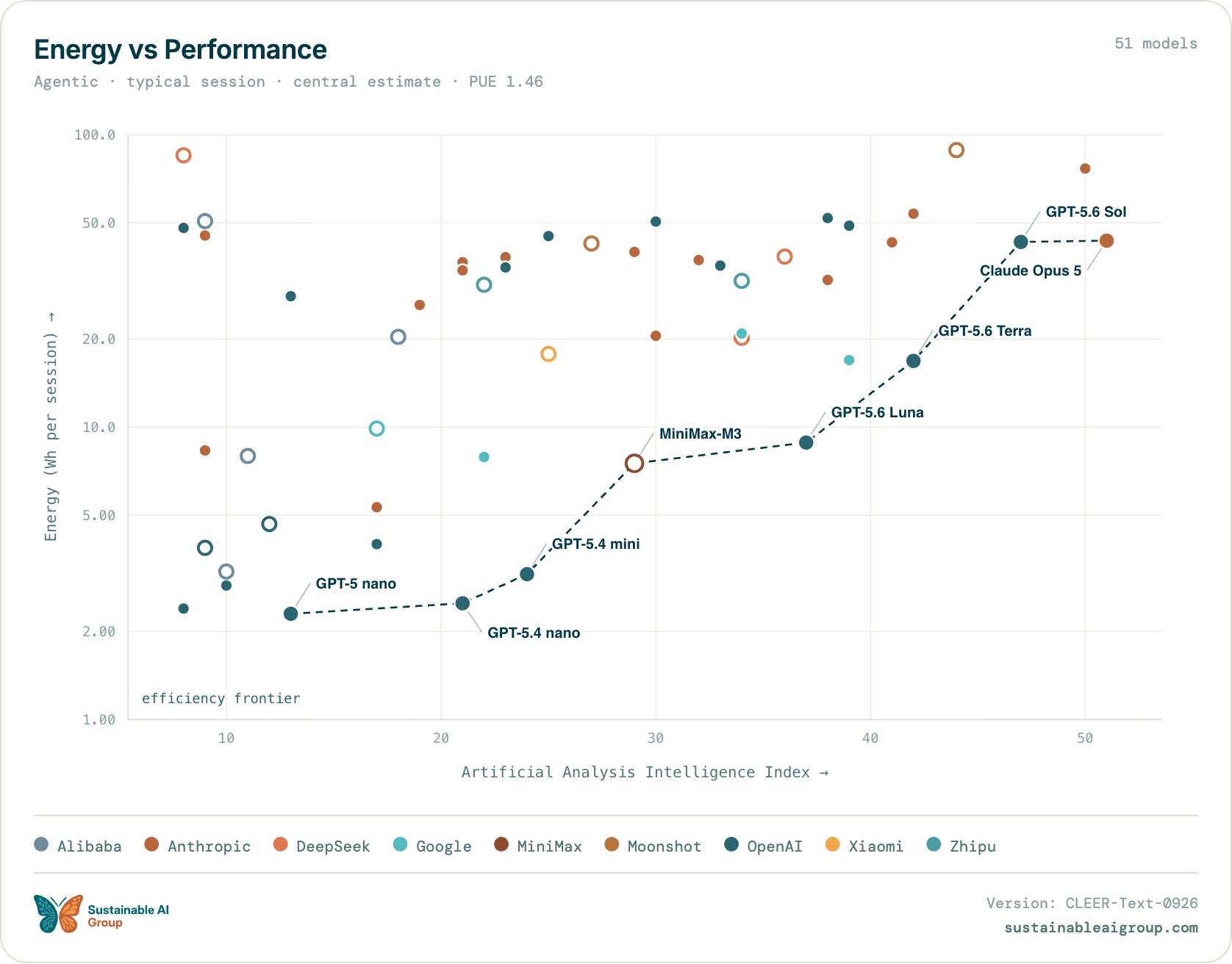
As global demand for digital infrastructure continues to increase, data centres must provide greater computing capacity and therefore require more energy to support their operations. For instance, using AI applications such as ChatGPT consumes significantly more energy than conducting conventional online searches, increasing the need for hyperscale facilities (Gavarrete, 2025).
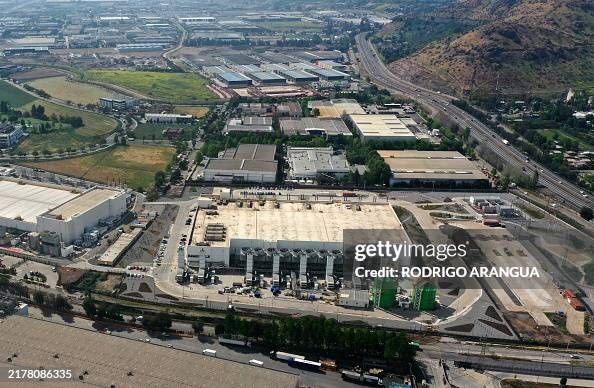
Aerial view of a data centre owned by Google in Santiago on October 9, 2024. (Photo by RODRIGO ARANGUA/AFP via Getty Images)
The resources powering the digital boom
Moreover, Latin America is rich in natural resources and critical minerals, making the region strategically important. As sustainability requirements for data centres across the world become stricter, Latin America – and Brazil in particular – is praised for its data centres powered by renewable energy. Brazil has the highest share of renewable energy in its energy mix of any Latin American country, with around 56 per cent coming from hydropower and 25 per cent from wind and solar (Accenture, 2026). In Chile, Santiago’s access to abundant hydropower has been critical to establishing the city as the country’s primary data centre hub, while Argentina is currently expanding its wind power capacity (Accenture, 2026).
Regarding critical minerals, Latin America possesses the world’s largest reserves of both copper and lithium. Chile and Peru are major copper producers, together accounting for 40 per cent of global production, while Chile and Argentina account for around 32 per cent of the global lithium supply (Columbia Center on Global Energy Policy). With the global energy sector shifting away from fossil fuels towards low-carbon alternatives, demand for these minerals is rising sharply: S&P Global predicts that copper demand will rise 50 per cent by 2040, from 28 million metric tonnes to 42 million metric tonnes (Ross, 2026). Indeed, data centre expansion requires a significant amount of copper for semiconductors, storage devices, grounding infrastructure, power grid expansion, and cooling systems. Cooling systems account for nearly 40 per cent of data centre energy consumption (Ross, 2026). Consequently, Latin America's abundant reserves have strengthened the region's attractiveness to data centre investors.
Pulling global capital into Latin America’s digital economy
Government-sponsored programmes and tax incentives are also accelerating the region’s data centre expansion. In Brazil, the government introduced the National Data Center Plan in September 2025, followed by a Special Regime for Attracting Data Centers, which suspended some federal taxes on essential equipment. The Chilean government also implemented its own National Data Center Plan to boost investment, and Argentina introduced a government-backed programme, the Incentive Regime for Large Investments. Together, these policies are reducing the costs of data centre development and encouraging domestic and foreign investment, hence supporting the industry’s growth.
The limits of Latin America’s data centre boom
Certain experts have cautioned, however, Latin America’s data centre sector may be expanding too quickly, raising concerns that increased investment will not necessarily generate economic spillovers to support local economic development. Massive hyperscale facilities can generate significant spillover effects, with Levy Yeyati (2026) noting that regions hosting these facilities see information-sector employment grow by over 20 per cent in the years following their construction. However, colocation facilities – the other driver of modern data centre infrastructure – operate differently, as they are typically built by landlords who lease space to a range of industries, including e-commerce and fintech. Despite 20 per cent growth in colocation inventory in 2025 (Picerni, 2026), studies show that these facilities produce significantly smaller local economic effects since they require little on-site labour, meaning that they create few employment opportunities for local communities.
More pressing, however, are concerns over the region’s ability to meet the infrastructure demands of the data centre boom. A lack of adequate planning has already contributed to energy constraints, and some projects in Mexico have reportedly been redirected to Brazil and Chile. Rising costs, potential power shortages, and, most importantly, water scarcity pose further challenges to the sector’s growth. In Brazil specifically, the tropical climate leaves data centres vulnerable to corrosion and increases the energy and water needed for cooling (Accenture, 2026). The region’s ability to keep pace with growing demand for digital infrastructure remains to be seen.
Water scarcity, high energy consumption, and extensive land use are also growing concerns for local communities, especially those living near data centres. For instance, in the state of Querétaro, Mexico, a major Latin American data centre hub, limited access to water has become a major issue. In May 2025, local authorities reported that 17 of the state’s 18 municipalities had not received enough rainfall, leaving the state’s dams running dangerously dry. In response to the prolonged drought, the local government began rationing water to residents. Yet, despite these existing water shortages, the state is home to 14 data centres, which consume large quantities of water for their cooling systems and consequently put even more strain on the local communities. As data centre expansion brings these facilities closer to residents, there are also concerns around potentially harmful effects on human health caused by factors such as the never-ending hum of cooling equipment, sleep disturbances, respiratory irritation, and 24/7 security lighting.
Europe’s own digital transformation amid the global AI race
For its part, the EU has developed a distinctive regulatory model centred on sustainable data centre governance, setting it apart from leading AI powers such as the US and China. On June 5th, 2025, the European Commission launched the EU’s International Digital Strategy, marking another step towards establishing the EU as a leader in global digital governance. This strategy builds on the broader framework established by the EU AI Act, introduced in 2024 as the world’s first comprehensive legal framework for artificial intelligence. Through these initiatives, the EU seeks to regulate AI while creating favourable conditions for its development and use (European Parliament). Its regulatory approach extends beyond AI itself to the infrastructure that supports it. Under the recast Energy Efficiency Directive, the EU has introduced mandatory reporting requirements and an EU-wide sustainability rating scheme for data centres (Mehta, 2025), based on indicators such as power usage effectiveness, water usage effectiveness, energy reuse factor, and renewable energy factor (Ebert et al., 2026). These measures form part of the European Commission’s vision for the digital transition, first articulated through the 2030 Digital Compass, published in 2021, which proposed a set of digital principles aimed at establishing a robust governance framework.
The struggle for digital sovereignty
The EU is currently lagging behind its competitors with more than 80 per cent of Europe’s digital infrastructure and technologies being imported (CEPS, 2025). Despite hosting more than 2,900 data centres in Western Europe alone, Europe remains significantly behind the US and China in several key sectors essential to advancing AI. For instance, Europe does not manufacture many of the components needed for data centres, and electricity in the EU can cost two or three times as much as it does in the US or China (Associated Press, 2026). Furthermore, US cloud providers dominate the European market, with the aforementioned ‘Big Three’ controlling more than 70 per cent of the European cloud market. To reduce this dependence, on July 30th, 2026, the EU announced a plan to build seven AI gigafactories.
In the EU, the top four data centre markets – Germany, France, the Netherlands, and Ireland – already account for nearly two-thirds of the EU’s data centre energy use (European Commission, 2024). This demand is expected to rise sharply, with data centre electricity use projected to nearly triple by 2030, from around 62 TWh today to more than 150 TWh (Mehta, 2025). As a result, the share of total EU electricity demand consumed by data centres could rise from around two per cent to nearly five per cent (McKinsey, 2026).
To read more about the energy impact of data centres, click here: https://voycecommunity.eu/home/f/energy-impact-of-data-centers
The link between the EU and Latin America
Given the expansion of Latin America’s digital market and the need for greater technological independence in Europe, the BELLA Programme marks a turning point for both regions. Created in 2016 as a partnership between the European Commission and a consortium of European and Latin American research and education networks, the BELLA Programme laid the institutional foundation for EllaLink, the submarine cable which now underpins digital cooperation between the two regions (European Commission).
Stretching nearly 5,900 kilometres beneath the Atlantic, EllaLink connects Sines, Portugal, to Fortaleza, Brazil, making it the first direct high-speed submarine cable between Europe and Latin America (Submarine Networks, 2021). The system has a design capacity of up to 100 terabits per second across four fibre pairs and cuts transatlantic latency to under 60 milliseconds, roughly half the delay of previous routes that looped through third countries. From its landing point in Fortaleza, the cable connects onward to São Paulo and Rio de Janeiro, feeding directly into Brazil’s largest concentration of hyperscale and colocation facilities.
Brazil’s position as the cable’s Latin American anchor is not incidental. As the region’s largest data centre market, hosting more than 200 facilities and attracting the largest share of intra-regional investment, Brazil already offered the scale needed to justify a dedicated transatlantic link. Its energy mix reinforces this: with around 75 per cent of the mix coming from clean sources, most of it hydropower (Cushman & Wakefield, 2025), Brazil offers hyperscalers the stability and predictability that energy-intensive AI workloads require. - EllaLink’s Fortaleza landing point therefore acts as a gateway into a market where European data can be processed and stored closer to end users and under favourable, low-carbon conditions.
Deepening the digital bridge
EllaLink’s launch was intended as a starting point rather than an end point. Alongside the cable, the European Commission established the EU–Latin America and Caribbean Digital Alliance, a framework intended to broaden bi-regional cooperation on data governance, connectivity, cybersecurity, and artificial intelligence (European Commission). Backed by the EU’s Global Gateway investment strategy, the Alliance created the EU–LAC Digital Accelerator, which aims to support at least 40 joint ventures between European and Latin American companies and start-ups (EU-LAC Digital Alliance). Two regional Copernicus Earth-observation data centres, based in Panama and Chile, add a further layer of shared digital infrastructure between the regions. Meanwhile, EllaLink itself continues to expand: branching units towards the Brazilian Amazon states of Pará and Maranhão are already in place, with new landings expected to broaden the network’s reach by the end of 2026.
Digital sovereignty at a crossroads
Yet greater connectivity between Europe and Latin America does not automatically translate into greater European digital sovereignty. Much of the data centre capacity being added across Latin America, even where the underlying infrastructure connects directly to EllaLink, is being developed and owned by US hyperscalers. Google, Amazon, and Microsoft remain among the leading investors in Brazil’s data centre sector, drawn by the same renewable-energy advantages that make the country attractive to European firms (International Trade Administration). In other words, a faster pipeline between Brussels and Brasília is only as sovereign as the infrastructure sitting on either end of it.
European companies have begun to respond, though so far mostly by building capacity at home rather than abroad. Mistral AI, France’s leading AI company, raised roughly €722 million in debt financing in 2026 to build its own data centres, including a 44-megawatt facility outside Paris and a further site in Sweden, with a stated target of 200 megawatts of European AI compute capacity by 2027 (The AI World, 2026). The company has explicitly framed the investment as an alternative to renting capacity from the ‘Big Three’ hyperscalers, which still control more than 70 per cent of the European cloud market (CNBC, 2026). Analysts note that continued reliance on American infrastructure carries real regulatory exposure for European users, including compliance risks tied to the US CLOUD Act (Built In Europe, 2026).
The same logic applies across the Atlantic. If European companies limit their strategy to building sovereign computing capacity at home while leaving Latin America’s booming data centre market entirely to US hyperscalers and their megaprojects, EllaLink risks becoming a highway that only benefits one side. A genuine EU–Latin America digital partnership would instead see European capital follow the same logic now driving Mistral’s expansion; investing directly in European-owned hyperscale capacity in Brazil, Chile, or Colombia to capitalize on the region’s renewable-energy advantage, rather than simply connecting to facilities that remain American in all but geography. Without that shift, both regions’ digital sovereignty will remain limited.
Conclusion
Latin America’s expanding data centre market is increasingly relevant to Europe, as closer ties with the region offer several advantages for digital infrastructure development, including access to renewable energy, available land, and growing digital markets. Brazil stands out in this context because of both the size of its data centre market and its predominantly clean energy mix. At the same time, the rapid expansion of the sector raises questions about energy and water use, infrastructure capacity, and the extent to which these investments will benefit local economies.
For Europe, closer digital ties with Latin America are important as the EU tries to reduce its dependence on foreign digital infrastructure. EllaLink has already established a direct connection between the two regions, accelerating data exchange and opening new possibilities for cooperation in areas such as research, education, and digital services. However, the cable itself cannot by itself eliminate that dependence. Much of the infrastructure on the Latin American side is still being developed and operated by US companies.
This creates an opportunity for European companies to become more involved in Latin America’s data centre expansion. Rather than focusing exclusively on building computing capacity within Europe, European firms could follow the example of US companies by investing in data centre infrastructure in countries such as Brazil, where access to renewable energy could provide an important advantage. This would give them a more direct presence in a rapidly growing market and could increase the economic and technological significance of the EllaLink connection.
Therefore, the growth of data centres in Latin America presents an opportunity for closer EU–Latin American cooperation, but also raises questions about who will own and control the infrastructure of the digital economy. EllaLink has provided the connection between the two regions. The next question is what will be built around it and who will build it.
References
Accenture. (2026). Data centre trends 2026. https://www.accenture.com/content/dam/accenture/final/accenture-com/document-4/Data-Centre-Trends-2026-Soben-Part-of-Accenture.pdf
Associated Press. (2026, July 30). EU lays out $11.4 billion for 7 AI gigafactories as it aims to catch up with US and China. AOL. https://www.aol.com/articles/eu-lays-11-4-billion-100154000.html
Bahar, D., & Wright, G. (2026, August 10). New evidence on data center employment effects. Brookings.
https://www.brookings.edu/articles/new-evidence-on-data-center-employment-effects/
Brightlio. (n.d.). Data center statistics.
https://brightlio.com/data-center-stats/
Built In Europe. (2026, May 20). Mistral raises €750M to build Europe’s biggest AI data center. https://builtineu.eu/news/mistral-830m-paris-data-center-european-ai-infrastructure-2026
Caribbean Telecommunications Union. (n.d.). EU-LAC Digital Alliance. https://ctu.int/wp-content/uploads/2023/11/EU-LAC-Digital-Alliance.pdf
Centre for European Policy Studies. (n.d.). The EU’s new international digital strategy offers a promising start, but how it’s implemented will determine its ultimate success. https://www.ceps.eu/the-eus-new-international-digital-strategy-offers-a-promising-start-but-how-its-implemented-will-determine-its-ultimate-success/
CNBC. (2026, February 13). Four charts on Europe’s reliance on U.S. digital infrastructure. https://www.cnbc.com/2026/02/13/four-charts-europes-reliance-us-digital-infrastructure.html
Columbia University, Center on Global Energy Policy. (n.d.). Critical minerals in Latin America: A bridge or a bottleneck for the energy transition? https://www.energypolicy.columbia.edu/events/critical-minerals-in-latin-america-a-bridge-or-a-bottleneck-for-the-energy-transition/
Cushman & Wakefield. (2025, December 19). Data center expansion in Latin America: Growth and opportunities in Brazil. https://www.cushmanwakefield.com/en/brazil/insights/data-center-expansion-in-latin-america
DataCenterMap. (n.d.). Data centers in Chile.
https://www.datacentermap.com/chile/
Datos Asociacion Mexicana Data Center.pdf. (n.d.) La Vecindad.
https://cloud.elclip.org/index.php/s/HmF3s87Ep38P8DJ?dir=/&editing=false&openfile=true
Dergacheva, D. (2026, May 1). The human cost of the data center push in Latin America. Global Voices.
https://globalvoices.org/2026/04/29/the-human-cost-of-the-data-center-push-in-latin-america/
EllaLink. (2026, August 21). EllaLink | Submarine Cable - Europe to Latin America.
https://ella.link/
European Commission. (n.d.-a). BELLA: Building the Europe Link to Latin America. International Partnerships.
https://international-partnerships.ec.europa.eu/policies/programming/programmes/bella-building-europe-link-latin-america_en
European Commission. (n.d.-b). EU-Latin America and Caribbean Digital Alliance. International Partnerships.
https://international-partnerships.ec.europa.eu/policies/global-gateway/eu-latin-america-and-caribbean-digital-alliance_en
European Commission, Joint Research Centre. (2024). Energy consumption in data centres and broadband communication networks in the EU (JRC135926). Publications Office of the European Union.
https://data.europa.eu/doi/10.2760/706491
European Parliament. (n.d.). EU AI Act: First regulation on artificial intelligence.
https://www.europarl.europa.eu/topics/en/article/20230601STO93804/eu-ai-act-first-regulation-on-artificial-intelligence
Gavarrete, J. (2026, April 15). How AI firms are appropriating Latin America’s resources. D+C Development and Cooperation. https://www.dandc.eu/en/article/us-ai-firms-resources-data-centres
Heikkinen, A. (2026, May 26). ‘What you see here is a wetland without water’: How the datacentre boom is exacerbating Chile’s mega-drought. The Guardian. https://www.theguardian.com/global-development/2026/may/26/chile-datacentres-water-tech-companies-mega-drought
Hristova, B. (2026, June 8). Latin America’s data centre boom: From emerging market to investment magnet. ISI Markets. https://isimarkets.com/insights/latin-americas-data-centre-boom-from-emerging-market-to-investment-magnet/
International Trade Administration. (n.d.). Brazil energy demands and data center growth. U.S. Department of Commerce, Market Intelligence. https://www.trade.gov/market-intelligence/brazil-energy-demands-and-data-center-growth
Kamiya, G., & Bertoldi, P. (2024). Energy consumption in data centres and broadband communication networks in the EU. European Commission, Joint Research Centre. https://data.europa.eu/doi/10.2760/706491
Levy Yeyati, E. (2026, June 9). Latin America’s data center gold rush: Myth and reality. Americas Quarterly. https://www.americasquarterly.org/article/latin-americas-data-center-gold-rush-myth-and-reality/
McKinsey & Company. (n.d.). The role of power in unlocking the European AI revolution. https://www.mckinsey.com/industries/electric-power-and-natural-gas/our-insights/the-role-of-power-in-unlocking-the-european-ai-revolution
Mehta, A., Timmann, S., & Collet, C. (2025, November 30). Europe’s difficult position in the AI data centre race. VOYCE. https://voycecommunity.eu/home/f/europe%E2%80%99s-difficult-position-in-the-ai-data-center-race
Milesi, O. (2025, September 4). Chile aims to become a Latin American hub for data storage and transmission. Inter Press Service. https://www.ipsnews.net/2025/09/chile-aims-to-become-a-latin-american-hub-for-data-storage-and-transmission/
Picerni, R. (2026, February 23). Latin America data center report: Year-end 2025. JLL. https://www.jll.com/en-us/insights/latin-america-data-center-report-year-end-2025
Powell, P. (2025, November 17). Hyperscale vs. colocation: Go big or go rent?
https://www.ibm.com/think/topics/hyperscale-vs-colocation
Ross, L. (2026, August 12). AI data center boom fuels surge in global copper demand. Thomasnet. https://www.thomasnet.com/insights/ai-data-center-boom-fuels-surge-in-global-copper-demand/
ScienceDirect. (2026). https://www.sciencedirect.com/science/article/pii/S2212473X26000672
Submarine Networks. (2021, February 19). EllaLink lands in Sines, to be operational in Q2 2021. https://www.submarinenetworks.com/en/systems/trans-atlantic/ellalink/ellalink-lands-in-sines-to-be-operational-in-q2-2021
Szczerba, R. J., Acevedo S. (2026, September 21). How safe is it to live near a data center?. Forbes.
https://www.forbes.com/sites/technology/article/are-data-centers-dangerous/
The AI World. (2026, March 31). Mistral AI raises €722M to build Europe’s AI infrastructure. https://theaiworld.org/news/mistral-ai-raises-722m-to-build-europes-ai-infrastructure
Uribe, P. M., Skoknic, F., Pradilla, A., Scofield, L., Hendrix, J., & Gavarette, J. (2025, October 10). Many Latin Americans Living Near Data Centers Don’t Feel Welcome in the Future. Tech Policy Press.
https://www.techpolicy.press/many-latin-americans-living-near-data-centers-do-not-feel-welcome-in-the-future/
Williment, C. (2026, April 26). Energy & Construction: Why Mexican data centres struggle. Construction Digital
https://constructiondigital.com/news/energy-construction-why-mexican-data-centres-struggle