
From Alliance to Autonomy?
The Mentality Shift in the Transatlantic Relationship
13 min read · 2,502 words
Introduction
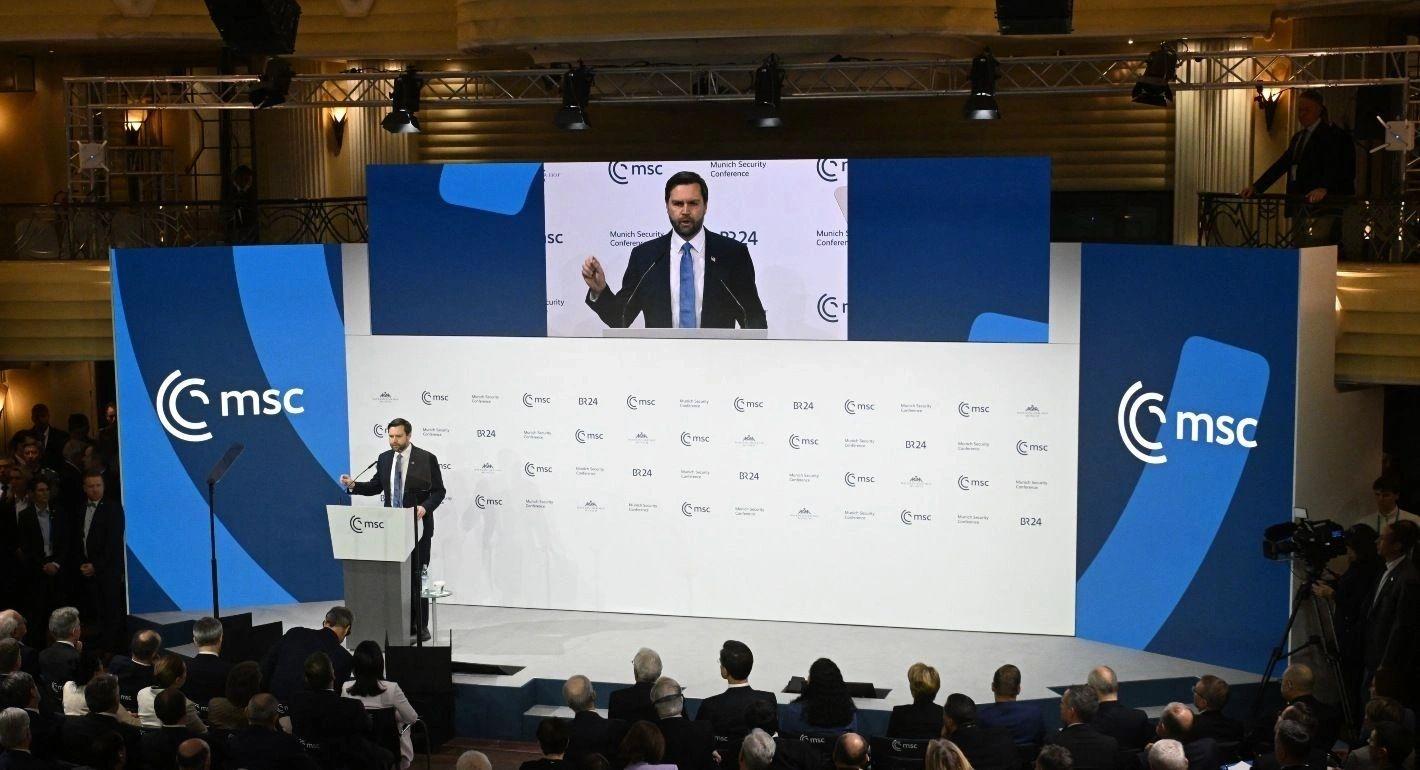
14 February 2025, 15:00 CET. U.S. Vice President JD Vance has just finished his speech at the Munich Security Conference 2025 and made every European a witness of a turning point in the transatlantic relationship. As one former senior U.S. diplomat remarked: “This is a new United States and it’s clear the old one Europe’s been used to for decades is gone. It could be this is the one wake-up call that actually wakes Europe up.” (Gramer et al., 2025). In the following weeks and months, the grand questioning began. How should the European Union react? To what extent is the U.S.-EU partnership still a functional alliance? Has the western alliance broken apart? Is the EU finally able to stage itself as an independent global power?
This uncertainty comes in a time of global distress influencing the EU’s foreign policy. The post-Cold War ideal of perpetual peace and prosperity are long gone. We are witnessing a full-scale invasion on European soil and severe economic challenges for every country, all in the context of rising global multipolarity and climate change as just a few of today’s challenges.
JD Vance criticized Europe’s perspective on free speech and democracy, but the disagreements between both sides of the Atlantic go far beyond. The past decade has seen a new era of protectionism between the two players as well as heavy divergence in issues like digital governance combined with the EU’s striving for new strategic autonomy.
The aftermath of the 20th century has led to one of the strongest alliances in global politics. Nevertheless, these past events and policy changes have led to a lot of rethinking on both sides. It is not the first time that we experience disagreements between the U.S. and the EU, be it the dissent about the invasion of Iraq 2003 or the NSA scandal of 2013, however this time, these conflicts do not only influence specific issues but rather the strategic cornerstones of the alliance. The European Union is at a crossroads facing an unreliable ally across the Atlantic, but the unique chance to gain new strength in unity.
A New era of protectionism?
One of the clearest signs of the paradigm shift in economic policy are the tariffs imposed by the Trump administration. The “Liberation Day” on 2 April 2025 has become emblematic of Trump’s protectionist approach. Imposing tariffs on almost every territory on the planet and in consequence hindering global trade and causing stock markets to crash has been one of the most brutal showcases of Donald Trump’s understanding of protectionism and his “America First” dogma.
The era of protectionism has however not been started this year under Donald Trump’s second term. Remember the Inflation Reduction Act (IRA) of 2022 under Joe Biden’s reign - a sweeping industrial policy combining hundreds of billions in subsidies with local content requirements (LCRs). Its aim: stimulating American green industries and securing America’s economy while lowering the inflation. In Brussels, even if the pro-climate stance has been welcomed, the act has been seen as a form of friendly protectionism - a contradiction in terms that has triggered concern and strategic recalibration (Scott et al., 2022). Europeans fear an even heavier amount of relocation of industrial investment toward the U.S., undermining their own climate and competitiveness goals.
On the other side of the Atlantic, the EU has launched its own industrial policy instruments: the Green Deal Industrial Plan, the European Chips Act, the Critical Raw Materials Act and ongoing discussions on a European Sovereignty Fund. These programs aim to enhance the competitiveness of the EU’s net-zero industry and increase the resilience of the single market for example by reducing dependencies (European Commission, 2022; European Parliament, 2023). The overall goal is to “make sure that the future of the industry is made in Europe” and to “make Europe the home of cleantech and industrial innovation on the road to net zero” as EU Commission President Ursula von der Leyen has stated previously (European Commission, 2022).
The impact of these protectionist policies on both parties’ economies and global trade overall must not be neglected. In 2024, the United States was the largest partner for EU exports of goods (20.6%) and the second largest partner for EU imports of goods (13.7%) (Eurostat, 2025). This closely tied trade relation has been essential for the EU and the U.S. over the past decades and the basis of the transatlantic relationship.
Normative divergence
Moving on from economic policies, the past years have seen an increased normative divergence. Nowhere is this transatlantic divergence more evident than in the governance of digital platforms and data. The EU has positioned itself as a global regulatory leader, implementing extensive frameworks like the General Data Protection Regulation (GDPR), the Digital Services and Digital Markets Act (DSA/DMA) or the Data Act (DA). On the other side, the United States remains without a federal privacy law and continues to rely on self-regulation and market competition. This marks a heavy normative divergence regarding digital governance (Krasodomski & Miller, 2025) and is particularly noteworthy given the structural dependency on US-based tech giants like Alphabet, Meta or Apple.
Attempts to resolve these differences such as the EU-US Data Privacy Framework offer temporary relief but fail to address deeper systemic tensions. This divergence poses a risk to not only commercial relations but to the long-term credibility of the West as a unified regulatory force with shared values. These frictions are not limited to data governance as they extend to digital taxation or content moderation. To put it in JD Vance’s words: “Across Europe, free speech, I fear, is in retreat” (msc, 2025). We have seen this conflict extend to mutual accusations and disruptions in the Western unity for the whole world to witness.
Paths Ahead: Scenarios for the Future
These tensions represent the change in the transatlantic relationship over the past years. It is questionable how unified the alliance stands today and what effects we will see globally. The multilateral world order as we know it today could experience several ripple effects , a full-scale trade war between the EU and the U.S. could have implications for the future of the WTO and negatively impact the G7 trade unity. Furthermore, there will be countries seeking exploitation of EU-U.S. rifts, in particular the BRICS bloc. Will the European Union look for other trade partners in Asia? Will political cooperation with China become a reality? We now look at the key possible scenarios for the transatlantic relationship in the medium - short term.
Stalled Decoupling: Strategic Drift and Fragmentation
The shared values of the western world have been undisputed for most of the time. Now even the fundamental shared values like free speech have been rattled as seen for example in JD Vance’s speech. If we continue this path of normative drift apart, we could a scenario of stalled decoupling:
Still 73 years after the first “union” of European states, the EU continues to talk about “strategic autonomy” but lacks consensus of capacity to act decisively. The interests across one of the most diverse landscapes of the world vary heavily, from Baltics’ defense industry to German’s automobile industry to Spain’s agri-export strategies. Especially regarding economic questions, every state has a different opinion and goals they want to achieve which come to light expressively when it comes to the goal of a “unified” foreign policy. In the United States, voices have arisen which call for a “burden shifting” from the USA to Europe (Kaim & Kempin, 2024). Europe shall take responsibility for itself, and the USA shall minimize its foreign policy commitments - an approach which finds appeal in the Trump administration.
Continuing this path the transatlantic relationship could become more symbolic than operational, with coordination occurring only when vital interests align. This would be an expression of the protectionist tendencies in policy mentioned above. By 2030 the U.S. could lose its position as one of the EU’s closest allies as shared norms erode because both sides pursue divergent interests in global governance.
Managed Détente: Pragmatic Alignment Amid Tensions
However, one could see the above-mentioned scenario not as the most realistic one, as both sides of the Atlantic still know what importance their alliance holds to them. In the scenario of managed détente, we could see a new form of foreign policy pragmatism. This scenario reflects itself in a recent study which found that the majority of Europeans no longer see the U.S. as an “ally” but a “necessary partner” (Corlin & Lory, 2025).
Even if some questions are heavily disputed, focus could shift from mutual accusations to institutionalized cooperation. This scenario would be characterized by new platforms for dialogue and compromise mechanisms like the Trade and Technology Council (TTC) introduced in 2021. Disputes over industrial policy, data regulation and much more are to be managed through such high-level dialogues and are not to be carried out in public.
Nevertheless, this scenario would need to see a mentality shift especially in the U.S. government, as we would need to see an increased willingness for more multilateral dialogues. It is questionable whether this could happen under the current administration. Perhaps in order to achieve this pragmatism the EU will have to wait for a possible democratic president in 2028. The EU then could experience a new stable, if cautious, partnership marked by transactional diplomacy and shared crisis management.
Bloc-like Rivalry: Economic and Ideological Competition
In the worst-case scenario for the next decade the world could see the complete falling apart of one of the globe’s most defining alliances. As economic and ideological competition increases combined with more and more protectionism, there is the possibility of a bloc-like rivalry in the western world itself.
The competing political and regulatory models in the U.S. and EU turn into tools of geopolitical power, the U.S. and EU compete in the Global South for trade partnerships and all transatlantic institutions are weakened, the challenges would be unimaginable. Today both sides are still dependent on each other, but fierce differences of opinion could lead to a structured and intentional decoupling as the strategic divide turns the U.S. and EU into quasi-rivals.
However, it is very questionable whether this scenario could ever become close to reality. Yes, we experience a divergence, and yes, the partnership may not be on the best level it has ever been – but for it to break apart completely, there is still a long way to go. In this context it is to be noted what there even is to gain for the parties. Especially regarding defense policy Europe is still heavily dependent on America’s support in NATO. On the other hand, the United States does need Europe economically. In a rational world, this scenario seems unrealistic, but the times we live in show that reason only goes so far.
Partial Re-Engagement: Atlanticist Revival under U.S. Moderates
Finally, in a rather positive scenario, the transatlantic partnership could see a form of revitalization and new unified strength. This scenario plays out under the condition that the United States see a political shift back to multilateralism and a revitalization of the transatlantic ties.
This could only be achieved by a new moderate or progressive US administration after the presidential elections in 2028 which is based on a lot of speculation today. We could see again a president that commits to NATO, free trade, climate agreements and much more. For now, this scenario - as it may well be a dream of many Europeans - is in fact that: a dream. In order to achieve this, a domestic political shift is necessary in the United States, which is very questionable as Trumpism undoubtedly tries to establish itself as the new form of government for decades to come.
Conclusion: Between Uncertainty and Opportunity
The transatlantic relationship is no longer defined by habit or historical inertia. Instead, it stands at a decisive inflection point. The speech by Vice President JD Vance in Munich was not merely a rhetorical provocation – it was a mirror held up to Europe, revealing the uncomfortable truth that the United States is shifting course, and the era of unquestioned transatlantic unity is over. What follows will not be a return to the past but a navigation of new geopolitical terrain marked by protectionism, normative divergence and competing visions of global order.
Yet within this uncertainty lies an opportunity. The European Union, long criticized for its reactive posture in foreign policy, now faces the chance and the necessity to chart its own course which reflects in the opinion of EU citizens: in September 2024 63% of people asked for more autonomy from the U.S. (Hoffmann, 2024). To achieve that it requires more than rhetorical commitments to strategic autonomy. It demands concrete steps toward a unified economic and foreign policy, deeper investment in technological and industrial resilience, and a new assertiveness in global governance.
None of the scenarios as sketched above are inevitable. They will be shaped by political will, institutional creativity, and the choices made on both sides of the Atlantic. While the future of the US remains unpredictable, the EU cannot afford to make its own strategic direction dependent on American electoral cycles. Whether Washington leads, withdraws, or divides, Europe must be prepared to lead itself.
If the transatlantic relationship is to endure in a form worthy of its legacy, it must be renewed on more equal terms – anchored not just in shared history, but in shared capacity and shared responsibility. This is the moment for Europe to stop asking whether it can act and start showing that it will.
References List
Gramer, R. et al. (2025). Vance brings a wrecking ball to diplomatic gathering in Munich, POLITICO. Available at: https://www.politico.eu/article/vance-brings-a-wrecking-ball-to-diplomatic-gathering-in-munich/ (Accessed: 13 June 2025).
Scott, M., Moens, B. and Palmer, D. (2022). Bitter friends: Inside the summit aiming to heal EU-US Trade rift, POLITICO. Available at: https://www.politico.eu/article/trade-tech-council-china-subsidies-ira-joe-biden-emmanuel-macron-summit-ttc/ (Accessed: 13 June 2025).
European Commission. (2022). A European Sovereignty Fund for an industry ‘made in Europe’ I blog of commissioner Thierry Breton. Available at: https://ec.europa.eu/commission/presscorner/detail/cs/STATEMENT_22_5543 (Accessed: 13 June 2025).
European Parliament. (2023). EU’s response to the US inflation reduction act (IRA). Available at: https://www.europarl.europa.eu/RegData/etudes/IDAN/2023/740087/IPOL_IDA(2023)740087_EN.pdf (Accessed: 13 June 2025).
Eurostat. (2025). USA-EU - international trade in goods statistics. Available at: https://ec.europa.eu/eurostat/statistics-explained/index.php?title=USA-EU_-_international_trade_in_goods_statistics (Accessed: 13 June 2025).
Munich Security Conference. (2025). Speech by JD Vance and Selected Reactions. Available at: https://securityconference.org/assets/02_Dokumente/01_Publikationen/2025/Selected_Key_Speeches_Vol._II/MSC_Speeches_2025_Vol2_Ansicht_gekürzt.pdf (Accessed: 13 June 2025).
Krasodomski, A. and Miller, C. (2025). The conversation: Are Europe and the US set for a digital decoupling?, Chatham House – International Affairs Think Tank. Available at: https://www.chathamhouse.org/publications/the-world-today/2025-03/conversation-are-europe-and-us-set-digital-decoupling (Accessed: 13 June 2025).
Kaim, M. and Kempin, R. (2024). Die Neuvermessung der Amerikanisch-Europäischen Sicherheitsbeziehungen, Stiftung Wissenschaft und Politik (SWP). Available at: https://www.swp-berlin.org/10.18449/2024S15/ (Accessed: 13 June 2025).
Corlin, P. and Lory, G. (2025). Europeans think us is ‘necessary partner’ not ‘ally’, study finds, euronews. Available at: https://www.euronews.com/my-europe/2025/02/12/europeans-think-us-is-necessary-partner-not-ally-study-finds (Accessed: 13 June 2025).
Hoffmann, I. (2024). Eupinions - Europäer:Innen Wollen Sich von den USA unabhängiger Machen, Bertelsmann Stiftung. Available at: https://www.bertelsmann-stiftung.de/de/themen/aktuelle-meldungen/2024/november/europaeerinnen-wollen-sich-von-den-usa-unabhaengiger-machen/ (Accessed: 13 June 2025).