
The Chip War and Europe’s Strategic Autonomy
by Giulio Draghetti and Constantin Tremmel
16 min read · 3,153 words
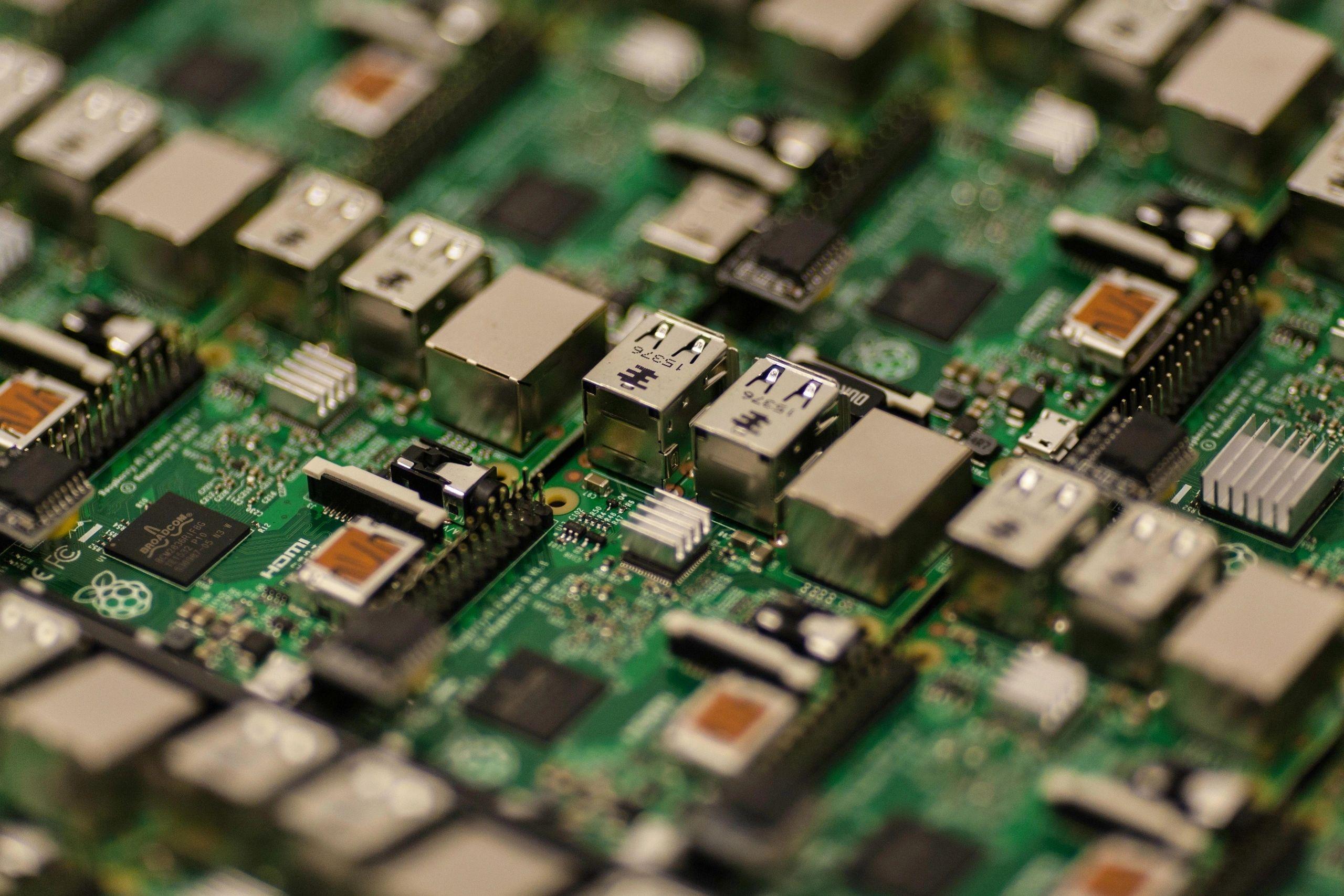
Rows of circuit boards with densely packed semiconductor components
()
1. Introduction
Semiconductors have become the indispensable infrastructure of the 21st century. They power everything from smartphones and cloud computing to advanced robotics and most decisively, artificial intelligence. Leadership in semiconductor technology is no longer merely an economical advantage but a determinant of geopolitical power. The ability to design, manufacture, and control the most advanced chips increasingly shapes political leverage through economic resilience, military capability and much more.
What was once a highly specialized industrial ecosystem has become a central foreign-policy battleground. The US enlarges its strategic competition with China through export restrictions and industrial subsidies under the CHIPS and Science Act. China, for its part, has invested heavily in domestic capacity and leverages its dominance in critical rare earth elements (REEs) and processing stages. Meanwhile, manufacturing of cutting-edge chips remains concentrated in East Asia, creating systemic vulnerabilities in the event of geopolitical disruption around Taiwan, with the island being the world’s biggest chips manufacturer.
Caught between these power centres, the EU faces structural dependence on foreign actors for both advanced design and large-scale production. This also heavily influences the EU’s ambitions to close the gap in AI development as currently 90% of all AI factories operate in the US or China and the EU therefore lacks the needed capacity to develop its own AI models at a competitive pace.
The European Chips Act seeks to double Europe’s global semiconductor market share by 2030 through coordinated public and private investment. Yet a 2025 assessment by the European Court of Auditors described elements of the strategy as “deeply disconnected from reality,” highlighting funding gaps and global overcapacity risks. Compared with the scale of U.S. and East Asian industrial policies, European efforts remain modest.
Europe’s primary structural leverage lies in one crucial chokepoint: ASML, the sole global supplier of extreme ultraviolet lithography machines required for manufacturing the most advanced chips. This unique position of the Dutch company provides the EU with influence in the evolving chip war. Yet even this leverage operates within a tightly interdependent global supply chain shaped by US export controls and Asian manufacturing dominance. The central question therefore is whether the EU can translate industrial niche strength into genuine strategic autonomy or whether it will remain structurally dependent in the most defining technological contest of our time.
Aerial view of an open-pit mine
()
2. Critical Raw Materials and Hidden Dependencies
Semiconductor production depends not only on advanced design and fabrication capacity, but also on a complex set of critical raw materials. Rare earth elements (REEs) are a group of 17 metals with unique properties that are indispensable for chip manufacturing and high-performance electronics, from defence to green energy. Although “rare earths” are not necessarily scarce in geological terms, their extraction and their processing are geographically concentrated.
China dominates global refining capacity for rare earths and maintains a leading position in the processing of several REEs with control of around 70% of rare earth mining and 90% of global separation and processing capacity (Kremiec, 2025). The EU’s exposure is acute: In 2024, China accounted for 46.3% of EU rare earth elements imports by weight followed by Russia with 28.4% (Eurostat, 2025). Over 80% of large European firms are within three supply-chain steps of a Chinese REE producer, according to European Central Bank estimates (Banin et al., 2025).
Beijing has moved steadily to weaponize this position. In April 2025, China introduced export quotas and licensing requirements on seven REEs in response to US tariff escalation which was followed by a second wave in October 2025 extending restrictions to twelve REEs in total, requiring foreign companies to obtain Chinese government approval for goods made outside China if they contain even trace amounts of Chinese-sourced rare earths (CSET, 2025; Kremiec, 2025). The licensing process has been described as “opaque, selective and slow by design” by various exporters, with REE prices in the EU skyrocketing after restrictions took effect (Arcesati & Junusova, 2025; European Parliament, 2025). Even if the second wave was temporarily suspended until November 2026 (European Parliament, 2025), the structural vulnerability it exposed remains unresolved.
The 2024 Critical Raw Materials Act (CRMA) is the EU’s primary legislative response aiming to limit these dependencies and vulnerabilities. According to its targets, by 2030, 10% of rare earths are to be extracted in the EU itself and 25% of the demand should be covered by recycling. Also, no single third country is to cover more than 65% of demand (European Commission, 2026). At the moment, these goals appear to be very ambitious, as the EU currently imports 95% of its rare earth materials and the recycling rate is below 1% (Cabanas & Kiorri, 2026)
This aspired diversification takes time and capital. On top of that, structural barriers in Europe hinder the acceleration of development through tedious permitting procedures, fragmented regulations across member states and local opposition. The Critical Raw Materials Act has been criticized for lacking the administrative and fiscal resources to credibly promote European mining projects and therefore not giving urgent priority to the European value chain (Findeisen & Wernert, 2023). It is yet to be seen whether the CRMA can defy the criticism and start a new era of European REE independence.
3. Industrial Policy as Geopolitical Tool
The semiconductor sector has become the primary scene for a new form of industrial policy in which investment subsidies, export controls and supply-chain regulations are used as instruments of geopolitical competition. The US, China and the EU have each deployed major policy frameworks with starkly different levels of ambition, resourcing and strategic coherence.
The US CHIPS and Science Act from 2022 committed $52 billion in federal funding for American research and manufacturing of semiconductors and catalysed private construction investment in computer and electronics manufacturing that grew up to ten times between 2021 and 2024, reaching $127 billion annually (US Congress, 2023; Scissors, 2025). Beyond domestic subsidies, a set of export controls have been established targeting China’s access to advanced chips above a certain performance threshold and the equipment needed to produce them (Sutter, 2025). The aspired effect is to prevent China’s rapid advancement in the semiconductor and technology sector while protecting the American industry. While the effects of the CHIPS and Science Act have proven to be crucial to achieve these goals, Beijing’s response was an even larger effort aiming to achieve self-sufficiency: China’s Big Fund III released in 2024, directed a further $47 billion into domestic chipmakers, AI processors approaching competitive benchmarks (Nag, 2025). Moreover, export controls also carry costs for US firms and could have unwanted effects if pursued further. Limiting market access would reduce revenue for US chipmakers and constrain their ability to fund research and development, harming the US firms’ competitiveness (Long, 2025).
Within this contest, the EU occupies an ambiguous and exposed position. The EU Chips Act, adopted in 2023, will be supported by €100 billion of policy-driven investment through 2030 (European Commission, 2026). By contrast, the top global manufacturers spent € 405 billion on semiconductor investment in just three years from 2020-2023 (European Court of Auditors, 2025). The EU’s share in the global market value has stagnated at around 10% with forecasts projecting only a marginal rise to 11,7% by 2030 which is far short of the 20% target (European Court of Auditors, 2025). The cancellation of Intel’s planned €30 billion mega factory in Magdeburg in August 2025 is only one instance that shows the gap between ambition and execution (MDR, 2025).
The EU also faces a strategic dilemma over ASML. The Dutch company’s monopoly on EUV lithography, needed for every advanced chip factory worldwide, gives Europe genuine leverage. Yet this leverage has proven to be difficult to exercise on European terms. Under pressure from Washington, ASML’s ability to service and supply high-precision lithography systems to China has been progressively restricted, aligning European export policy with US strategic priorities rather than necessarily EU ones (Trueman, 2024).
Another potential harm factor for Europe is currently being discussed. The AI GAIN Act, currently under consideration by the US congress, would require chip manufacturers to fulfil orders from American customers first before exporting abroad, a measure that, if enacted, would directly disadvantage European buyers in an already tight market for advanced AI chips (Luna, 2025). For the EU, this convergence of Chinese supply coercion and US priority allocation represents a structural squeeze that industrial policy alone cannot resolve. Semiconductor strategy must be integrated into the EU’s broader foreign and security policy architecture if Europe is to secure its position in the defining technological contest of the coming decades.
4. Security Implications
The semiconductor industry is no longer only an economic concern. It has become a matter of security in the broadest sense, as it now sits at the intersection of military capability and geopolitical leverage. This is particularly clear in the case of Taiwan, whose position in the global semiconductor ecosystem has turned the island into one of the most sensitive strategic nodes in the world economy.
Taiwan’s centrality does not simply lie in the scale of its production, but in its role in the most advanced segment of the market. The real vulnerability is not overall chip output, but the concentration of cutting-edge manufacturing capacity in a very limited number of facilities. This matters because the most advanced semiconductors are essential for artificial intelligence, high-performance computing, secure communications, and, increasingly, defence technologies. In that sense, the issue is not only one of supply chain efficiency, but of strategic exposure. A disruption in Taiwan, whether caused by military escalation, coercion, or even a non-political shock, would have consequences far beyond East Asia.
This concentration has made semiconductors part of the military balance itself. Advanced chips are embedded in systems ranging from surveillance and missile guidance to cyber capabilities and data processing infrastructure. They are, therefore, both a civilian technology and a strategic military asset. This dual-use nature explains why export controls have become such an important instrument of statecraft. Restrictions on access to advanced chips, manufacturing equipment, and design software are not merely commercial tools. They are intended to slow technological catch-up and shape the military capabilities of rival powers.
For Europe, this creates a difficult position. On the one hand, the Union remains highly dependent on external manufacturing centres for the most advanced chips. On the other hand, it holds leverage through specific technological chokepoints, most notably in lithography. Yet that leverage exists within a wider system increasingly shaped by U.S. security logic and by the growing confrontation between Washington and Beijing. As a result, the EU is not insulated from escalation. It is drawn into it through industrial interdependence and its own strategic assets.
The danger is that the semiconductor sector becomes locked into a spiral of securitization. Once chips are treated primarily as instruments of national power, states are more likely to respond with export bans, investment screening, subsidies, and retaliatory measures. What begins as an effort to reduce vulnerability can quickly give rise to new forms of fragmentation. In that sense, the chip war is not only about competition for technological leadership. It is also about the risk that interdependence itself becomes unstable when it is increasingly interpreted through the lens of security.
5. What Is at Stake for the EU
For the European Union, the central challenge is not to achieve complete semiconductor self-sufficiency. Such a goal would be unrealistic and economically inefficient. What is at stake instead is whether Europe can reduce its most dangerous dependencies while preserving the openness on which much of its prosperity still depends. The issue, in other words, is how to balance strategic room for manoeuvre and security.
This is made more difficult by the EU’s position between the United States and China. The Union is closely aligned with Washington on many security concerns and shares growing unease about technological dependence on China. At the same time, it does not fully control the direction of U.S. strategy, which is increasingly affecting European firms. Europe is therefore not only reacting to Chinese industrial expansion but also adapting to an American policy framework that can at times constrain its own strategic choices.
Relations with China are equally complex. China is not only a systemic rival but also a major market and a critical supplier of materials and industrial inputs that remain indispensable to European manufacturing. This makes it difficult to sustain a simplistic decoupling strategy. The more plausible European position is reducing exposure in critical sectors without severing economic ties altogether. Yet this is easier said than done.
In this context, Europe’s role as a regulator becomes especially important. The EU may not dominate advanced manufacturing, but it still possesses significant market power and regulatory influence. Its ability to shape standards and respond to economic coercion gives it tools that go beyond traditional industrial policy. These instruments do not at all replace fabrication capacity, but they do allow the Union to defend its strategic sectors and influence the terms of global competition.
The real policy question, then, is what kind of semiconductor strategy Europe wants to pursue. If we commit to a race for market share, we are likely to fall short, especially given the scale of American and East Asian investment. What is ultimately at stake is Europe’s capacity to act. Without a stronger semiconductor position, the EU risks remaining dependent in one of the most decisive technological domains of the coming decades. And that dependence would shape Europe’s ability to make autonomous political and strategic choices in an increasingly fragmented world.
6. Conclusion
The chip war is not a temporary disruption or a passing industrial dispute. It reflects a deeper structural shift in the world economy, and it’s here to last. As artificial intelligence capabilities expand, their applications in military technologies evolve, and global trade becomes more politicised, the strategic importance of semiconductors can only increase.
For the EU, this means that semiconductor policy must be understood as part of its foreign policy and economic strategy choices simultaneously. Europe’s position in the global semiconductor ecosystem is too important to be left to fragmented national efforts or to the market alone.
But the EU does not need to produce everything at home in order to become strategically relevant. It does, however, need to identify where its interdependence becomes a symptom of vulnerability and where openness is and isn’t an advantage. That requires a more realistic understanding of strategic autonomy. It’s not autarky, but the ability to avoid being trapped between stronger powers in a conflict that will shape the global order.
Bibliography
Arcesati, R. and Junusova, A. (2025) Beijing’s rare-earths export licensing system: Delays by design?, Merics. Available at: https://merics.org/en/comment/beijings-rare-earths-export-licensing-system-delays-design (Accessed: 08 March 2026).
Banin, M. et al. (2025) How vulnerable is the euro area to restrictions on Chinese rare earth exports?, European Central Bank. Available at: https://www.ecb.europa.eu/press/economic-bulletin/focus/2025/html/ecb.ebbox202506_01%7E44d432008e.en.html (Accessed: 08 March 2026).
Cabanas, L.B. and Kiorri, E. (2026) Is Europe losing the race to secure rare earth materials?, euronews. Available at: https://www.euronews.com/my-europe/2026/01/20/is-europe-losing-the-race-to-secure-rare-earth-materials (Accessed: 08 March 2026).
CSET (2025) Ministry of Commerce Notice 2025 No. 61: Announcement of the decision to implement controls on exports of rare earth-related items to foreign countries, Center for Security and Emerging Technology. Available at: https://cset.georgetown.edu/publication/mofcom-notice-2025-61/ (Accessed: 08 March 2026).
European Commission (2026a) Chips act, Chips Act | Shaping Europe’s digital future. Available at: https://digital-strategy.ec.europa.eu/en/factpages/chips-act (Accessed: 09 March 2026).
European Commission (2026) Critical raw materials act, Internal Market, Industry, Entrepreneurship and SMEs. Available at: https://single-market-economy.ec.europa.eu/sectors/raw-materials/areas-specific-interest/critical-raw-materials/critical-raw-materials-act_en (Accessed: 08 March 2026).
European Commission and High Representative of the Union for Foreign Affairs and Security Policy. Joint Communication to the European Parliament, the European Council and the Council on “European Economic Security Strategy” (JOIN(2023) 20 final). Brussels, 20 June 2023.
European Court of Auditors (2025) Special report 12/2025 en the EU’s strategy for Microchips. Available at: https://www.eca.europa.eu/ECAPublications/SR-2025-12/SR-2025-12_EN.pdf (Accessed: 09 March 2026).
European Parliament (2025) At a glance EPRS | European Parliamentary Research Service. Available at: https://www.europarl.europa.eu/RegData/etudes/ATAG/2025/779220/EPRS_ATA(2025)779220_EN.pdf (Accessed: 08 March 2026).
European Parliament and Council of the European Union. Regulation (EU) 2023/1781 of 13 September 2023 Establishing a Framework of Measures for Strengthening Europe’s Semiconductor Ecosystem (Chips Act). Official Journal of the European Union, 2023.
Eurostat (2025) Imports of rare earth elements saw 30% drop in 2024, Imports of rare earth elements saw 30% drop in 2024 - News articles - Eurostat. Available at: https://ec.europa.eu/eurostat/web/products-eurostat-news/w/ddn-20250409-1 (Accessed: 08 March 2026).
Farrand, Benjamin. “The Economy–Security Nexus: Risk, Strategic Autonomy and the Regulation of the Semiconductor Supply Chain.” European Journal of Risk Regulation 16 (2025): 279–293.
Findeisen, F. and Wernert, Y. (2023) Meeting the costs of resilience: The EU’s critical raw materials strategy must go the extra kilometer, Jacques Delors Centre. Available at: https://www.delorscentre.eu/en/publications/eu-critical-raw-materials (Accessed: 09 March 2026).
García-Herrero, Alicia, and Pauline Weil. Lessons for Europe from China’s Quest for Semiconductor Self-Reliance.Bruegel Policy Contribution 19/2022. Brussels: Bruegel, 2022.
Kremiec, K. (2025) Trapped in the Chip War: Europe’s AI ambitions at risk, Leading defence news hub. Available at: https://defence24.com/technology/trapped-in-the-chip-war-europes-ai-ambitions-at-risk (Accessed: 08 March 2026).
Long, T. (2025) Decoupling risks: How semiconductor export controls could harm us chipmakers and Innovation, RSS. Available at: https://itif.org/publications/2025/11/10/decoupling-risks-semiconductor-export-controls-harm-us-chipmakers-innovation/ (Accessed: 09 March 2026).
Luna, A. (2025) The gain AI Act in context: Export controls and U.S. ..., American Action Forum. Available at: https://www.americanactionforum.org/print/?url=https%3A%2F%2Fwww.americanactionforum.org%2Finsight%2Fthe-gain-ai-act-in-context-export-controls-and-u-s-ai-competitiveness%2F (Accessed: 09 March 2026).
MDR Sachsen-Anahlt (2025) Intel-Aus in Magdeburg: Milliarden-investition und 3.000 jobs geplatzt, Intel-Aus in Magdeburg: Milliarden-Investition und 3.000 Jobs geplatzt | MDR.DE. Available at: https://www.mdr.de/nachrichten/sachsen-anhalt/magdeburg/magdeburg/intel-stoppt-chipfabrik-investitionsstopp-112.html (Accessed: 09 March 2026).
Nag, R. (2025) Big fund III: China’s Long Game to control the chips that make the world work – analysis. Available at: https://www.eurasiareview.com/10122025-big-fund-iii-chinas-long-game-to-control-the-chips-that-make-the-world-work-analysis/ (Accessed: 09 March 2026).
Scissors, D. (2025) Does the chips and Science Act argue for industrial policy? | American Enterprise Institute - AEI, American Enterprise Institute. Available at: https://www.aei.org/research-products/report/does-the-chips-and-science-act-argue-for-industrial-policy/ (Accessed: 09 March 2026).
Sutter, K.M. (2025) U.S. export controls and China: Advanced semiconductors | congress.gov | library of Congress. Available at: https://www.congress.gov/crs-product/R48642 (Accessed: 09 March 2026).
Thadani, Akhil, and Gregory C. Allen. Mapping the Semiconductor Supply Chain: The Critical Role of the Indo-Pacific Region. Washington, DC: Center for Strategic and International Studies, 30 May 2023.
Trueman, C. (2024) Dutch government revokes some ASML lithography export licenses, due to US pressure - sdxcentral. Available at: https://www.sdxcentral.com/news/dutch-government-revokes-some-asml-lithography-export-licenses-due-to-us-pressure/ (Accessed: 09 March 2026).
United States International Trade Commission. U.S. Exposure to the Taiwanese Semiconductor Industry. Publication No. 2023-11-A. Washington, DC, 21 November 2023.
US Congress (2023) Frequently asked questions: Chips act of 2022 provisions and implementation | congress.gov | library of Congress. Available at: https://www.congress.gov/crs-product/R47523 (Accessed: 09 March 2026).
Wong, Chan-Yuan, Henry Wai-chung Yeung, Shaopeng Huang, Jaeyong Song, and Keun Lee. “Geopolitics and the Changing Landscape of Global Value Chains and Competition in the Global Semiconductor Industry: Rivalry and Catch-up in Chip Manufacturing in East Asia.” Technological Forecasting and Social Change 209 (2024): 123749.