
A Pyrrhic Victory: Why the EU-US trade deal buys calm today but risks trouble tomorrow
By Margot Padilla
18 min read · 3,652 words
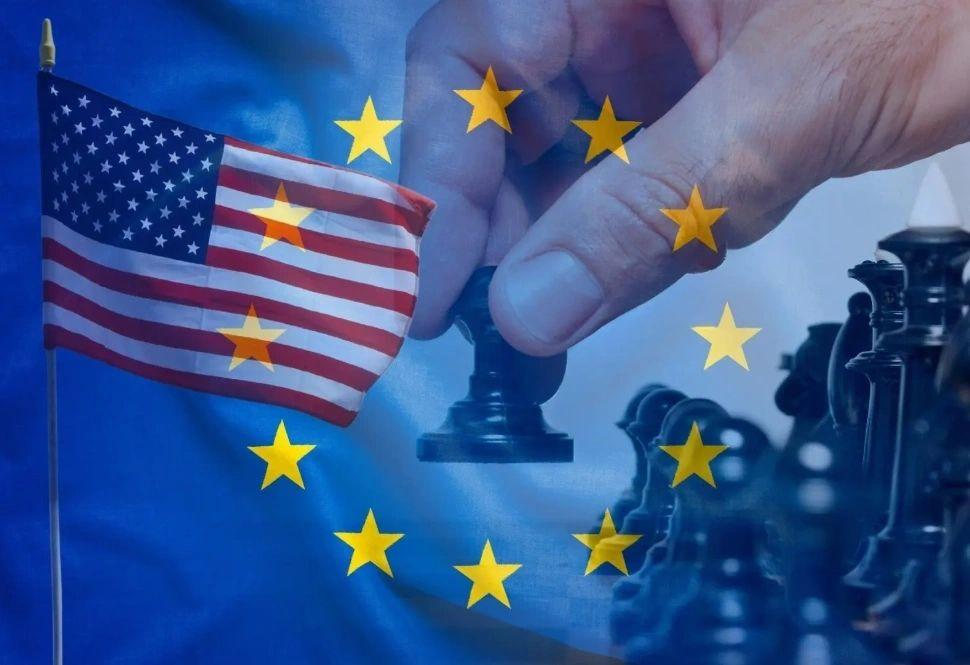
On 27 July 2025, European Commission President Ursula von der Leyen and US President Donald J. Trump finalized a deal on tariffs and trade, after tense negotiations. This was framed as a major diplomatic success.
The European Union and the United States form the world’s largest and most integrated bilateral trade and investment partnership. Combined, they account for nearly 30% of global trade and represent almost 44% of global GDP. Over the past decade, EU-US trade in goods and services has doubled, reaching €1.68 trillion in 2024 with €867 billion of trade in goods and €817 billion in services. More than €4.2 billion of these cross the Atlantic daily, illustrating the deep and interconnected economic relationship. This partnership is further strengthened by mutual investment, with EU and US companies holding €5.3 trillion in investments in each other’s markets as of 2022.
Therefore, the announcement of a trade deal with Trump could be seen as a personal triumph for von der Leyen. She took a risk by traveling to Scotland to negotiate, aware that only Trump’s direct involvement could finalize the agreement. Previously, he had reacted to a deal negotiated by his cabinet, based on a 10% baseline tariff, by sending the EU a letter threatening tariffs of up to 30%. With his unpredictability and the absence of a strong personal rapport, the outcome was uncertain, with both leaders admitting a roughly even chance of success. Yet, despite these challenges, they managed to secure a deal that protects this economic partnership from a potentially devastating trade war. However, unlike many agreements that deepen cooperation, this deal may ultimately distance the EU from its partner rather than bringing them closer together.
Stability? Yes, but at what cost?
At first glance, the deal seems to deliver what both sides needed: a pause in escalating trade tensions and a sense of predictability for businesses. The European Commission described the agreement as a framework to “restore confidence” and provide room for further dialogue on technical barriers and regulatory cooperation. Yet beneath this veneer of stability lies a more complex reality.
For many MEPs and analysts, the agreement is unbalanced, with the EU conceding too much while the United States secured favorable access for its key industries. It has been even argued that the deal sends a worrying signal: that Europe may be increasingly reactive to US pressures rather than shaping trade rules on its own terms, which jeopardizes the EU's quest for strategic autonomy. By conceding to a tariff ceiling under pressure, the EU has arguably traded away leverage that could have been used to strengthen its competitiveness and industrial base.
The central question is therefore whether the EU should consider itself fortunate to have secured this compromise, or whether it should be concerned that this agreement could compromise Europe's long-term competitiveness and strategic autonomy.
Short-term advantages
Ursula von der Leyen called this trade agreement with the United States a “huge deal”, emphasizing the urgent need for certainty in transatlantic trade.
One of the most immediate benefits of the deal is that it averts a full-blown trade war by capping US tariffs on the vast majority of EU exports. As the European Commission noted, the agreement established a “single, all-inclusive” 15% ceiling that applies across sectors such as cars, semiconductors, pharmaceuticals, and lumber, with no stacking of additional duties above this rate. Importantly, for certain sensitive or strategic categories, the deal goes further: goods like cork, aircraft and aircraft parts, generic pharmaceuticals, or chemical precursors are subject only to the most-favored-nation (MFN) tariff regime. In other words, zero or near-zero US tariffs for those specific products.
Beyond that, the agreement includes a joint commitment to shield the steel and aluminum sectors from “unfair and distortive competition.” According to the Commission, both sides will work together to address global overcapacity in these metals, acknowledging that excess capacity threatens not just EU producers but US industry as well. This protection for metals, combined with the tariff ceiling, gives European exporters some relief, at least in the short term, while reducing the likelihood of renewed escalation.
This leads to another immediate benefit: the restoration of business confidence for EU consumers and firms. From the EU’s perspective, the transatlantic partnership is so central that even small improvements in trade terms can have a big economic impact. On the practical side, the deal promises significant savings for EU importers and consumers. The Commission estimates that liberalizing US exports to the EU could reduce tariffs by around €5 billion per year, while continuing to protect sensitive EU industrial and agricultural sectors.
They also commit to reducing non-tariff barriers: by aligning car standards, lowering procedural red tape, and mutually recognizing a broader range of product checks across industries. Beyond trade, the agreement includes “cooperation on economic security”, enhancing supply chain resilience, tackling non-market practices, and deepening collaboration on investment screening and export controls. Moreover, the deal also opens a new channel for critical energy and future-oriented resources: the EU intends to procure US liquefied natural gas (LNG), oil, and nuclear energy products, which Brussels argues will help replace Russian energy imports.
Crucially, these measures are anchored in a formal follow-up mechanism. The Joint Statement published on 21 August 2025 commits both sides to ongoing technical and regulatory cooperation. For businesses, that promises a clearer, more predictable compliance environment and lower costs of technical certification; for policymakers, it institutionalizes economic-security tools within the trade architecture, making supply-chain and investment cooperation a permanent feature of transatlantic engagement.
However, this framework is a double-edged sword.
Long-term weaknesses
While it could enable more harmonized rules and reduce friction, it also means Europe is committing to a long-term engagement under high US influence. If the regulatory agenda skews too far toward US interests, there is a risk that Brussels will yield ground in future negotiations, potentially undermining European autonomy in critical standard-setting domains. Politically, the perception of capitulation erodes confidence in the Commission’s ability to defend European interests in high-stakes negotiations.
Economically, the agreement’s asymmetric trade architecture reduces Europe’s leverage in its largest export market and raises costs for manufacturers exposed to transatlantic trade. Under the framework, most EU goods face a single 15% tariff ceiling on entry to the US, while the EU has removed or sharply reduced tariffs on many US industrial goods. This structure shifts bargaining power and leaves the bloc with less room to reciprocate. Persistent tariff pressure, combined with preferential access granted to US industries, could create real incentives for investment and production to migrate outside the EU, eroding the bloc’s industrial base over time.
Energy provisions amplify those concerns. The commitment to purchase around $750 billion of US oil, LNG and nuclear fuel replaces dependence on one external supplier with reliance on another, and would require a very large expansion of US-sourced energy supplies to materialize. Analysts have described this goal as unrealistic and warned it risks undermining the European Green Deal and the bloc’s decarbonization agenda.
Politically and institutionally, the deal has already provoked backlash across member states and strained internal solidarity, weakening the Commission’s bargaining position and President von der Leyen’s standing. The perception that Brussels conceded under heavy US pressure has become a recurring theme in reporting and parliamentary criticism, feeding narratives that the Commission traded long-term strategic autonomy for short-term stability.
This agreement also signals an institutional drift away from rules-based multilateralism toward transactional, bilateral bargaining. By prioritizing a large bilateral package over multilateral channels such as the WTO, the EU risks normalizing a diplomacy where concessions are extracted under pressure rather than negotiated through predictable mechanisms, a change that could weaken Europe’s capacity to set global standards and defend its regulatory model in future disputes.
Recent developments
By 24 November 2025 the deal entered a fraught implementation phase: senior US trade officials pressed their European counterparts in Brussels with a fresh set of demands, underscoring that the agreement had opened a continuing negotiation rather than producing a closed settlement. Since this summer, divergent “wish lists” have become visible on both sides, with Washington using regulatory reforms (notably on digital and competition rules) as leverage for further tariff relief, while Brussels has focused its requests on concrete roll-backs of metal duties and guarded carve-outs for sensitive sectors.
EU competition chief Teresa Ribera notably accused US officials of “blackmail” after reports indicated Washington was conditioning tariff relief on revisions to the EU’s digital regulatory framework. Ribera said using regulatory change as leverage threatened the EU’s regulatory sovereignty and warned that treating the Digital Markets Act and Digital Services Act as bargaining chips would undermine trust between the partners and complicate implementation. Several member states and MEPs reiterated that digital rules protect consumers and competition and cannot be traded away for short-term tariff concessions.
Attention therefore shifted quickly from headline politics to the legal work of implementation, a process that has exposed both progress and tension. A few days later, on 28 November 2025, the Council adopted negotiating mandates for two regulations intended to translate the tariff elements of the Joint Statement into EU law: one covering customs duties and tariff-rate quotas for a broad set of US industrial, seafood and agricultural products, and the other extending the duty suspension on certain lobster imports. That Council text also tightens economic oversight by including a bilateral safeguard mechanism and instructs the Commission to monitor effects and report back by 31 December 2028.
Those formal steps, however, have not ended the controversy. EU governments are pushing for additional protections, including an explicit review clause. Under the July agreement, the US would impose broad 15% tariffs on EU goods while the EU removes many duties on US imports, including creating tariff-free quotas for some industrial, seafood, and agricultural products. Member states want the European Commission to be able to suspend these duty changes if import surges threaten EU producers and to monitor the effects and report back by the end of 2028. The final legislation will be negotiated between EU governments and the European Parliament. The parliament, which is due to define its position in late January, is considering similar safeguards, such as an 18-month sunset clause and measures to respond if the US fails to uphold the deal. It also wants the US to remove newly introduced 50% tariffs on 407 steel and aluminium derivative products (such as wind turbines and motorcycles), or else the EU would keep its own tariffs on those items.
Policies to consider
Academic and policy literature on the EU-US trade deal highlights several recurring themes and recommendations for managing its implementation and long-term impacts.
1. Review clauses: Introduce time-limited reviews to assess economic impacts and renegotiate terms if needed.
Scholars and analysts widely advocate for time-limited review mechanisms, arguing that regular reassessment, such as biannual reviews, is crucial for adapting the agreement to evolving economic and geopolitical realities. This approach is seen as particularly important given the dynamic interplay between EU and US industrial policies, where sudden shifts in subsidies, trade barriers, or regulatory frameworks can disrupt market stability.
Research underscores that such adaptive governance structures help both parties renegotiate terms in response to new challenges, ensuring the deal remains relevant and fair over time. Plus, drafting these clauses as binding implementing-regulation obligations and not merely political promises would reduce the risk that implementation drifts under subsequent pressure.
2. Strategic carve-outs: Protect key European industries from lasting disadvantage.
Another prominent recommendation is the introduction of strategic carve-outs for key European industries, such as semiconductors or pharmaceuticals. Studies warn that without targeted protections, European firms in these sectors risk losing competitiveness due to subsidy races or uneven market access. The literature points to existing precedents, such as tariff exemptions for pharmaceutical generics, as potential models for broader safeguards.
These carve-outs are framed not as protectionist measures, but as a necessary tool to prevent lasting sectoral disadvantages and to support the EU’s strategic autonomy. Indeed, they must be crafted to protect dynamic sectors without degenerating into permanent protectionism, and should include sunset clauses and objective performance metrics (for example, R&D presence, local value-added, or manufacturing-capacity thresholds) that condition continued protection on demonstrable industrial benefits and progressive liberalisation plans.
3. Energy diversification: Redirect commitments toward renewables and regional partnerships to avoid overdependence on US fossil fuels.
The deal’s energy provisions have also drawn criticism, particularly regarding increased EU dependence on US fossil fuel imports. Such commitments could expose the EU to geopolitical and price volatility. Rather than reinforce this dependency and risk locking itself into carbon-intensive pathways, the EU should prioritise renewable investments and stronger regional partnerships. Energy diversification is therefore seen as essential for reducing vulnerability to external shocks and aligning trade policy with the EU’s climate and energy security goals.
In addition, headline fossil-fuel purchase pledges are often non-binding: energy purchases in the EU are determined by private-sector choices and guided by market dynamics. In principle, the European Commission lacks the legal authority to compel member states to undertake such large-scale commercial procurements.
Policy best practice therefore is to treat any dollar-value energy pledges as commercial targets only, require company-level reporting against sustainability criteria, and attach those targets to binding Green Deal consistency checks. Where fossil imports remain necessary, contracts should be conditional on investments in European regasification, decarbonisation-technologies and cross-border interconnectors so that supply diversification also advances the EU’s climate objectives.
4. Multilateral rebuilding: Reinvest in WTO alliances and cooperative trade frameworks to counterbalance US dominance.
Beyond bilateral arrangements, renewed engagement with the World Trade Organization (WTO) and allied economies, such as Japan, South Korea, or Canada, is also essential for the EU to restore multilateral trade governance and balance US economic influence. This multilateral approach is viewed as a way to mitigate the risks of over-reliance on a single partner and to foster greater strategic resilience.
Rebuilding multilateral options is not only a defensive, but also an offensive strategy. Defensive measures include harmonising FDI-screening practices, updating export-control lists for dual-use and emerging technologies, and operationalising prompt safeguard mechanisms so that surges in imports can be managed without ad-hoc political brinkmanship. Offensive multilateralism requires reinvesting diplomatic capital on digital regulation, subsidy transparency and procurement standards. The literature suggests that coordinated approaches to dispute settlement and common standards reduce the incentives for a powerful partner to extract concessions in bilateral talks and preserve rule-based governance over the longer term.
5. FDI screening and export-control : Protect sensitive sectors by checking foreign investments and restricting risky tech exports in transatlantic trade.
The role of Foreign Direct Investments (FDI) screening and export-control is another recurring theme. Recent European Commission reports highlight the growing importance of monitoring third-country investments that could threaten critical assets. Research on trade and investment linkages show that FDI networks significantly affect trade flows, especially in manufacturing sectors. Moreover, dependencies in advanced technology and rare-earth supply chains argues that economies heavily reliant on critical input imports face structural vulnerabilities, further supporting the need for stronger export controls, supply-chain diversification, and upstream resilience efforts. These measures are seen as essential for addressing structural vulnerabilities and ensuring that the EU retains sovereignty over key industries.
Several cross-cutting measures are necessary to render the package credible and implementable. Trade-defence instruments should be modernised with clear trigger thresholds and shortened investigation timetables so safeguards can be deployed quickly and proportionately.
FDI-screening and conditionality should be hardened so that investment approvals can be linked to commitments on jobs, R&D and limits on forced technology transfer. Industrial policy instruments should include SME cushions, adjustment funds, and green public procurement that create guaranteed demand for EU clean-tech suppliers as market openings take effect.
Finally, monitoring and public reporting obligations could be embedded in the implementing text so Parliament, Member States and stakeholders can evaluate effects in real time.
Conclusion: a warning disguised as peace
In appearance, the deal succeeded in preventing an acute trade war. But as implementation begins, it also reveals deeper vulnerabilities that could shape Europe’s future.
In late November, the Council adopted its negotiating mandates for two regulations transposing the tariff-related commitments from the Joint Statement into EU law: one streamlines customs duties and sets tariff-rate quotas for US industrial and some agricultural products, while the other extends a duty-free regime for certain seafood imports. Alongside, the Council inserted a bilateral safeguard mechanism and mandated an economic-impact report by December 2028, implicitly acknowledging that liberalisation carries real risks for sensitive European sectors.
This legal progress may restore some predictability, yet it also reframes the agreement as the start of a long and uncertain implementation process rather than a closed compromise. Indeed, the United States has already used leverage from the July deal to push for US goals beyond tariffs, demanding that the EU rework its digital-regulation and competition laws if it wants further tariff relief on steel and aluminium.
That dynamic signals that the agreement could morph into a living negotiation, where initial commitments become bargaining chips in future rounds, making Europe’s regulatory autonomy and industrial interests increasingly vulnerable.
What does this mean for the EU’s longer-term prospects?
First, the structural asymmetries of the deal remain: a 15% US tariff ceiling on most EU goods, compared with extensive EU tariff removals, means European exporters retain less leverage, and sensitive industries remain exposed. Combined with growing US influence over regulation, the agreement risks locking in disadvantages that could erode competitiveness and industrial capacity over time.
Second, the energy and strategic dependencies embedded in the deal risk constraining Europe’s ability to pursue independent climate and industrial policies. The supposed “switch” from Russian energy to US supply may replace one dependency with another, limiting the EU’s capacity to steer its own green transition on its own terms.
Third, the internal political cost is already visible: growing criticism across member states and in the European Parliament threatens to fragment the EU’s unified trade stance, undermining the Commission’s credibility and bargaining power in future negotiations.
Finally, the shift away from multilateralism toward bilateral diplomacy may weaken Europe’s role in global rule-making. In a world of growing economic competition, this institutional drift could erode the EU’s long-term capacity to shape trade, regulatory standards, and global cooperation.
That said, the window for course correction remains. If the safeguard clauses are strengthened, if review mechanisms are triggered, and if Europe uses the breathing space bought by the deal to invest in strategic industries, diversify its energy sources, and rebuild multilateral alliances, this “temporary peace” could become a foothold for strategic renewal rather than a trap.
But that outcome hinges on political will, unity among member states, and a conscious shift from reactive dealmaking to proactive industrial, energy and regulatory policy. Otherwise, what looks like stability today may calcify into constraints on Europe’s competitiveness, autonomy and capacity to act as a global rule-maker.
Bibliography
Blenkinsop, P. EU members seek safeguards in US tariff deal to protect industry. (28 November, 2025). Reuters.
Burwell, F. Trump and von der Leyen made a deal. But the US and EU are drifting apart on trade. (28 July, 2025). Atlantic Council.
Butler, E. US-EU trade deal wards off tariff escalation but threatens growth. (29 July, 2025). Euronews.
EU-US trade: facts and figures. (12 June, 2025). European Council.
EU-US trade deal explained. (29 July, 2025). European Commission.
EU-US trade deal explained. (29 July, 2025). Représentation au Luxembourg.
EU-US trade relations: Council moves forward in implementing the tariff elements of the Joint Statement. (28 November, 2025). European Council.
Felbermayr, G.; Stamern, V. Transatlantic restart: Proposals for trade cooperation between the EU and the United States. Foundation for Family Businesses / Stiftung Familienunternehmen. (2021). Stiftung Familienunternehmen.
FitzGerald, J.; Geoghegan, T. Who are the winners and losers in the US-EU trade deal? (August 21, 2025). BBC.
Foreign direct investment screening continues to boost EU economic security. (14 October 2025). Directorate-General for Trade and Economic Security.
García Bercero, I.; Poitiers, N. From strategy to doctrine: the next steps for European economic security. (30 September, 2025). Bruegel.
García Bercero, I. How the EU should plan for global trade transformation. (21 May 2025). Bruegel.
Joint Statement on a United States-European Union framework on an agreement on reciprocal, fair and balanced trade. (21 August, 2025). Trade and Economic Security.
Kimball, S. Trump’s EU trade deal is based on massive energy purchases that are unlikely to materialize, analysts say. (29 July, 2025). CNBC.
Klimek, P.; Baum, S.; Gerschberger, M.; Hess, M. Systemic trade risk suppresses comparative advantage in rare earth dependent industries. (1 August, 2025). Cornell University.
Liboreiro, J.; Corlin, P. Brussels defiant against persistent criticism of EU-US trade deal. (3 September, 2025). Euronews.
Micheletti, F., & Parry, J. Top EU official accuses US of ‘blackmail’ in trade talks. (27 November, 2025). Politico.
Nunzi, S. European strategic autonomy in the energy field: navigating geopolitical challenges, policy coordination and innovation. (8 January, 2025). LUISS, Insitute for European Analysis and Policy.
O’Neil, S. K.; Huesa, J.; Paz-Soldan, G. A guide to Trump’s Section 232 Tariffs, in maps. (15 November, 2025). Council on Foreign Relations.
Sasipornkarn, E. EU and US reach trade deal, avoiding tariff escalation. (July 29, 2025). Deutsche Welle (DW).
Sen, A.; Suraj, S. The EU–US Trade Deal: A $750 billion commitment caught between supply security and climate strategy. (12 August, 2025). UKTPO.
Sgrignoli, P., Metulini, R., Zhu, Z., Riccaboni, M. The Indirect Effects of FDI on Trade: A network Perspective. The World Economy, Vol. 40, Issue 10, pp. 2193-2225. (5 May, 2017). Cornell University.
Swanson, A.; Smialek, J. Why Europe and the Are Still Haggling on Trade. (24 November, 2025). The New York Times.
The EU-US trade deal: Restoring stability and predictability. European Commission.
Tréhu, J. Transatlantic Cooperation on Semiconductors: a US perspective. IAI PAPERS, Vol. 24, Issue 05. (2024). Istituto Affari Internazionali, Fondazione Compagnia di San Paolo.
U.S.-EU trade deal sparks criticism across Europe. (29 July, 2025). Europe News.
What's in Trump's trade deal with Europe? (21 August, 2025). Reuters.