
AMLA Takes the Helm: EU’s New Front Against Financial Crime
6 min read · 1,225 words
Anti-Money Laundering Authority in Europe
The European Union's Anti-Money Laundering (AML) regime is fragmented. National authorities each carry out AML supervision under their own interpretation of EU directives. Although there is a shared basis, the absence of a standardized approach results in many inconsistencies regarding how risk is measured and managed across member states.
As of today, EU actions are mainly reliant on directives 2015/849 and 2018/849, commonly known as the Fourth and Fifth AMLDs. Such a heterogeneous legal and supervisory framework challenges supervisory effectiveness and creates a risk of regulatory arbitrage. For instance, a fraudulent entity could exploit weaker national legal frameworks in one of the member states to launder money in the EU. Moreover, sanctions vary from country to country, limiting deterrence capabilities. Finally, the absence of a European authority with direct supervisory powers limits the EU's ability to counter large-scale money laundering operations. (European Commission, 2025)
In particular, cross-border financial institutions have a large compliance burden, as they have to adhere to differing reporting and risk assessment requirements in each state they operate in. A key example is Customer Due Diligence (CDD), a critical step in the identification of suspicious financial activity. Overall, this results in higher operational costs without necessarily increasing AML efficiency.
Evidence of this structural weakness can be witnessed in the Danske Bank’s case (2018). Headquartered in Denmark, Danske Bank was subject to Denmark’s relatively strict AML regulations. However, the bank leveraged its branch in Estonia, a country whose anti-money-laundering legislative framework is significantly weaker, to legally process an estimated €200 billion coming from suspicious cross-border activities (Elisabetta Bjerregaard; Tom Kirchmaier, 2019). Eventually, the courts ruled that the bank substantively abused regulatory gaps and now faces multi-billion euro fines.
Overall, the impact of illicit financing is significant with more than $750 billion laundered in 2023—2.3% of the region's GDP. The main sources of laundering lay in corruption, drugs and last but not least, illegal cross-border flows, estimated at $195 billions. (Nasdaq Serafin, 2025)
The New Framework with AMLA
Regulation 1620/2024, drafted in 2021 and approved in 2024, created the Anti-Money Laundering Authority (AMLA). The AMLA is a single EU body charged with harmonizing technical standards, implementing direct supervision, and designing a unique sanction framework.
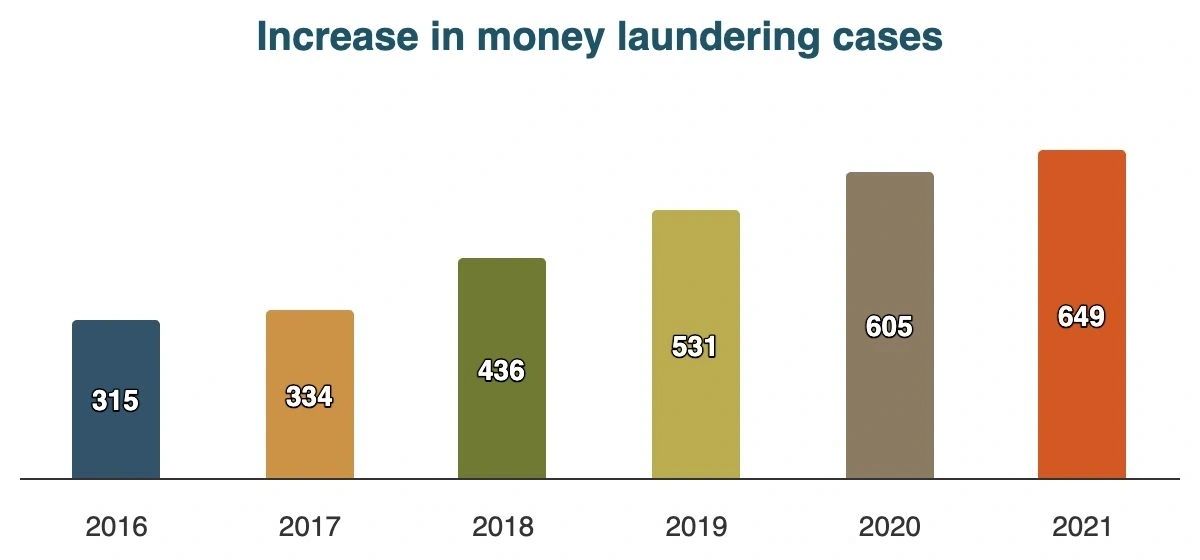
Figure 1: Evolution of money laundering cases in the EU. Source: European Union Agency for Criminal Justice Cooperation; 2022
With illegal financial flows sharply increasing over the last decade, and money laundering cases in the Eurozone more than doubling between the years 2016 and 2021, the need for increased concerted action became apparent.
The establishment of the AMLA will address all the aforementioned issues, facilitating the development of an EU-wide AML scheme.
With standardized guidelines across member states, its main innovation is the creation of a homogeneous assessment method of the inherent and residual risk of the subject. The AMLA will develop binding Regulatory Technical Standards requiring supervisors across the EU to examine financial institutions based on homogenous criteria. Risk profiles will be graded into four tiers, using a system scoring methodology, removing variability and allowing comparability among cases. The supervisors will review risks annually or once every three years in the case of very small institutions.
Another major feature of the AMLA is its future role as supervisor of determined high-risk cross-border institutions. Such designated institutions must operate in at least six member states with ‘material’ activities (i.e. over 20,000 customers or at least €50 million worth of transactions in each member state).
In addition, CDD obligations will also be harmonized across the Union. The AMLA rulebook will set how financial institutions must carry out identity verification and monitoring. Enforcement practices will be aligned, implying supervisors will classify breaches by shared intensity indicators and apply consistent standards in setting penalties. This aims to close past enforcement loopholes in which similar breaches incurred disparate penalties across countries (AMLA, 2025).
Terrorism Financing in the EU
The terrorist threat to the European Union remains high, with almost a hundred completed terrorist attacks in 2023 (European Parliament, 2025), primarily from jihadist terrorism. In order to combat their financing, the EU has responded with regulatory reforms and enhanced cooperation mechanisms.
Terror groups utilize multiple channels to fund themselves. They rely on systems like Hawala, international networks of money changers, which bypass traditional banking regulations and transfer funds in a fast and anonymous manner (Bowers, 2009). Terrorist organizations also rely on crowdfunding platforms, particularly extreme right-wing groups. This practice, however, remains limited in Europe.
Current Regulatory Framework
Currently, the fight against terrorism financing is legislated and enforced on a national level, although there is cooperation at an EU level. The European Counter Terrorism Centre (ECTC) at Europol is in charge of coordinating counter-terrorism efforts and plays a key role in detecting suspicious transactions, with recent initiatives focused on enhancing their powers and improving cooperation.
Other initiatives include the EU Global Facility on AML and CFT which provides support to exterior countries with deficiencies in their national regimes. This initiative aims to reduce financial flows from organized crime to terrorist organizations abroad and strengthen international financial monitoring networks, but remains limited in size, with a €30 Million budget (European Commission, 2017).
Future Perspectives of CFT with AMLA
The creation of the AMLA is the most significant development in the EU’s effort to counter terrorism financing. It is charged with overseeing and coordinating national supervisors, but most importantly it can issue binding decisions to ensure consistent applications of CFT rules. It will also contribute to the development of a CFT rulebook to standardize rules across the EU, through technical standards, guidelines, and recommendations. We are moving away from a system where national supervisors issued their own regulations based on EU directives to a single rulebook, which enables homogeneous and effective regulation at the EU level.
Conclusion
The AMLA is set to become fully operational by 2026 and will begin implementation of the latest Sixth AML directive by 2027. What remains to be seen is how effective the standardization of AML and CFT rules and guidelines across the EU proves to be. However, regardless of success, this showcases member’s states' desire to pursue further unity and solidarity at the EU level.
References List
AMLA (n.d.) About AMLA [Online]. Available at: https://www.amla.europa.eu/about-amla_en (Accessed: 22 May 2025).
Bjerregaard, K. and Kirchmaier, I. (2019) The Danske Bank Money Laundering Scandal [Online]. Copenhagen Business School. Available at: https://research.cbs.dk/files/60661878/Bjerregaard_Kirchmaier_The_Danske_Bank_Money_Laundering_Scandal_2019.pdf (Accessed: 15 May 2025).
Bowers, C. (2009). Hawala, money laundering and terrorism finance: micro-lending as an end to illicit remittance [online]. Available at: https://djilp.org/wp-content/uploads/2011/08/Hawala-Money-Laundering-Terrorism-Finance-Micro-Lending-End-Illicit-Remittance-Charles-B-Bowers.pdf (Accessed: 22 May 2025).
European Commission (n.d.) Anti-money laundering and countering the financing of terrorism in the EU [Online]. European Commission – Financial Crime. Available at: https://finance.ec.europa.eu/financial-crime/anti-money-laundering-and-countering-financing-terrorism-eu-level_en (Accessed: 22 May 2025).
European Commission (2017). EU Global Facility on Anti-Money Laundering and Countering the Financing of Terrorism. [online] Service for Foreign Policy Instruments. Available at: https://fpi.ec.europa.eu/projects/eu-global-facility-anti-money-laundering-and-countering-financing-terrorism_en (Accessed: 22 May 2025).
European Parliament | Topics (2025). Terrorism in the EU: trends, terror attacks and arrests in 2023 | Topics | European Parliament. [online] Available at: https://www.europarl.europa.eu/topics/en/article/20250124STO26468/terrorism-in-the-eu-trends-terror-attacks-and-arrests-in-2023.
European Union Agency for Criminal Justice Cooperation (n.d.) Money Laundering Cases Registered at Eurojust Doubled in Last 6 Years According to New Report [Online]. Available at: https://www.eurojust.europa.eu/news/money-laundering-cases-registered-agency-doubled-last-6-years-according-eurojusts-new-report (Accessed: 22 May 2025).
GlobeNewswire (2025) Nasdaq Verafin Report Finds that $750 Billion in Money Laundering and Illicit Funds Flowed Through Europe [Online]. 31 March. Available at: https://www.globenewswire.com/news-release/2025/03/31/3051953/6948/en/Nasdaq-Verafin-Report-Finds-that-750-Billion-in-Money-Laundering-and-Illicit-Funds-Flowed-Through-Europe.html (Accessed: 22 May 2025).