
Europe’s Difficult Position in the AI Data Centre Race
27 min read · 5,493 words
Introduction
Artificial intelligence (AI) is at the centre of our lives and plays a crucial role in the new digital economy, serving as the most transformative technology of our time. The AI era is defined by massive computational capacity, which is highly energy-intensive; yet Europe is not scaling its data center and energy infrastructure fast enough to keep pace. While the United States drives a hyper-competitive data center scale strategy led by private companies and China is executing a fully aligned, state-driven model, Europe risks drifting into technological dependency on both.
Europe, the United States, and China represent three fundamentally different political-economic approaches. In China, all major telecom operators are state-owned, and what are deemed "private" cloud firms align closely with the centralized government strategy. As a result, China experiences rapid investment scaling and minimal regulatory friction. In the US, major tech companies and hyperscalers, rather than the government, control financing, innovation, and infrastructure. The government acts primarily as a strategic enabler, intervening selectively to maintain US technological leadership and removing regulatory or infrastructural obstacles that could hinder private-sector growth. Europe, including the UK, takes a regulation-first approach to minimize potential risks of AI. While well-intentioned, this approach reduces the region’s attractiveness to private investors seeking to build AI infrastructure, slowing its ability to scale competitive data center capacity.
In this article, we compare Europe's AI scale strategy with those of China and the US, and show that unless Europe addresses its energy, investment, and technological constraints, its future in AI and digital innovation will be shaped by others.
Energy Constraints & Strategies
As data centres require uninterrupted electricity for compute hardware and energy-intensive cooling systems, their viability is fundamentally tied to a stable, abundant, and increasingly low-carbon power supply, while the accelerating growth of data centre infrastructure is reshaping the global energy landscape. The International Energy Agency (IEA) estimates that global data centre electricity consumption will more than double by 2030, reaching ~945 TWh, equivalent to nearly 3% of global electricity demand (IEA, 2024). This surge, concentrated in a limited number of metropolitan hubs, is forcing governments and energy systems to confront a new reality: digital expansion now competes directly with national decarbonization strategies, grid capacity, and long-term energy security.
Europe illustrates the scale of the challenge. Green energy solutions have been developed, but not enough to break free from the EU’s dependence on fossil fuels from Russia and the Middle East. The rapid data centre growth is occurring in parallel with the Russia-Ukraine-driven existing energy crisis, slow build-out of clean generation, storage, and transmission, creating supply-demand imbalances that are already visible in Ireland, Belgium, the Netherlands, and Germany. Comparable tensions are emerging in the US and China, though for different reasons: in the US, local grids near major AI clusters (Virginia, Georgia, Ohio) are hitting capacity constraints, while in China rapid load growth in coastal provinces strains transmission and forces dependence on long-distance west-to-east power flows.
To understand these dynamics, we compare the EU, US, and China across three energy-related dimensions: (a) demand scale and trends, (b) grid and supply, and (c) policy and governance frameworks.
Firstly, across all major regions, data centre electricity consumption is rising steeply, though the underlying drivers and growth rates differ. In Europe, the related electricity use will nearly triple by 2030 from roughly 62 TWh today to more than 150 TWh, pushing data centres from about 2% to nearly 5% of total EU electricity demand (McKinsey, 2024). In the US, data centres consumed about 176 TWh in 2023, with substantial growth expected before 2028 as AI-oriented compute clusters scale up rapidly (DOE, 2024). China shows an equally strong trajectory: the country already accounts for about 25% of global data centre electricity consumption, with demand projected to almost double or even triple and reach 300TWh by 2030 (Carbon Brief, 2025).
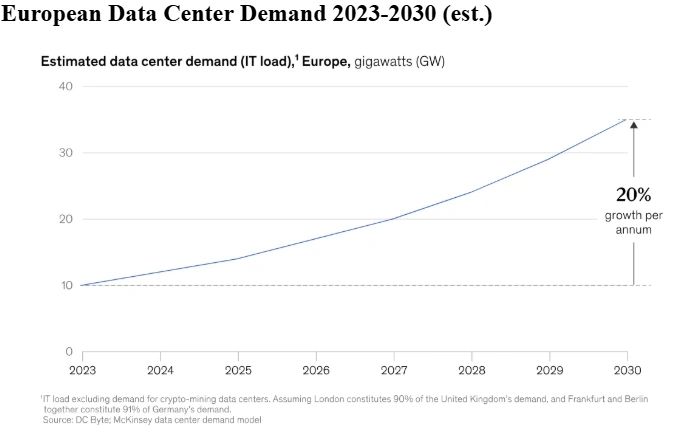
Underlying these trends is a structural shift: AI accelerates server intensity and requires denser compute clusters, magnifying electricity demand. These loads are largely inflexible, baseload-like, and densely concentrated, placing pressure on local grids rather than national averages.
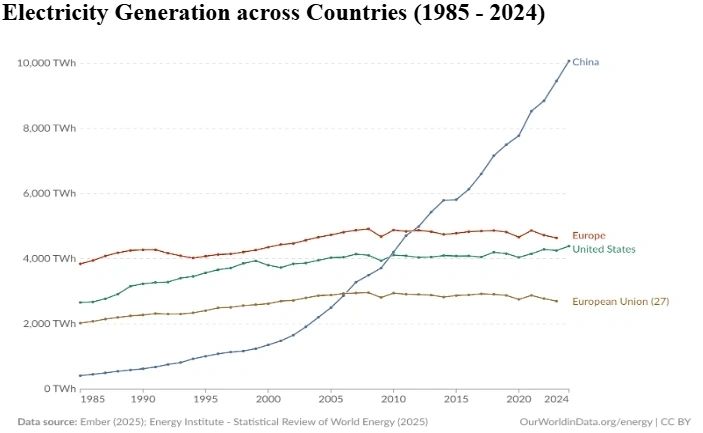
The wider context matters: primary electricity generation varies sharply between the three regions, with China’s steadily increasing electricity generation, currently double that of the US and four times that of the EU (Our World in Data, 2025). This gap is likely to widen further as China continues to accelerate large-scale power-generation capacity additions including wind, solar, hydro, nuclear, and coal.
This divergence affects both the carbon intensity of data centre growth and the feasibility of clean-power expansion. For Europe, the implication is clear: with slower generation growth and tighter supply-demand balances, the EU faces a far more constrained environment for accommodating large-scale, AI-driven electricity loads compared with the US and especially China, making efficient deployment, grid reinforcement, and accelerated renewable build-out essential prerequisites for competitiveness.
Second, Europe, the US, and China are all expanding renewable generation, but their ability to align clean-energy supply with rapidly growing data centre demand diverges significantly. In Europe, operators are scaling procurement of renewable PPAs (Power Purchase Agreements), on-site generation, and participation in flexibility markets (CERRE, 2025), yet persistent permitting delays, limited transmission capacity, and a shortage of dispatchable low-carbon generation create structural constraints. Several EU countries have even imposed temporary limits or conditional approvals on new data center grid connections (Data Center Dynamics, 2025). The region’s continued reliance on natural gas for balancing further underscores its vulnerability as data center loads rise. In the United States, abundant land, large renewable basins (such as Texas solar/wind and Midwest wind), and relatively cheap gas support expansion (Utility Dive, 2024), but the grid remains fragmented and aging. AI-focused clusters in Virginia, Georgia, and Ohio are already straining local infrastructure (BBC, 2025), and the heavy dependence on fossil-fuel generation in many states complicates ambitions for 24/7 clean power. To address these pressures, U.S. federal and state authorities are accelerating grid-modernisation programs, expanding transmission build-out, and supporting utility-scale storage deployment, while hyperscalers increasingly sign long-term clean-energy contracts and co-invest in new renewable and battery projects to reduce reliance on fossil-fuel generation (Reuters, 2025). China’s approach is more structurally coordinated: the “Eastern Data, Western Compute” program relocates non-real-time compute loads to western provinces rich in solar, wind, and hydro (Carbon Brief, 2025), while latency-sensitive workloads remain in eastern hubs. China pairs this with stringent efficiency mandates: PUE (Power Usage Effectiveness) targets of 1.25 by 2025, compared with Germany’s 1.5 mandated from 2027 (Carbon Brief, 2025), giving it a relative advantage in both energy alignment and reduced dependence on fossil fuels.
For Europe, this means that despite its regulatory leadership and strong efficiency focus, the EU faces a critical challenge: its ability to accommodate the next wave of hyperscale data center growth will depend heavily on accelerating low-carbon power generation, improving grid flexibility, and streamlining permitting processes. Without rapid infrastructure and policy adaptation, Europe risks delays in data center deployment, higher electricity costs, and potential relocation of investment to regions like the US or China, where energy supply can better meet large-scale, continuous digital demand.
Lastly, the energy regulatory landscape diverges sharply across the European Union, the United States, and China, each shaping data centre development through distinct governance philosophies. The EU remains the global leader in regulatory sophistication: under the recast Energy Efficiency Directive, it has introduced mandatory reporting requirements and an EU-wide sustainability rating scheme for data centers (European Commission, 2024). Operators must report detailed metrics, including total energy use, PUE (Power Usage Effectiveness), water consumption, and heat-reuse performance into a central EU database, while the EU Code of Conduct for Data centers provides voluntary best-practice guidelines (EU Code of Conduct, 2023). In contrast, the United States follows a fragmented, market-driven approach. Federal oversight remains limited, though the Department of Energy has become increasingly proactive, releasing modelling tools and grid-planning frameworks to help states and utilities manage accelerating AI-driven electricity demand (DOE, 2024). State-level policies vary widely: some jurisdictions offer generous tax incentives and flexible zoning to attract data center investment, whereas others prioritize sustainability requirements and emissions constraints (Alvarez & Marsal, 2025). China’s model is the most centralized, with national ministries coordinating siting decisions, power allocation, and interprovincial transmission. Key policy instruments include performance-based energy quotas, stringent PUE standards, capacity reservations for designated data center clusters, and the large-scale east-west compute redistribution strategy under its “Eastern Data, Western Compute” initiative (Carbon Brief, 2025).
For Europe, this indicates both an advantage and a challenge. While the EU’s sophisticated regulatory framework positions it as a global leader in sustainable data center governance, the fragmented, faster-moving, and often less-regulated models in the US and the highly coordinated, capacity-driven approach in China may attract investment more readily if Europe cannot streamline permitting, support rapid grid and renewable expansion, and maintain competitive incentives. To remain an attractive location for hyperscale data center growth, Europe must complement regulatory rigor with infrastructure readiness and policy agility.
Despite regional differences, a common theme emerges: data center growth is outpacing the expansion of low-carbon electricity and transmission infrastructure. Efficiency improvements like cooling innovation, waste-heat reuse, and advanced chips will help but cannot offset the scale of AI-driven demand. Without rapid policy adaptation and energy-system transformation, future data center deployment in Europe may face mounting constraints including risking delays, energy-price surges, or relocation to the US or China.
This tension between digital expansion and energy transition underscores why energy supply constraints are not merely operational challenges but strategic economic and geopolitical issues.
Investment Constraints
Investment in data centers is a central pillar of national AI strategies. Governments in the US, China, and Europe, along with private-sector companies, have significantly increased funding and investments, with a global increase of 46.8% from 2024 to 2025 (CIO, 2024). Yet each region is pursuing this expansion in its own way, reflecting different priorities and policy frameworks.
In 2025, the global data center market was valued at $527.46 billion and is projected to reach $739.05 billion by 2030, growing at a compound annual growth rate (CAGR) of 6.98% (Statista, 2025). Cloudscene, a global data center directory, maps the distribution of listed data centers, counting 11,800 data centers worldwide. Of these, 5,427 (about 46%) are located in the United States. Germany and the United Kingdom follow as major hubs, contributing to the 2,433 data centers (about 21%) found in Europe, while China lists 449 centers (about 4%). This directory has strong coverage in the US and Europe, but is weak in China, leading to a possibly distorted image. Many Chinese data centers are not publicly listed, as operators often consider facility locations to be sensitive information (Cargoson, 2025). This also shows the high strategic value the Chinese government sets on its AI strategy.
The computational power shows a slightly different picture, as Europe tends to have many smaller facilities, while the United States and China focus on larger hyperscale data centers. As of Q1 2025, global data center capacity reached 122.2 gigawatts of installed IT power (Cargoson, 2025). The United States leads with approximately 53.7 GW, accounting for around 44% of the total global capacity. Europe follows with about 20.8 GW, which is approximately 17% of the worldwide total. China is close behind with roughly 19.6 GW, corresponding to about 16% of global IT power capacity (Cargoson, 2025).

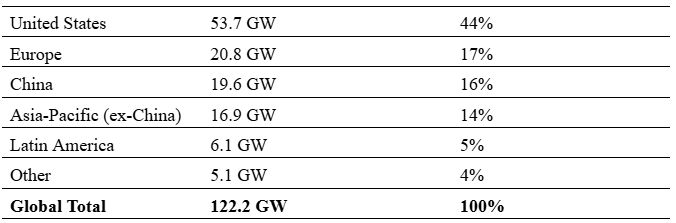
These numbers are only a snapshot and are likely to shift substantially as the US, China, and Europe pursue sharply different strategies for scaling data centre capacity.
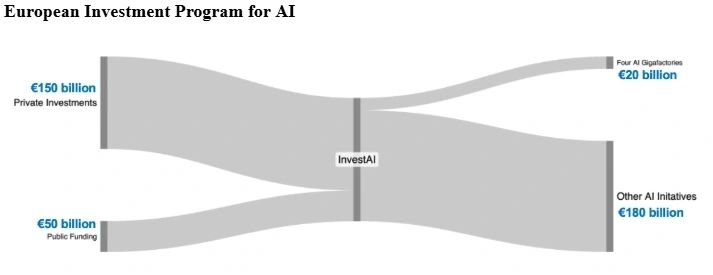
To strengthen its AI sector, the European Union launched InvestAI in February 2025, a €200 billion program aimed at enhancing AI infrastructure, research, and support for startups. This financing model is built on a partnership between the public and private sectors. Of the total funding, €50 billion will come from public sources, including the Digital Europe Programme, Horizon Europe, and InvestEU. Additionally, Member States can contribute resources from their Cohesion envelopes. The remaining €150 billion is expected to be provided by private investors and industry partners (European Commission, 2025). InvestAI will operate as a layered investment fund, incorporating various risk and return profiles to attract a diverse range of investors (EUFundingMAG, 2025). The overall €200 billion package includes €20 billion specifically allocated for the construction of four AI gigafactories, each equipped with approximately 100,000 state-of-the-art AI chips (FinTech Weekly). The goal is to ensure that European companies, regardless of their size, have access to the necessary computational power.
Historically, promising startups have often been acquired by US companies or relocated abroad due to a lack of investment. The EU operates under structural constraints that limit investment and technological ambition with fragmented national markets preventing unity in investment policy, and stringent regulations on labour, innovation and startup development. Risk-taking and experimentation become too costly, preventing European private firms from attracting investment and becoming technological powers. In other words, while a hyperscaler in the US can pursue multiple initiatives knowing that a single major success can offset the losses from the others, the situation is different in the EU. As a result, European firms are far more cautious about investing in a broad portfolio of high-risk ventures. This applies to the development of data centres to respond to the demand, where EU companies face obstacles, reinforcing Europe’s technological dependency on foreign hyperscalers. (Montaigne, 2022) While major data centre investments are being announced around the world, Europe remains far behind the US and China, and it is uncertain whether InvestAI’s incentives can help change that. The coming months will show whether these new initiatives can lead to tangible growth of data centre capacity scaling in Europe (FinTech Weekly).
In the United States, investments are primarily led by private-sector companies, with minimal government influence. The government's role mainly focuses on deregulation; for instance, President Trump repealed a directive from Biden that aimed to regulate
In the United States, investments are primarily led by private-sector companies, with minimal government influence. The government's role mainly focuses on deregulation; for instance, President Trump repealed a directive from Biden that aimed to regulate artificial intelligence (Reuters, 2025). As a result, the US has become home to the largest AI developers, creating a technological autonomy that fosters optimal conditions for private companies to thrive. With a tech-first industrial strategy, it has created optimal conditions for high-risk and high-reward private investment. This environment enables continuous innovation with many startups able to scale into mega-corporations such as Amazon, Alphabet, Meta, Apple, and Microsoft. These hyperscalers finance 75% of the total $200B in US R&D, enabling strong advances in data centre technology. Therefore, the US has a risk-tolerant innovation culture based on portfolio experimentation: firms launch many ambitious projects in the prospect of having one successful venture that can earn great returns. This gives the US a structural innovation advantage: constant push for new technologies and firms that can reinvest massively in R&D. By 2025, private spending on AI data centres, driven by those hyperscalers, is projected to contribute more to US economic growth than consumer spending (Fortune, 2025). Big Tech firms such as Amazon, Alphabet, Microsoft, and Meta have reported plans to spend up to $364 billion in 2025, largely on AI investments (Finance Yahoo, 2025).
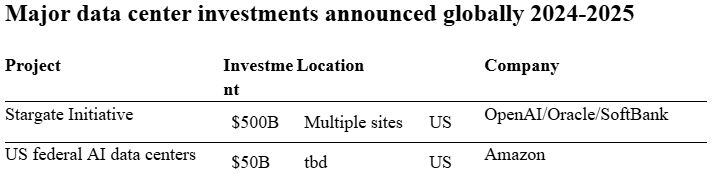
Beyond the hyperscalers, large private consortia are pursuing even more ambitious projects. SoftBank, Oracle, and OpenAI have announced the Stargate project, committing up to $500 billion toward next-generation data centres and supporting infrastructure. Additional investments include Google’s $40 billion AI data centre cluster in Texas, Amazon’s $35 billion expansion in Virginia, and multiple large-scale acquisitions and infrastructure programs worth tens of billions of dollars.
The Chinese government plays a very active role in its AI investment strategy. The government owns all of the major telcos (China Mobile, China Telecom, China Unicom) and controls the private cloud firms (Huawei Cloud, Alibaba Cloud, Tencent Cloud, Baidu AI Cloud). The bottom line is that gigantic Chinese AI data centre investments are effectively government investments, even when the announcements involve companies as investors. This approach facilitates massive aligned investments from both “private” and public sectors, with public institutions offering support in planning and even providing locations for data centres to private actors (MIT Technology Review, 2025). In its approach to consolidate already-existing but dispersed data centres into one unified and linked network, total investments in Chinese AI capital expenditure are projected to be between $84 billion and $98 billion in 2025, representing a potential 48% growth from 2024 levels (Tech Wire Asia, 2025). Of this amount, government and public sector contributions are expected to account for up to $56 billion, or 57% of the total. Unlike the US, where AI spending primarily targets information technology hardware like semiconductors, China's strategy includes all necessary measures to build data centres and provide sufficient energy infrastructure (Tech Wire Asia, 2025). Major investments announced in 2025 include a Xinjiang Desert AI Data-Centre Hub for $48bn in western China, an AI Mega-Cluster for $37bn in and around Wuhu or multiple “East Data, West Compute” Hubs for $33bn (tomsHardware, 2025). All of those investments are led by state-owned telcos, with massive government subsidies and strategically placed locations. In January 2025, the state-owned Bank of China announced an action plan to support the development of the AI industry chain, allocating $102bn in financial support to entities in the AI sector through 2030. The government has also reacted to the US’s trade war by banning foreign artificial intelligence chips from new data centre projects that have received any state funds, one of China's most aggressive steps yet to secure its critical infrastructure and achieve its quest for AI chip self-sufficiency (Reuters, 2025).
The following overview, which does not claim to be complete, illustrates how the global data centre industry is currently experiencing unprecedented investment, with several individual projects exceeding $20 billion. Apart from one investment announcement in China and two in Europe, including the UK, all of them were placed in the United States and China.artificial intelligence (Reuters, 2025). As a result, the US has become home to the largest AI developers, creating a technological autonomy that fosters optimal conditions for private companies to thrive. With a tech-first industrial strategy, it has created optimal conditions for high-risk and high-reward private investment. This environment enables continuous innovation with many startups able to scale into mega-corporations such as Amazon, Alphabet, Meta, Apple, and Microsoft. These hyperscalers finance 75% of the total $200B in US R&D, enabling strong advances in data center technology. Therefore, the US has a risk-tolerant innovation culture based on portfolio experimentation: firms launch many ambitious projects in the prospect of having one successful venture that can earn great returns. This gives the US a structural innovation advantage: constant push for new technologies and firms that can reinvest massively in R&D. By 2025, private spending on AI data centers, driven by those hyperscalers, is projected to contribute more to US economic growth than consumer spending (Fortune, 2025). Big Tech firms such as Amazon, Alphabet, Microsoft, and Meta have reported plans to spend up to $364 billion in 2025, largely on AI investments (Finance Yahoo, 2025).
Beyond the hyperscalers, large private consortia are pursuing even more ambitious projects. SoftBank, Oracle, and OpenAI have announced the Stargate project, committing up to $500 billion toward next-generation data centers and supporting infrastructure. Additional investments include Google’s $40 billion AI data center cluster in Texas, Amazon’s $35 billion expansion in Virginia, and multiple large-scale acquisitions and infrastructure programs worth tens of billions of dollars.
The Chinese government plays a very active role in its AI investment strategy. The government owns all of the major telcos (China Mobile, China Telecom, China Unicom) and controls the private cloud firms (Huawei Cloud, Alibaba Cloud, Tencent Cloud, Baidu AI Cloud). The bottom line is that gigantic Chinese AI data center investments are effectively government investments, even when the announcements involve companies as investors. This approach facilitates massive aligned investments from both “private” and public sectors, with public institutions offering support in planning and even providing locations for data centers to private actors (MIT Technology Review, 2025). In its approach to consolidate already-existing but dispersed data centers into one unified and linked network, total investments in Chinese AI capital expenditure are projected to be between $84 billion and $98 billion in 2025, representing a potential 48% growth from 2024 levels (Tech Wire Asia, 2025). Of this amount, government and public sector contributions are expected to account for up to $56 billion, or 57% of the total. Unlike the US, where AI spending primarily targets information technology hardware like semiconductors, China's strategy includes all necessary measures to build data centers and provide sufficient energy infrastructure (Tech Wire Asia, 2025). Major investments announced in 2025 include a Xinjiang Desert AI Data-Center Hub for $48bn in western China, an AI Mega-Cluster for $37bn in and around Wuhu or multiple “East Data, West Compute” Hubs for $33bn (tomsHardware, 2025). All of those investments are led by state-owned telcos, with massive government subsidies and strategically placed locations. In January 2025, the state-owned Bank of China announced an action plan to support the development of the AI industry chain, allocating $102bn in financial support to entities in the AI sector through 2030. The government has also reacted to the US’s trade war by banning foreign artificial intelligence chips from new data center projects that have received any state funds, one of China's most aggressive steps yet to secure its critical infrastructure and achieve its quest for AI chip self-sufficiency (Reuters, 2025).
The following overview, which does not claim to be complete, illustrates how the global data center industry is currently experiencing unprecedented investment, with several individual projects exceeding $20 billion. Apart from one investment announcement in China and two in Europe, including the UK, all of them were placed in the United States and China.
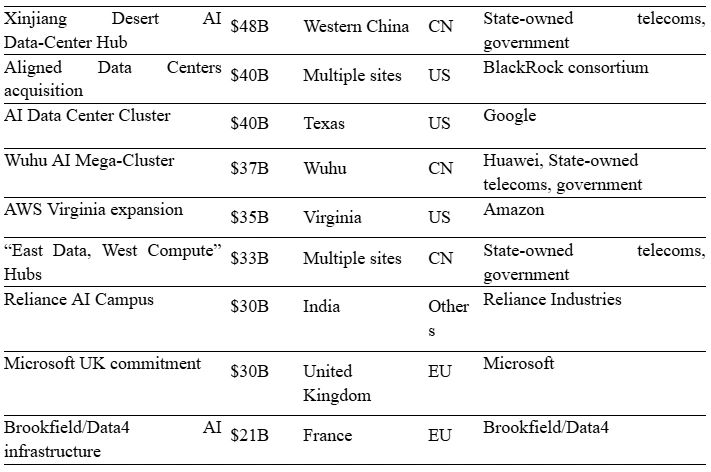
Recently announced investments in Europe, such as Schwarz Group's €11 billion investment in Lübenau, Google's €5.5 billion in mainly Frankfurt, and the €1 billion partnership between NVIDIA and Telekom in Munich, are just a small fraction of what is needed. These figures highlight how significantly the EU is falling behind the United States and China in terms of investment capital.
Technological Dependence
Data centres’ competitiveness depends on private investment capacity and technological autonomy. Europe is lagging behind on both; the private sector is investing far less than competitors in China and the US, and European firms are increasingly outsourcing elements of data centre infrastructure to cheaper foreign providers. These two processes reinforce each other: dependency reduces incentive to invest, and under-investment deepens dependency. However, private capital is the decisive force for the global AI scaling race.
The first gap is in the data centre build-out, determining who governs the digital economy. Europe hosts large shares of global data centres but doesn’t control most of their infrastructure and value chains underpinning cloud and AI. The US and China dominate technologically with the most efficient chips, servers, cloud stacks, and training clusters, creating a European dependency on these products.
The US controls the most technologically developed parts of the global digital value chain with semiconductor innovation, hyperscale cloud platforms, and frontier AI compute. Indeed, US hyperscalers represent 44% of the global Information Technology, technology to manage and store data, power capacity, giving them the ability to train clusters and be fully autonomous in the development of data centres from the chip design, to the infrastructure, and the cloud to the AI services themselves (Cargoson, 2025). Therefore, Europe is extremely reliant on the US digital supply chain. Focusing on Europe, US hyperscalers represent the primary foreign builder of European digital infrastructure. In 2024, US hyperscalers invested $113 billion in European information services and $29.7 billion in hardware (CEPA, 2025). This process stimulates the European economy, with Apple employing more than 1.7 million European employees for its development, and Google’s multibillion-euro investment in Poland is projected to boost its GDP by 8% (CEPA, 2025). Therefore, Europe becomes increasingly dependent on the US, not only on data centre technology but also on the hyperscaler’s presence to stimulate the economy. The US is gaining control over Europe’s cloud and AI data centres.
China has developed a contrary approach, aiming to be self-reliant technologically, notably in the construction of data centres. Chinese hyperscalers, such as Alibaba and Huawei, invest more than 70 billion dollars each year in AI infrastructure to ensure their dominance and autonomy in AI (Goldman Sachs, 2025). Investment is not as important as in the US; China compensates with quick development and political alignment in the technology industry. Therefore, China’s dominance in data centres’ expansion expresses itself through domestic infrastructure scale, with over 500 AI-oriented computing centres, and global expansion, with the Digital Silk Road. China is building data centres across continents, in Asia, the Middle East, and Latin America, gaining significant soft power by applying its standards and governance internationally (Goldman Sachs, 2025). By doing so, China creates a global standard of chips, cooling systems, and networking equipment that Europe can’t meet and therefore has to depend on.
Overall, Europe is disadvantaged by the limited development of chips and servers, which it has imported from the US and China, as well as high operational costs averaging €8.4 million per MW (Puppe, 2024). The US dominates in Europe’s cloud and data centre infrastructure, while China leads in the global supply chain, spreading its influence through the development of data centres. Europe is in between these two models: being reliant on US platforms while exposed to Chinese technological development, without its own integrated system, and having a strong disadvantage in data centre build-out.
The R&D weakness and limited infrastructure build-out lead to the second gap: technology supply-chain dependency. European firms cannot invest in technologies for data centres because there is no innovation in the key elements of their infrastructure, and limited capital. Therefore, dependency reduces the incentive to build data centres, and under-investment pushes towards outsourcing.
First, Europe depends on advanced chips from US and Taiwanese companies because it does not have its own leading semiconductors. Semiconductors are the foundational materials and manufacturing technologies used to fabricate microchips. Therefore, without semiconductors, Europe cannot design its own AI accelerators to train large-scale models. This creates a structural dependency which exposes Europe to geopolitical constraints, especially in times of geopolitical tightening in the US, and disincentivizes domestic investment. Second, Europe has become dependent on foreign cloud providers, with 70% to 80% of European cloud workloads hosted by AWS, Microsoft Azure, and Google Cloud (Synergy Research Group, 2025). This is contrary to Europe’s fragmented sovereign cloud initiatives, cloud services that intend to ensure European data stays inside Europe and under European jurisdiction. As a result, revenues generated by European digital activity flow back to US hyperscalers that dominate the cloud industry. European dependency on foreign cloud raises issues of security because government and corporations' sensitive workloads are controlled by foreign infrastructure, especially in fintech. In turn, European private capital doesn’t invest in domestic cloud and AI infrastructure, because the revenues flow to foreign providers. Third, Europe's dependency on China for raw materials and manufacturing has exposed it to geopolitical risks. China dominates the production of batteries, servers, and networking equipment and controls logistics, holding stakes in at least 15 major European ports and 90 freight hubs, embodying an important role in Europe's energy, infrastructure, and data centres (ASCAME, 2024). Therefore, Europe cannot secure supply during geopolitical crises, resulting in an unstable system, which can be hit harder economically in the case of the rupture of economic ties. In conclusion, these structural dependencies prevent Europe from relying on private capital to have sovereignty over AI and its data centres, lacking the technological foundations.
Conclusion
From an energy perspective, Europe’s ability to expand its data centre capacity sustainably is constrained by limited dispatchable low-carbon generation, permitting delays, and transmission bottlenecks. The EU’s continued reliance on natural gas for balancing further limits flexibility, while the rapid growth of AI-driven compute demand threatens to outpace the pace of grid upgrades and renewable deployment. These energy constraints compound Europe’s strategic dilemma: even if it chooses to remain neutral in the AI rivalry, its capacity to host hyperscale data centres, key infrastructure for AI competitiveness, will depend on accelerating clean-power expansion, improving grid flexibility, and streamlining regulatory approvals.
Europe finds itself in a difficult position with regard to its investment strategy. With its 27 member states and various stakeholders involved, it cannot strategically pool all its investments and lags far behind the US and China in terms of investment amount. Although there is high demand for computing power in Europe, it is not seen as the most attractive market for private-sector companies. Furthermore, scaling start-ups in Europe is considerably more difficult. The EU's initiatives, such as InvestAI, are recognizable and make efforts to improve the situation, but they only contribute modestly to competitiveness against China and the US.
Moreover, Europe is also facing data centre technological dependency: It has a strong reliance on foreign hardware, that spans the entire supply chain, from advanced chips and networking equipment to cloud management software and large-scale training clusters, leaving European firms unable to shape standards, capture value, or control strategic infrastructure. Consequently, Europe risks becoming a passive consumer of external technologies rather than an active participant in shaping the digital economy.
Overall, Europe is becoming increasingly dependent and technologically behind in growing into a data centre power. Therefore, Europe will have to align with China or the US, the leaders, to stay at the top in the technology realm. China has conflicting values with Europe, as a self-reliant dictatorship, while the US is shifting to an isolationist policy; Europe’s future is uncertain.
Bibliography
Alvarez & Marsal. (2025). Powering Data Centers: The State of the States. https://www.alvarezandmarsal.com/sites/default/files/2025-07/Powering%20Data%20Centers%20-The%20State%20of%20the%20States_0.pdf
ASCAME. (2024). Europe’s economic dilemma: Trapped between China’s industry and America’s tech. https://www.ascame.org/europes-economic-dilemma-trapped-between-chinas-industry-and-americas-tech/
BBC. (2025). A humming annoyance or jobs boom? Life next to 199 data centres https://www.bbc.co.uk/news/articles/c93dnnxewdvo
Carbon Brief. (2025). Explainer: How China is managing the rising energy demand from data centres. https://www.carbonbrief.org/explainer-how-china-is-managing-the-rising-energy-demand-from-data-centres/
Cargoson. (2025). Number of data centers by country. https://www.cargoson.com/en/blog/number-of-data-centers-by-country
CERRE. (2025). Flexibility for data centres and electricity systems https://cerre.eu/wp-content/uploads/2025/05/CERRE-Report_Flexibility_Final.pdf
Center for European Policy Analysis. (2025). Tech 2030: A roadmap for Europe–US tech cooperation. https://cepa.org/comprehensive-reports/tech-2030-a-roadmap-for-europe-us-tech-cooperation/
CIO. (2024, October 24). Gartner projects major IT spending increases for 2025. https://www.cio.com/article/3587053/gartner-projects-major-it-spending-increases-for-2025.html#:~:text=Gartner%E2%80%99s%20new%202025%20IT%20spending%20projection%2C%20of%20%245.75,2024%20in%20anticipation%20of%20generative%20AI%20infrastructure%20needs
Data Center Dynamics. (2025). Irish data centers missing out on investment due to power policy, industry chief says. https://www.datacenterdynamics.com/en/news/irish-data-centers-missing-out-on-investment-due-to-power-policy-industry-chief-says/
EUFundingMAG. (2025). EU funding for your project. https://eufundingconsulting.eu/
European Commission. (2024). Commission adopts EU-wide scheme rating sustainability of data centres. https://energy.ec.europa.eu/news/commission-adopts-eu-wide-scheme-rating-sustainability-data-centres-2024-03-15_en
European Commission. (2025, February 11). EU launches InvestAI initiative to mobilise €200 billion of investment in artificial intelligence. https://digital-strategy.ec.europa.eu/en/news/eu-launches-investai-initiative-mobilise-eu200-billion-investment-artificial-intelligence
FintechWeekly. (2025, February 15). EU's InvestAI Initiative: Can €200 Billion Close the AI Gap with the U.S. and China? https://www.fintechweekly.com/magazine/articles/eu-investai-initiative-can-200-billion-close-the-ai-gap-with-us-and-china?utm_source=northatlantic.fi
Fortune. (2025, August 6). Spending on AI data centers is so massive that it’s taken a bigger chunk of GDP growth than shopping—and it could crash the American economy. https://fortune.com/2025/08/06/data-center-artificial-intelligence-bubble-consumer-spending-economy/
Goldman Sachs. (2025, November 3). China’s AI providers expected to invest $70 billion in data centers amid overseas expansion. https://www.goldmansachs.com/insights/articles/chinas-ai-providers-expected-to-invest-70-billion-dollars-in-data-centers-amid-overseas-expansion
IEA. (2024). Energy demand from AI. https://www.iea.org/reports/energy-and-ai/energy-demand-from-ai
IE University, Center for the Governance of Change. (2025, April 10). Reducing Europe’s technological dependencies through strategic indispensability. https://www.ie.edu/cgc/news-and-events/news/reducing-europes-technological-dependencies-through-strategic-indispensability/ ie.edu
Joint Research Centre (JRC). (2023). EU Code of Conduct for Data Centres: Toward more innovative, sustainable and secure data-centre facilities. https://joint-research-centre.ec.europa.eu/jrc-news-and-updates/eu-code-conduct-data-centres-towards-more-innovative-sustainable-and-secure-data-centre-facilities-2023-09-05_en
McKinsey & Company. (2024). The role of power in unlocking the European AI revolution. https://www.mckinsey.com/industries/electric-power-and-natural-gas/our-insights/the-role-of-power-in-unlocking-the-european-ai-revolution
MIT Technology Review. (2025, March 26). China built hundreds of AI data centers to catch the AI boom. Now many stand unused. https://www.technologyreview.com/2025/03/26/1113802/china-ai-data-centers-unused
Montaigne. (2022, December 5). Digital Tech: Europe's Growing Gap in Eight Charts. https://www.institutmontaigne.org/en/expressions/digital-tech-europes-growing-gap-eight-charts#:~:text=In%20terms%20of%20R%26D%20invested,considered%20European%20in%20this%20ranking
Our World in Data. (2025). Total Electricity Generation https://ourworldindata.org/grapher/electricity-generation?tab=line&country=OWID_EUR~CHN~USA~OWID_EU27
Puppe, C. (2024). The multi-billion euro race for digital supremacy in Europe. LinkedIn. https://www.linkedin.com/pulse/multi-billion-euro-race-digital-supremacy-europe-christoph-puppe-xvtye/
Reuters. (2025, November 5). Exclusive: China bans foreign AI chips from state-funded data centres, sources say. https://www.reuters.com/world/china/china-bans-foreign-ai-chips-state-funded-data-centres-sources-say-2025-11-05
Reuters. (2025). US grid investors focus on demand hotspots in planning shift https://www.reuters.com/business/energy/us-grid-investors-focus-demand-hotspots-planning-shift--reeii-2025-10-20/
Reuters. (2025). Trump revokes Biden executive order on addressing AI risks. https://www.reuters.com/technology/artificial-intelligence/trump-revokes-biden-executive-order-addressing-ai-risks-2025-01-21/
Statista. (2025). Data Center - Worldwide. https://www.statista.com/outlook/tmo/data-center/worldwide
Synergy Research Group. (2025, July 24). European cloud providers’ local market share now holds steady at 15%. https://www.srgresearch.com/articles/european-cloud-providers-local-market-share-now-holds-steady-at-15
TechWire Asia. (2025, June 26). China to deploy $98bn in AI investment this year amid US tech rivalry. https://techwireasia.com/2025/06/china-ai-investment-98-billion-2025-us-rivalry/
tomsHardware. (2025, September 22). $37 billion 'Stargate of China' project takes shape — country is converting farmland into data centers to centralize AI compute power. https://www.tomshardware.com/tech-industry/artificial-intelligence/china-is-converting-farmland-into-data-centers-as-part-of-usd37-billion-effort-to-centralize-ai-compute-power-project-dubbed-stargate-of-china
U.S. Department of Energy. (2024). DOE releases new report evaluating increase in electricity demand from data centers. https://www.energy.gov/articles/doe-releases-new-report-evaluating-increase-electricity-demand-data-centers
Utility Dive. (2024). Big Tech is upending the clean energy landscape https://www.utilitydive.com/news/big-tech-amazon-google-microsoft-meta-upending-clean-energy-landscape-renewables-nuclear/729082/
Yahoo!finance. (2025, August 1). Big Tech's AI investments set to spike to $364 billion in 2025 as bubble fears ease. https://finance.yahoo.com/news/big-techs-ai-investments-set-to-spike-to-364-billion-in-2025-as-bubble-fears-ease-143203885.html