
“I used to know your great-grandfather”: Masculinity through time
9 min read · 1,873 words
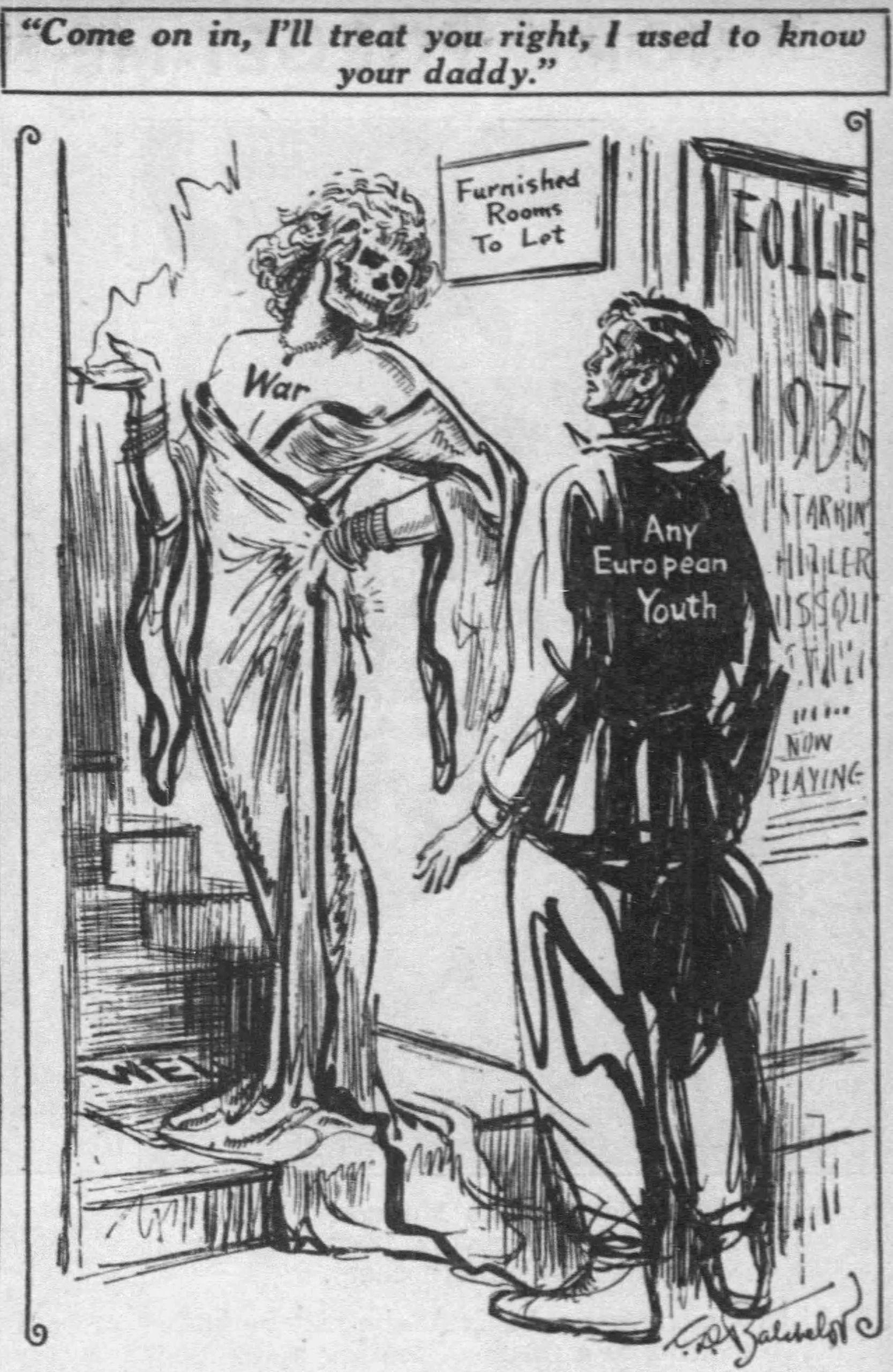
Europe hinges at the likely end of a long period of peace. An age of stability and prosperity that, sadly, seems to be approaching its conclusion. While this fate seemed clear ever since the beginning of the year, with tensions amongst our allies and European nations such as Sweden and the Netherlands issuing booklets to citizens on how to behave in a military conflict, the recent weeks have seen the beginning of a new war that may, very soon, involve our home too. Although there is undoubtedly much that in many cases has already been said, the topic is usually discussed from a perspective grounded in economics, military spending, and infrastructure.
However important those outlooks are in order to maintain a relative sense of order, I believe we must also look at European cultural trends, as they pertain to armed conflict and militarization. Based on some researchers' work, I will be reflecting on this subject, as I have come to notice this issue. We can easily draw parallels between current trends and many academic analyses of culture in the years leading up to the Great War. There, for example, they identified definite traits of militarization and toxic masculinity as partial causes for the armed conflict. Today, many concerning factors suggest that we may be slowly becoming, once again, similar to the sort of culture that embraces armed conflict and glorifies the loss of life and the heroic persona of soldiers, represented by war.
First, we can observe these factors within the primary sources of the time. Usually, when discussing World War I, we mostly focus on purely pragmatic components: tactics, logistics, weaponry, politics, and so forth. As soon as we look at the artists and cultural exponents of the so-called “lost generation”, the shadow of a different problem appears to loom over the conflict: the lionization of war.
On both sides of the conflict, we can see a feeling of disenfranchisement with the ideals and glory sold to the young recruits, whether that be amongst the Allies, with Wilfred Owen’s Dulce et decorum est espousing that “If you could hear, at every jolt, the blood come gargling from the froth-corrupted lungs, [...] My friend, you would not tell with such high zest to children ardent for some desperate glory, the old Lie: dulce et decorum est pro patria mori.”, or amongst the Central Powers, where Enrich Maria Remarque explains in All Quiet on the Western Front, “While they went on writing and making speeches, we saw field hospitals and men dying: while they preached the service of the state as the greatest thing, we already knew that the fear of death is even greater.”.
While for statesmen it may have been a war of borders, and for strategists one of attrition, we often forget that for soldiers it was a war of duty. A task that, they’d been told, would turn boys into men and men into heroes, playing on men’s “natural” tendency of care and protection being attached to strength and power. In fact, failure to die for one’s country was often seen as a sign of cowardice and weakness, as we can observe from the public outrage against the veterans of Caporetto in post-war Italy: to die in war ennobles, but to return defeated (not to mention often mutilated, which significantly decreased the options for reintegrating into civil society) was unacceptable. We can thus clearly construe from primary observations that the Great War was partially perceived to be a consequence of the culture that had brewed in Europe over the first years of the 20th century, and its attitude towards militarism.
There is another important point to be made regarding the figure of the soldier in the Great War. As many academics have noted, the militaristic culture of the time was born as an answer, and in some ways a cure, to a “crisis of masculinity” that had been perceived in the west in the previous decades. As noted by Rachel Zack (2022), the figure of the soldier can be seen as a counterpoint to the major two perceived threats to masculinity in the culture of the time: white collar culture, and the feminist movement for suffrage.
Militarism, then, provides a counterpoint to the former in that it is imagined to be an environment that can turn boys into “hard” and “traditional” men, as opposed to the “softened” office workers of the early 20th century, which authors such as Crosland had portrayed as a weakened product of the times.
Analysing militarism as a counterpoint to the latter, we see a much more complex system is at play. In the political theory of the early modern period, military service had been inextricably tied to citizenship: the 19th century’s series of political upheaval, civil wars, and revolutions, had been built on the inherent promise that serving one’s country would result in a higher standard of privilege and political standing. It is obvious how this aptitude would mesh with a perceived threat against those very same privileges, and especially one coming from people who were not granted access to military service.
Great Britain can be taken as a well documented example of how propaganda began circulating in the years before the entrance into conflict, targeting specifically young boys and alluring them with rethorics steeped in these two perceived threats, from boarding schools “making men, not bookworms”, and encouraging boys to take part in school-based tribalism; to recruitment posters utilizing slogans such as “Women of Britain say - Go!” and pushing on the gender issue, portraying “weak” and “effeminate” women that the hardy boys of Britain had to enlist to protect. If one wants a testament to the success of such targeted cultural propaganda, it can be partly found within the constant influx of volunteers over the first two years of the war: it wasn’t until 1916 that Britain had to resort to conscription for its soldiers.
As observed by these studies and data (Zack 2022, Nye 2007, Romer 2005, Mackenzie & Foster 2017), there is a strong case to be made that militarism and toxic masculinity are not two separate cultural traits, but rather a cause-and-effect. The perceived threat to masculinity and traditional gender structures results in too much emphasis on the link between civic freedoms and civic service and duty to the homeland, leading to a culture that lionizes war, a culture that forms its young into perfect soldiers, and eventually, a culture that willingly heads into open warfare, having been long primed for it.
Having thus established the historical relevance of such factors within the beginning and development of the Great War, we can now move to discussing current cultural trends and issues, and whether they seem to align with what we have identified within history. Much has been said academically about the modern incarnation of toxic masculinity. It has been a hot button issue within academia for years now, and yet it has remained on the rise. While most scholarship on the subject focuses on the United States or on general international trends, we can make a twofold case for why it should be a concern within Europe too. Firstly, as with most movements, subcultures and trends, the widespread use of social media has made diffusion and homogeneity much easier across distances and continents. The spaces of the so-called “manosphere” are not physical (and thus geographically limited) ones, but rather digital forums and channels to which anyone from any point of the globe can be subject. As such, general analyses of ideologies can be assumed to hold somewhat similarly across the world. Secondly, we find proof of this within poll results. A recent study by King’s College London has identified a significant spread of reactionary ideologies within Gen Z in a sample of countries, many of which are European. Statements such as “We have gone so far in promoting women’s equality that we are discriminating against men” (which was agreed to by 46% of sampled men in Italy, 37% in Germany, 43% in France, and 60% in Spain, to name a few), or “Young men should try to be physically tough, even if not naturally big” or “A husband should have the final word on important decisions made in his home” all ranked highly popular, especially with the youth, and serve as an important proof of how European culture is, more than in decades prior, embracing traditional and normative attitudes.
Having established that such ideologies do exist in Europe, and that, as shown in King’s College’s study, they are in fact on the rise, we must now ask: does the current manosphere exhibit the traits we identified above in early 20th century culture, and is it therefore of the kind that leads nations to more aggressive political positions? Rachel Zack, as quoted above from Masculinities in Crisis: Manhood at War (2022), identified two key components of aversion that turned mere toxic masculinity into its pro-military form: firstly, a feeling of dissatisfaction with the state of the job market, mostly linked to the feeling that the jobs offered are no longer “masculine”. While less obvious than its 1900s counterpart, the modern manosphere also displays such ideas, as exemplified by its focus on investments, multi-level-marketing “get rich quick” schemes, and terms such as “rat race” for the “normal” types of employment. The second, and perhaps more obvious one, was a reaction and opposition to social progress and victories achieved by the left. As shown by the King’s College polls, the recent decades have, in fact, garnered significant support for statements such as “When it comes to giving women equal rights with men, things have gone far enough in my country” and “Men are being expected to do too much to support equality”. This movement is in fact characterized by a sense of frustration and of disappointment with regards to perceived social promises, and most importantly a distinct widespread feeling of having been left behind.
While the mere appearance of a pattern is not itself indication of causation, the fact remains that, when taking together the full picture of studies and analyses about the cultural movements behind World War I, and the current movements burning across Europe, many similarities begin to appear. In considering the future of Europe in a military context, I believe it would be unwise to discount them altogether.
Bibliography
Zack, R. (2022), Masculinity in Crisis, Manhood at War, Living Histories: A Past Studies Journal, 1(1)
Nye, R. A. (2007). Western Masculinities in War and Peace. The American Historical Review, 112(2), 417–438. http://www.jstor.org/stable/4136608
Roper, M. (2005). Between Manliness and Masculinity: The “War Generation” and the Psychology of Fear in Britain, 1914–1950. Journal of British Studies, 44(2), 343–362. https://doi.org/10.1086/427130
McCARTNEY, H. B. (2014). The First World War soldier and his contemporary image in Britain. International Affairs (Royal Institute of International Affairs 1944-), 90(2), 299–315. http://www.jstor.org/stable/24538556
Domeier, N. (2014). The Homosexual Scare and the Masculinization of German Politics before World War I. Central European History, 47(4), 737–759. http://www.jstor.org/stable/43965084
MacKenzie, M., & Foster, A. (2017). Masculinity nostalgia: How war and occupation inspire a yearning for gender order. Security Dialogue, 48(3), 206–223.
King’s College London, 2026 International Women’s Day Global Charts