
India-EU FTA: Underlying Contentions in a Global North-South Cooperation
Background
29 min read · 5,779 words
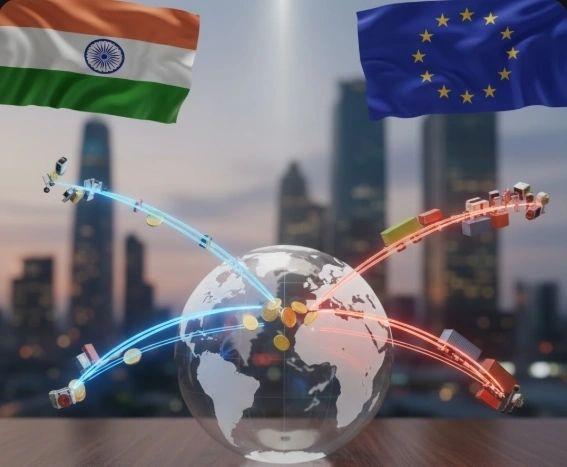
Pliny the Elder in his book Naturalis Historia lamented about the decline in Roman gold reserves due to excessive luxury imports from India such as textiles, spices, silk and pearls, calling India ‘the sink of world’s gold’. Indian goods have always been demanded in Europe and, with the facilitation of land routes, through Arab traders. Both (sub)-continents have traded technology and goods for time immemorial, such as the decimal system and the concept of zero coming from India. Since industrialization and subsequent colonial control in India, there has been a major economic power imbalance between both regions with Europe in general being the center of economic power of the world and India was relegated to being a raw material factory and final good consumer, a system constructed by the British government to benefit English manufacturing firms.
After India gained independence for the UK, it chose to remain non-aligned between the two major powers of the time, the West and USSR, but had a stronger alignment with the USSR, while its adversary, Pakistan, chose to align strongly with the western powers. This birthed the stringent but mutually beneficial relations between India and the newly formed EEC. Diplomatic relations were formalized in early 1960s but tangible deepening in politico-economic ties began after India liberalized its markets in the early 1990s with a Joint Political and Co-operation Statement being signed in 1993 and 1994 with the EU respectively and a formalization of the relationship to “Strategic Partners” in 2004. Multiple summits were held in the following decade under the leadership of the Barroso Commission in Europe and Former Prime Minister Manmohan Singh in India.
A critical moment in the deepening of economic relations was the commencement of EU-India FTA talks in 2007. Multiple chapters were negotiated in 15 rounds between Brussels and New Delhi including Trade in Goods, Services, Investment, Sanitary and Phytosanitary Measures, Technical Barriers to Trade, Trade Remedies, Rules of Origin, Customs and Trade Facilitation, Competition, Defense, Government Procurement, Dispute Settlement, Intellectual Property Rights & Geographical Indications, Sustainable Development. Although there were broad agreements on less controversial chapters, the recent Euro-crisis and upcoming elections within EU as well as upcoming elections in India with the incumbent administrations being deeply unpopular made tougher concessions improbable from both European and Indian perspective. After 15 rounds of deliberations, talks stalled after 13th May 2013 and remained in limbo until 2022.
EU-India Trade and Technology Council was established after EU Commission President Ursula Von Der Leyen’s April 2022 visit to India, effectively reigniting intentions for trade talks. European Commission Executive Vice President Valdis Dombrovskis and Indian Commerce Minister Piyush Goyal at the helm, on 17th June 2022 reignited talks with both parties agreeing on a completion timeline within 2023 starting with an Investment Protection Agreement and Geographical Indicators Agreement. In 2021, before the FTA talks, EU was already India’s 3rd largest trade partner with €88 billion worth of trade in goods which occupied 10.8% of India’s total trade in goods while India remained the 10th largest partner occupying 2.1% of EU’s trade in goods. Between 2017- 2020, EU’s FDI in India grew 37.1% to €87.3 billion while India constituted €30.4 billion of trade in services for the EU.
Geopolitical Context of the ‘Reignition’ of Trade Talks
Talks between India and Europe had stalled due to fundamental roadblocks within strategic positioning of both economies blocking way for meaningful negotiations, but the global economic space has shifted significantly since the election of Donald Trump in 2016. He ushered in, even in his first term, an era of economic protectionism especially against China, but also targeting the EU. An instance of specific target on EU goods was the imposition of “counter‐measures” of about US$7.5 billion annually on EU goods for Airbus subsidies, where the claim arose from subsidies and exemptions given to Airbus as a competitive advantage against US-made Boeing. The EU as a retaliatory measure imposed tariffs on about US$4 billion worth of U.S. goods (15% duty on aircraft, 25% on other products). Although this particular dispute was resolved in June 2021, under the Biden Administration, there was an increasing protectionist movement in the US with another campaign for re-election launched by Donald Trump, with protectionist measures being a core feature of the campaign message. The EU needed to diversify its trade networks as overreliance on the US may incur a concentration risk towards a party that is increasingly choosing political isolationism and economic protectionism.
Within the same purview, China and its economic and geopolitical rise has been a matter of concern for the EU as it remains aligned with an adversary of the EU that had recently attacked Ukraine, Russia. China has also increased its assertiveness within its region, especially in the South China Sea targeting Taiwan in particular, which is the largest producer of semiconductor chips in the world. China had been the largest exporter for the EU occupying 20.8% of goods in 2022 and the 2nd largest overall trade partner behind the US, while also being the 3rd largest importer of EU goods with 9.8% of EU goods being exported to China. The EU primarily purchases relatively cheaper machinery and electricity as well as furniture and automobiles from China; as China grows more politically and economically assertive, the EU needs a diverse source to import cheaper production goods from.
With the Russian invasion of Ukraine in February 2022, a barrage of sanctions on Russia shook global supply chains inducing inflationary pressure within the EU, especially in the energy market, and this is where India also holds an adversarial yet beneficial position against the EU. India has a complicated relationship with China as it still remains the largest exporter of goods to India comprising 15.06% of exports to India, while also remaining a geopolitical adversary. China holds strong military and economic ties with Pakistan and has supported its military actions in Kashmir, while also disputing Indian claims over parts of the heavily militarized Jammu and Kashmir as well as Arunachal Pradesh region of India. Although diplomatic relations had been stringent for decades, the Doklam Valley clash of 2020 represented a rock-bottom of India-China relations. While the relations have improved since then, China’s increasingly assertive moves in India’s northeastern regions has forced India to rethink the leverages that China holds against India, which largely exist in the context of a trade deficit $85.1 billion in 2023-24, accounting for 35% of India’s total trade imbalance.
In the context of Russian alignment, India holds the status of being second largest purchaser of Russian Crude Oil, behind China, which it refines within its refineries and exports to a diverse group of nations, including the EU. India has acted as a back-channel for Russian refined oil and its position as such has been vital to stabilize global oil prices as Russia remains the third largest producer of global crude oil production occupying 12% of global market share. With the current government in India strongly aligning with the refinery industry with PM Narendra Modi having long-term ties with the Reliance Group, and the largest oil refinery in the world, in Jamnagar, owned by the Reliance Petroleum, there is little political will in Indian administration to reconfigure this supply chain as it benefits an ally of the administration as well as stabilizing energy prices for 1.4 Billion India people (although the latter retain the status of being secondary beneficiaries of this system). We do observe, that this year, as this supply chain was antagonised by Donald Trump with a 25% additional tariff on Indian goods as punishment for rerouting Russian oil on top of the 25% liberation day tariffs, has only strengthened the Indian administration’s political will to diversify its trade partners and remain strategically independent.
Subsequently, an FTA with India gives the EU strong economic leverage while deepening political ties while also shifting India politically away from the Russian-sphere of influence. The EU sees India as a growing democratic economy with the largest absolute consumer-base in terms of population in the world. India has been growing between ~6-8% for the past few decades as it holds strong demographic capital and resources. Indian technology and services have led the growth which created a strong upper-middle class with a high willingness to pay. As global trade becomes increasingly fragmented, EU sees India as an independent agent with strong incentives to diversify its own production chains which has strong economic ties with EU’s geopolitical adversaries, namely Russia, that it can steer away India through trade ties. Looking at the current status of EU-India relations, we can clearly observe that solely trade negotiations have induced an increment within trade between parties as the trade of goods between EU and India is projected to be around €120-130 billion, an increase of ~36-47% from 2021 relative to ~2% growth in trade of goods between 2017 and 2021.
The forces that are inducing the FTA to be a strategic imperative seem to have increased in variety and magnitude. Trump’s 2nd term has been a pivotal moment in global trade policy as his economically and legally questionable unilateral tariff regime imposed on its trade partners has been a significant reconfigurative force. The formula used to calculate specific tariffs on nations did not reflect sound economic policy as even the goals of the administration, which were to reduce other economies taking advantage of the US’s consumer markets without buying US products, were not met. Brazil, one of the few net importers for the US, was assigned the minimum 10% tariff rate, while the EU was assigned a 20% tariff rate on all goods. The EU has since renegotiated the rate down to 15%, which still remains more than 10 times the previous average of 1.47% on European goods. This has confirmed the fears of a global trade realignment feared during the first Trump administration as the US, the largest trade partner for both India and the EU changes its economic strategies. Furthermore, Indian goods were assigned a 25% base tariff rate which was increased to 50% in August 2025 with the additional 25% as a punitive measure for Russian Oil purchases. It is questionable if this will act as a deterrent from Indian oil purchases as a base 25% liberation day ‘retaliatory’ tariff already removes a lot of trade leverage which could have been used to strong-arm India into pausing Russian Oil purchases. This also forces India to diversify its export partnerships and as EU-India trade talks have deepened the economic ties between nations, it has become imperative to both parties to conclude the negotiations as soon as possible.
Conflicting Chapters
Carbon Border Adjustment Mechanism
After the 14th round of negotiations as the Sanitary and Photosanitary (SPS) chapter was closed, 12 chapters of negotiations have been closed and furthermore, other chapters have been agreed upon in principle. There are still significant divergent positions that need deeper deliberations or change in strategic positioning for certain chapters to be concluded. A significant strategic divergence is the EU’s Carbon Border Adjustment Mechanism (CBAM) within the Trade and Sustainable Development Chapter (TSD) as the EU has rejected the Indian request for exemption from CBAM tax. CBAM aims to assist the heavy industry in Europe with levelling the playing field as they are subjected to emissions charges within the EU market who have to buy permits to emit carbon based on market prices, currently about €80/ton. EU has suggested the Indian government to introduce a domestic carbon pricing scheme in order to renegotiate an deduction on CBAM not an exemption, while India requests a CBAM charge based on value of the good instead of carbon-content. India is particularly exposed by CBAM as a tool to reduce carbon leakage as it targets Emissions Intensive Trade Exposed (EITE) sectors such as iron, steel, aluminium, cement and fertilizers. A study by Joydeep Ghosh and Rajat Verma for CSEP used a CGE model to evaluate the effect of CBAM on Indian export goods; their analysis showed that although goods accounting for 0.2% of Indian GDP are affected by CBAM taxes, iron and steel exports comprise of 90% of exposed goods.
They simulated 3 scenarios of carbon taxation implemented in 2026-2030 where in the first case, India implements a domestic carbon tax with the revenue is accrued by India, in the second case, EU accrues the revenues of CBAM through imports from India, and a third case where carbon taxes are halved and split between both parties. They concluded that as an impact on GDP, the second scenario will reduce India’s GDP by ~0.02-0.03% as carbon tax revenues are shifted to the EU. If however, there is a hybrid model as the third scenario, India increases its GDP by ~0.01% as the distortions are cushioned. Importantly, they conclude that a higher domestic tax revenue will lead to higher distortions if the revenue is not efficiently reinvested. Sectorally, Indian aluminium, steel and iron producers experience decline in all scenarios whereas fertilizer sector benefits specifically in the first scenario where all the revenue is accrued by India as substitution effect plays in caused by lower relative carbon intensity of the sector. Importantly, renewable sectors within India are projected to benefit through increased demand offsetting the losses in fossil fuel intensive industries. Fiscally, India gains ~1% of GDP in 2030 in revenues where it accrues all the carbon taxation revenues, ~0.5% of GDP where it shares the tax revenue by half with the EU, and loses revenue where EU accrues all the tax revenue through CBAM caused by negative economic spillovers on EITE sectors. India benefits from implementing a domestic carbon tax regime while negotiating an exemption or reduction on CBAM as it can redistribute the tax revenue from domestic carbon tax regimes towards green subsidies; whereas EU stands to gain from CBAM regardless of Indian tax regime, it can use possible exemption as leverage to renegotiate other conflicting chapters of agreement.
Furthermore, India has also denounced the EUDR (European Union Deforestation Regulation) which is a proposed ban on goods where the production includes significant deforestation such as cattle, wood, palm oil, cocoa, soy, coffee, rubber and derived goods such as leather and chocolate. This measure aims to reduce carbon emissions caused by EU consumption and production by 32 million metric tonnes a year but has not been implemented. The EUDR was voted to be delayed by one year on November 21st 2025 marking a second one-year postponement of the legislation largely due to opposition from international businesses, especially in Brazil, US and India.
Automobile Sector
The highest automobile tariff regime in the world has been implemented by India at over 100%, as India is one of the most protectionist countries when it comes to the local auto industry. India is home to major international players within automobile sectors such as Tata, Mahindra and the joint venture of Japanese automaker Suzuki with Indian automaker Maruti. The automobile sector in India comprises 7% of GDP and 49% of manufacturing GDP as India has become the 4th largest automobile producer globally. The Indian labour market is deeply integrated with the industry as it hires 4.2 million people directly and 26.5 million people indirectly. In an effort to increase industry protection, India had increased duties on CBUs (completely built units) priced at lesser than 40k USD to 70% which excludes additional 28% GST and consumption cess, whereas EU has maintained its MFN 10% tariff rate applied on India.
The Indian administration has also introduced a strong performance linked incentive (PLI) scheme to incentivize local automobile production and mitigate import reliance, while also reducing GST on EVs down to 5% from 12% and on EV chargers and stations to 5% down from 18%. Intuitively, India would have a strong defensive stance on maintaining its automobile tariffs stance, it not only protects Indian industry but also attracts European manufacturers to build cars in India as the tariffs solely apply on CBU units. Any abrupt tariff cut would expose Indian manufacturers to European units which perform better in most analytic departments. Indian administration might be incentivized to reduce tariffs on EVs and green tech in exchange for wider access to EU markets and technology.
Indian manufacturers would need to approach a potential FTA with expectations of a reshaped market landscape with a historically dominated domestic market threatened due to sharp tariff reductions, but also an increased international market access. European manufacturers especially threaten medium-premium vehicles and EV vehicles due to higher quality and reliability of their units whereas Indian manufacturers may utilize this opportunity to expand exports of low-cost smaller cars. They can also benefit from increased technology access to improve the domestic products, increase efficiency through simplified homologation and push for more lenient NTBs that may restrict exports to the EU. In any case, Indian industrialists have lobbied the government to retain duties on the vehicles above 30%.
If India were to reduce their tariffs to the desired 10%, it should adopt a phased approach as to not induce market shocks and allow local manufactures to adopt to the competition while collaborating with EU players who would try to expand their market dominance early in expectations of phased tariff reductions making geographic diversification profitable in the long run. Indian consumers in this case gain to benefit from cheaper, more reliable products from the EU and Indian manufacturers as they would be incentivized to improve quality and their increased access to the EU market and technology transfer may help them in competing against EU exporters.
Manufacturers within the EU have been facing strong competition from Chinese EVs and slow EV demand. They would benefit from a sharp reduction in tariffs through a thorough and strong FTA while maintaining the EU's strong disciplines on NTBs, rules of origin, and regulatory cooperation. Certain states such as Germany, Slovakia and Czechia are especially vocal as they depend heavily on car exports. EU firms also stand to gain from using India as a manufacturing and export base, not just a consumption market, as low cost labour would help reduce costs for firms in the EU while gaining access to growing markets in SAARC and ASEAN regions which are particularly pursued by Chinese EV manufacturers.
EU manufacturer’s primary concern would be an FTA with weak commitments on tariff reductions and weaker NTB and IP restrictions as well as Indian local production incentivization schemes. Therefore, EU manufacturers have repeatedly advocated for a zero-for-zero tariff structure through ACEA. EU consumers stand to gain significantly with a reduction in tariffs as they face many more choices of vehicles, especially on the smaller and more inexpensive. If firms pursue the strategy of developing India as an export hub, EU workers face job offshoring risk even when exports increase significantly. Although increased export demand in India may stabilize labour market shifts, certain industrial workers face higher labour market pressure than others. In India, as the local medium-cost to premium car market is threatened by increased EU export exposure, if EU firms establish local export hubs, the jobs within those particular subsectors of car manufacturing may shift towards foreign firms, increasing wages and worker welfare. Whereas, as Indians firms try to expand local production within the EU for smaller vehicles and SUVs, the EU labour market expands with increased job creation in the EU. Another important factor to note is that the FTA must include strict sustainability guidelines and climate objectives as a weaker pollution mandate in the FTA may risk a shift in production to India solely to shift pollution costs and re-import the cheaper product in the EU. This highlights the important role the CBAM provision will play throughout the agreement.
Stakeholders with offensive interests (EU OEMs) are pushing for faster and sharper concessions and stakeholders with defensive interests (Indian OEMs) are forcing a slower and more phased approach. Subsequently, both parties largely stand to gain from a freer automobile market and sectoral losses may be mitigated by stronger incentive schemes.
Agricultural Tariffs
In a developing country where a large proportion of the population relies on farming as a primary source of income, an FTA that introduces market challenges may not only affect lives deeply but also have significant spillover effects. Agriculture in India employs 46% of workers in India and provides livelihood to 42% of people in India with the industry largely dominated by micro-holdings and small scale farmers who practice at near subsistence levels. India produces 13% of global agricultural output occupying 2nd place behind the US and positions India as a major exporter of rice, wheat, buffalo meat, and the historically relevant spices and the workers within this sector depend heavily on agricultural performance.
On the other hand, the EU accounts only 1.2% of its GDP in Agriculture with most of it concentrated in the tertiary sector. Although, there is heterogeneity within the EU regarding the proportion of the workforce in agriculture with northern countries accounting for around 1-2% of their population in this sector whereas south-eastern members such as Romania employ 18% of their workforce in agriculture; there is still a significant disparity between the highest proportion of workforce working in Agriculture in EU compared to any region in India. The EU's agricultural industry is largely capital intensive and commercial farming in contrast to India’s labour intensive and largely subsistence farming.
Although both administrations subsidize agriculture, the EU’s CAP policy and strong economic support will create market distortions if allowed to trade completely and threaten the largest employment base within India. The downward pressure on prices through FTA would threaten millions of small micro-holdings. EU agro-exports to India is dominated by largely non-edible technical use products such as industrial fats and other inputs followed by specific animal products and dairy. The producers that stand to gain the most from a free trade space are EU dairy farmers who receive substantial support through CAP policy and threaten millions of workers within India’s dairy industry which is the largest in the world, both in consumption and production. As consumption will likely remain stable across the board, major producers will face significant downward pressure.
India’s largest milk producer, Amul, which is a cooperative of 3.6 million milk producers, had lobbied against a strong FTA in the agricultural sector in 2013 during the early talks. Amul noted then that the EU is not willing to offer GI protection for traditional India products such as Lassi (Indian Sweet Buttermilk) and Paneer (Indian Cheese) and has refused to curb the bio-piracy of Indian resources and knowledge such as Ayurveda and Neem. Amul also criticized the EU for not allowing Indian products within the EU through NTBs, essentially claiming that the EU is asking for a quasi-monopoly access to Indian market to flood its subsidized products with higher intellectual property while not providing access to its own markets or GI protection of Indian products within its market in return.
In response, within the current FTA, the EU has largely accepted Indian sensitivities over the agricultural sector as Piyush Goyal noted regarding a tacit understanding of Indian redlines. Recent Indian trade agreements with Switzerland, Norway, Australia and the United Kingdom too have excluded the dairy sector and crucial farm products as India stands to lose not only a competitive edge, but also risk a large proportion of its population. It is important to note that prior to the FTA, liberalization of the agricultural sector has been a problem for the EU producers and for years much anger has been directed at Brussels and EU’s agriculture ministers for the EU’s low wholesale milk prices. Many parts of Europe have seen protests against the processing businesses that pay little for the raw material and charge high prices from the consumer for finished products such as yoghurt or cheese. CIAA (Confederation of the Food and Drink Industries of the EU) has shown particular concerns about the exports of value-added products from the ‘new and emerging economies’ like India.
There is another sector of agriculture where there are more concessions to be made by India towards the EU, especially in the field of wines and spirits. India has previously reduced tariffs on whiskey and other alcoholic beverages from the UK in the recently confirmed India-UK FTA. This remains an area of discussion outside of the ‘redlines’ protecting Indian agriculture. Currently, Indian import duties on wines and spirits from the EU can reach up to 150% and on top of federal duties, each Indian state adds its own hefty excise duties, like Karnataka's 83% or Delhi's 62%, further increasing costs. The EU is pushing towards reducing this tax to below 100% and phasing it down to 50% or lesser over the decade. Wines, alcoholic beverages and premium food consumption products in general, which do not threaten the base agricultural sector of India, such as premium chocolates and specialty foods such as premium cheeses (caciocavallo, gorgonzola), remain across the redline and up for negotiation.
Another field of contention, as previously mentioned by Amul, remains the SPS standards imposed by the EU as a form of NTB. Codex Alimentarius Commission, which is a WHO and FAO international body agreeing on food standards, can be used as a reference point for how strict EU food import regulations can be. For example, aflatoxin limits in peanuts and other commodities is 2–4 µg/kg in the EU compared to the Codex limit of 15 µg/kg. The EU, from a market protection and a consumer safety standpoint remains at odds with India who argues the stringent SPS rules act as unfair trade barriers, limiting trade growth despite low import tariffs for products from India. The EU already faces pressure from its Mercosur FTA from farmers regarding relaxing SPS rules and giving producers from developing countries access to its markets, and considers SPS as a non-negotiable redline. A mutually beneficial FTA would try to increase Indian SPS standards itself while providing space for phasing out lower food standards, which would be a trade example of the famous ‘Brussels Effect’ (which referred to higher legal standards across the world inspired from the EU legislation, especially in Data Protection and Technology Law).
Agriculture is the backbone of Indian economy, whereas in the EU, it is a small but fiercely protected sector, in this case, EU stands to increase Indian food standards as well as provide access to capital, technology and wider market access, while it gains access to markets that are less consequential to Indian labour market and fall under higher margin premium products. A mutually beneficial agriculture chapter could turn agriculture from being the most problematic area of the FTA to one of the signature success stories of the India–EU partnership.
Visa and Labour Standards
The EU is at the crossroads of a demographic problem which has been turned into a crisis in certain member states such as Italy as an ageing population in an increasingly large social safety net system, lower birth rates and substantial emigration rates due to higher income opportunities cause a public debt problem and growth rate stagnation. A traditional solution to such a problem is providing liberal access to cover skill shortages to foreign workers. These workers not only cover particular labour market concerns, but as consumers increase market consumption and provide tailwind pressure to the economy. But, with the rise of far-right populism within the EU, immigration and liberal visa standards would remain a politically contentious issue. As of January 2024, 6.4% of the EU population is a non-EU citizen and 9.0% is born outside of the EU. Inflows of foreign workers, especially from India, has been a particularly sensitive domestic immigration issue in the anglosphere, particularly in Canada, Australia and the US. Although immigration policy issues are complicated in nature, there has been a large public perception shift within these countries blaming foreign-born workers with undercutting wages and increasing local housing costs, both being fundamental issues causing a shift towards populist far-right leaders such as Trump. Although the EU migration politics largely surround Muslim immigrants as the effects of Refugee migration post-Syrian civil war, and Indian migration has not been a particularly strong issue, as Indians choose to move to English-speaking economies, a liberal access to European labour markets may worsen the political dynamics of this issue.
The Indian labour force largely remains employed within low-productivity informal sectors as India faces a large urban unemployment rate of 7.2%, compared to rural unemployment rate of 4.4% underlining the problem with city job markets which largely employ highly productive workers. Therefore, the Indian government in all its recent FTAs has been pushing for easier labour mobility rules for students, professionals and service workers for its educated but underemployed and under-utilized urban workforce. The EU has been facing structural skill shortages due to aforementioned ageing demographics, and EU countries have picked up the mantle to cover such shortages through increasing access such as the Blue Card directive. This FTA should cover specific parts of immigration access, especially focusing on Mode 4, which covers temporary professional access, not including permanent migration in the scope of FTA but temporary mobility permits. Although this part of the FTA would remain as a secondary boost to EU’s already improving access directives (Blue Card), it would clear specific problems within bureaucratic frameworks of worker access, such as dealing with double contributions, mutual recognition of qualifications, and better structured Mode 4 access while also combating an increasingly large issue of irregular migration which may improve negative perception regarding immigration that lead to populism within the EU.
Heterogeneity of Benefits within Eu
Although India occupies only 2.4% of EU’s trade, it has increased its position by 90% over the last decade making it one of the fastest growing large trade partners of the EU. This trade exposure has been unevenly distributed as port-nations, especially the Netherlands, have emerged as the largest EU trade market for India. Netherlands has acted as a gateway for Indian refined petroleum (often Russian crude oil refined in India effectively bypassing sanctions). Germany on the other hand is the largest exporter to India particularly with its exports of input material and stands to gain a lot from a strong FTA, however the German EITE sector on the other hand, which is linked to stringent EU carbon laws, may be at risk depending on the CBAM negotiation implications. Other major trade partners include Italy for its machinery, fashion and textiles, and food processing exports, as well as France, Portugal and Spain who largely dominate agricultural trade. On the other hand, Eastern and Central European members such as Poland, Czechia and Slovenia have lower direct trade volumes with India but being embedded in the Customs Union, largely trade through German and Dutch ports. They play a large and growing role in the automobile industry in India as firms such as Škoda see growth of 110% in YoY sales in 2025.
Although the benefits of such a trade directly affect larger European economies and port countries more, with the Customs Union structure of EU, the knock on effects are relatively well distributed, both positive and negative. In general, heterogeneity of effects of an FTA within countries would depend on sectoral differences as countries that rely on Automobile exports stand to gain more relative to ones depending on core agricultural exports which remain a ‘redline’ for India regarding market access. In general, consumer benefits remain large as a liberal market would put downward pressure on prices of expensive local products, if NTBs are relaxed significantly, as Indian administration and firms increase their market presence in the EU. There is a base difference in negotiating position for India and the EU, as Indian firms stand to gain more from lower NTBs rather than lower tariffs and EU stands to gain a lot from lower tariffs.
Conclusion
For both economies, this FTA remains vital for a mutual growth strategy in a largely uncertain economic and geopolitical calculus. In the current state of global trade, diversification and friendshoring are not only mutually beneficial, but necessary for diplomatic integration. India stands at the crossroads of economic and geopolitical dependence on an EU adversary, Russia, while it is projected to become the 2nd largest economy in the world by 2038 overtaking the US. India is a growing consumer and production market with one of the largest demographic potentials in the world in the sheer size and scope of its young worker population. For India, this FTA can help expand its export opportunities, increase technology transfer, and strengthen its position as an independent global economic actor amid shifting great-power dynamics.
We can observe that the agreement has many parts that are mutually beneficial for both economies such as SPS negotiations that may increase standards for India through helping Indian firms in phasing out lower production standards. Contentious chapters of the FTA show the structural asymmetry of developing and developed economies. EU’s strong insistence on sustainability contrasts Indian strategic autonomy on carbon policy and EU’s insistence on market access contrasts India’s protection of vulnerable working classes. These are not merely technical disagreements, they are rooted in socio-political and economic realities that cannot be bypassed.
Despite these divergences, if the trajectories of these negotiations remain balanced, a mutually beneficial outcome can deepen political and economic ties between the EU and the largest democracy in the world which can act as an economic counterweight to China. As mentioned before, heightened US isolationism and protectionism, China’s assertiveness, and GVC fragmentation have increased the strategic cost of inaction for both economies. Furthermore, an India-EU FTA can act as a standard for cooperation and mutual growth in a Global North-Global South partnership, turning the tides on the historically underleveraged India-EU relations providing economic dividends and a rules-based anchor in an increasingly rule-defiant global order.
Bibliography
1) European Commission – EU-India Relations Timeline.
2) European Parliament Briefing (2021), “EU–India trade and investment relations.”
3) European Commission, Joint Statement on EU–India TTC (2022).
4) Eurostat, “EU trade in goods with India.”
5) WTO Dispute DS316 (Airbus); USTR Tariff Notices (2019).
6) European Commission, “EU–China Strategic Outlook” (2019).
7) International Energy Agency (IEA), Oil Market Report 2022–2024.
8) Government of India, EXIM Data, Ministry of Commerce.
9) Regulation (EU) 2023/956 establishing CBAM.
10) Joydeep Ghosh & Rajat Verma, “Impact of CBAM on India” (CSEP, 2023).
11) European Parliament Press Release (2025) on EUDR delay.
12) SIAM (Society of Indian Automobile Manufacturers) data.
13) ACEA Position Paper on EU–India FTA (2023).
14) FAO India Agriculture Profile.
15) Business Standard, “Amul opposes EU–India FTA,” (2013).
16) Codex Alimentarius, CXS 193-1995; EFSA aflatoxin limits.
17) Eurostat Migration Database (2024).
18) EU Blue Card Directive (Revised 2021).
19) Eurostat Country-wise India trade tables.
20) Goldman Sachs, “The Path to 2075: India’s rise.” (2023).