
Is Sustainable Tech Still the Priority?
Europe's shift from vision to pragmatism
14 min read · 2,722 words
Introduction
Just a few years ago, Europe was positioning itself as a global leader in sustainable technology. The European Green Deal, Fit for 55, and the Circular Economy Action Plan symbolized a new era of optimism.
However, that optimism has now faded. The phase-out of combustion engines is at risk, the Packaging Waste Regulation was adopted with weaker targets and extended timelines, and digital product passports are buried under bureaucracy. Just recently, the European Commission amended the European Climate Law, making it weaker and more "flexible." In the face of turbulent economic and geopolitical circumstances, the political message is subtle but clear: sustainability is no longer a priority.
In this article, we trace Europe’s political zigzag on the green transition, explore the forces behind it, assess its impact on the sustainable-tech sector, and outline what must change to restore credibility and momentum.
Europe, Once Leading the Green Transition
Between 2019 and 2022, Europe positioned itself as the global leader of the green transition. With the launch of the European Green Deal in December 2019, the European Union (EU) committed to transforming its economy into a climate-neutral system by 2050 (European Commission, 2019). This ambition was later anchored in the 8th Environment Action Programme (8th EAP), adopted in 2022, which provided the overarching framework for EU environmental and climate policy up to 2030 and 2050 (European Parliament & Council, 2022a). The 8th EAP outlined clear objectives, including reducing greenhouse gas emissions by at least 55 percent by 2030, achieving a regenerative circular economy, pursuing a zero-pollution vision, and protecting biodiversity and natural capital across all sectors (European Parliament & Council, 2022b).
This policy momentum created an entire market for sustainable technology. By establishing clear targets and providing long-term regulatory certainty, Europe transformed sustainability into an economic opportunity rather than a limitation. Public funding programs, such as Horizon Europe, with a budget of €95.5 billion allocated for 2021 to 2027 (European Commission, 2023a), along with the Innovation Fund, mobilized billions for climate-related research and development (European Commission, 2020). Many corporations developed actionable sustainability strategies, often directly linked to their digital and technological initiatives, which further opened up the market for sustainable tech.
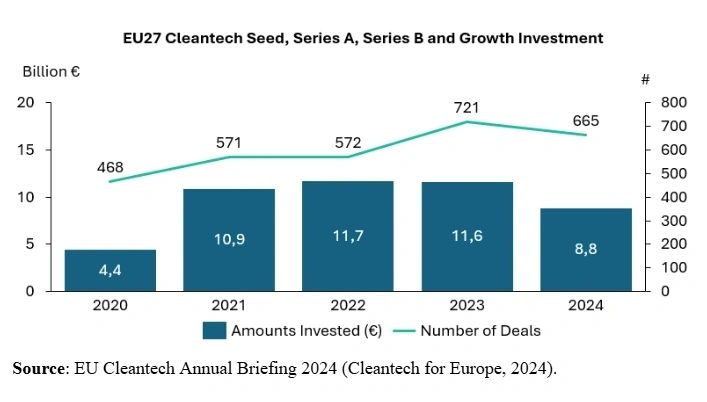
As a result, there was a surge of innovation and investment. Venture capital funding for European climate-tech startups doubled in 2021 compared to the previous year, reaching approximately €11 billion (Cleantech for Europe, 2024). Sustainable and impact-focused investments made up about 37% of total venture capital funding (Dealroom, 2025), indicating a significant shift toward greener investment portfolios. Green hydrogen, battery technologies, sustainable mobility, and circular manufacturing emerged as new symbols of industrial competitiveness.
Economic Fear Beats Sustainable Vision
After years of positioning itself as the global frontrunner in sustainability, Europe’s political climate is shifting. In a context of economic slowdown, high energy costs, and industrial competition, environmental ambition has given way to pragmatism. Political leaders now treat sustainability less as a growth driver and more as a potential burden. Across sectors, once-flagship initiatives of the European Green Deal are being delayed, diluted, or reinterpreted.
For several climate-related policies, we outline its ambitions, describe how it has been weakened or delayed, and the impact this has on the sustainable tech industry.
1. The 2035 Combustion-Engine Phase-Out
The 2035 target for zero-emission new cars is still law but losing credibility.
Germany's 2023 demand led the EU to allow an exemption for synthetic e-fuels (EuroNews, 2023).
Several Member States are advocating for a complete revision of the ban in 2025 (DW, 2025).
Impact: Uncertainty for manufacturers and a slowdown in investment in fully electric mobility or new mobility solutions.
2. European climate law (ECL)
The 2040 target of a 90% emissions cut was weakened by allowing 5% of reductions through foreign carbon credits.
The implementation of the new carbon trading system for buildings and transport (ETS2) has been postponed from 2027 to 2028 (European Commission, 2025a).
Impact: Weakening of low-carbon industries, carbon-accounting tools, and clean-tech investment across Europe.
3. Corporate Sustainability Due Diligence Directive (CSDDD)
The directive was originally aimed at holding large companies accountable for human rights and environmental damage.
Its scope has been narrowed after lobbying efforts and applies only to very large firms.
Includes optional transition plans and slower enforcement timelines (Net Zero Investor, 2025).
Impact: A reduced need for transparent supply chain technologies.
4. Packaging and Packaging Waste Regulation (PPWR) & End-of-Life Vehicles Regulation (ELV)
The PPWR was adopted in December 2024 but heavily amended; with reduced or postponed reuse and recyclability targets, and weakened binding obligations (European Commission, 2024a).
The ELV reform is currently stalled in trilogue due to disagreements on scope, recycling targets, and producer responsibility (European Commission, 2023b).
Impact: Declining market certainty for sustainable tech providers, bio-based materials, chemical recycling and circular design software.
5. Digital Product Passport (DPP)
The DPP is a cornerstone of the Ecodesign for Sustainable Products Regulation (ESPR), meant to enable product traceability and circular design across industries (European Commission, 2024b).
The ESPR came into effect in July 2024, but detailed delegated acts outlining product categories, data requirements, and technical standards are still pending (Lopes and Barata, 2024).
Impact: Reduced investment in digital traceability, materials-data platforms, and product-life-cycle software.
6. Carbon Border Adjustment Mechanism (CBAM)
CBAM was introduced to enhance Europe’s green industrial competitiveness by pricing imported carbon and protecting EU manufacturers from unfair competition (European Commission, 2025b).
Its transition phase has faced complexity and delays and the timeline for moving from reporting to payment has been postponed to 2027.
Exemptions and softer enforcement are being considered due to concerns from industries about competitiveness (E&E News, 2025).
Impact: Growing regulatory uncertainty for clean industrial technologies and carbon-accounting solutions
7. Green Claims Directive
The EU’s anti-greenwashing proposal was paused in mid-2025 after concerns about administrative burden (Hogan Lovells, 2025).
The suspension leaves sustainability claims largely unregulated.
Impact: Weaker demand for verification, certification, and environmental-data solutions
The European Environment Agency’s 2024 halftime review finds Europe already off track for its 2030 climate and environmental goals (European Environment Agency, 2024). Even before recent economic and political turbulence, most targets were unlikely to be met. The widening gap between ambition and implementation underscores how Europe’s sustainable-tech momentum continues to weaken.
The Forces Behind the Shift
The current political debate shows how difficult it remains to reconcile long-term sustainability goals with short-term economic interests. This shift in attention by both institutional and private actors, leading the focus further away from sustainable development, can be explained by two main perspectives: political polarization and economical instability.
For the first one, the data is clear: the rise of populist movements and fear in international environments has had a negative impact on the EU’s plans for sustainable development. We can see this consistently in many data sets regarding political preferences in the EU over the past few years. The EuroBarometer survey for 2025 shows Climate dropping from one of the main concerns amongst European voters for 2024 to a secondary issue in 2025, as this decline in popularity leaves space for other issues such as defense and national security to take over the spotlight (EuroBarometer, 2025).
Germany is a great example to analyse, not only for the data that its recent elections provide, but also as the first European economic power often plays the role of catalyst for new political trends around Europe, and while in the past decade its influence increased the international focus on green solutions, this time it seems to have had the opposite effect. With the far-right party AFD rising in popularity, especially since the COVID-crisis, and reaching as high as 26% of the popular preferences in 2025 (Politico, 2025), placing itself as a main contender for the spot of leading party in Germany, we can observe two harmful consequences for the sustainable development race.
First of all, as observed in most countries in the EU lately, the rise of far right parties shifts the attention of the median voter to the right, which causes most parties’ stances to also shift in that direction, as they try to capture the median voters’ decisive support, or just to appeal to a more conservative voter base (Downs, 1957). Secondly, the combination of rising populism and international fear due to conflicts in Ukraine, Gaza and other regions causes the public focus to shift from more progressive values, such as sustainable development, to conservative ones, such as national security or defense. Fear causes people to shift from wanting to improve the future to trying to protect the present. These reasons explain why political focus has shifted away from sustainable development, a trend that is widely backed by data such as for the 2025 snap elections in Germany in which climate dropped in voter concerns ranking 5th at 13% importance (down from 22% in 2021), behind domestic security (18%), social security (18%) and migration (15%) (ARD, 2025).
Secondly, the economical landscape has been shaped by instability and missed opportunities for growth in sustainable development. The promise done by those fueling the effort towards a green economy was that green solutions would equal exponential green returns on investment. For this to happen in Europe, companies had to bet that they would contribute to the birth of an industry that could rival China and the US as well as other foreign competitors and quickly gain a comparative advantage in the sector. However, this bet does not seem to have paid off. The race for the biggest slice of the EV market has been a clear failure, as Asian manufacturers such as BYD have managed to leverage China’s extremely advanced production of batteries and other parts to beat EU competition both in price efficiency and attractivity of the product (Forbes, 2023). Green energy solutions have been developed, but not enough to break free from the EU’s dependence on Russian gas imports, German fossil energy needs and oil imports from the Gulf (Ember Energy Reports, 2025). One solution that has been discussed for the past decade is the comeback of nuclear energy at large scale, a source produced by an innovative and quickly developing industry, but the stigma around nuclear energy production and the length of political discussions around it have failed the process to deliver any clear results.
These drawbacks in energy independence come at the wrong time, as AI development is projected to make the situation even worse. In fact, as many of the decisive actors on such topics, both in the political and economical landscape, enter the AI gold rush, they place both their funds and their support in an industry that needs vast amounts of energy to succeed. The consequences are less legislative efforts and lobbying towards sustainable development and instant exponentially higher demand towards electricity, which ultimately limit the efficiency gains needed to achieve net-zero (IEA, 2025). The IEA projects data center electricity demand to more than double by 2030 to 945 terawatt-hours, with AI-driven ones to require an increasing share of it. According to the agency, 60% of this new energy will come from fossil fuels, directly contradicting climate commitments.
This data shows how this drawback from sustainable development goals is not just a trend, but rather the consequence of both lower than expected efforts towards a green economy in the past decade and the projection of a future economy based on increased consumption to achieve the AI dream.
The question remains the same as for the past decade: will we be able to shift away from unsustainable growth? The latest AI frenzy is surely not a positive sign, for now.
The Impact on Europe’s Sustainable Tech Landscape
After rapid expansion between 2021 and 2023, Europe’s sustainable-technology investment has slowed markedly since 2024. In the first quarter of 2025, European climate-tech startups raised only €2 billion, the lowest quarterly amount since 2020 (The Next Web, 2025). Within Europe, total cleantech venture capital funding declined by 24 percent year-on-year, from €11.6 billion in 2023 to €8.8 billion in 2024 (Cleantech for Europe, 2024).
The share of sustainable and impact-focused investments of total VC funding in Europe already decreased from about 37% in 2023 to 15% in 2025 (Dealroom, 2025).
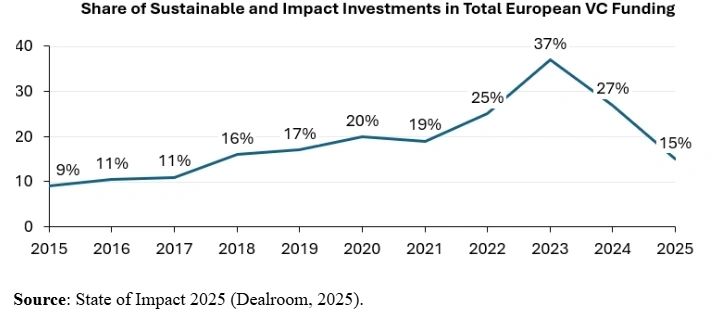
Together these data indicate that investor confidence has collapsed, with many no longer seeing sustainable technology, or the European green vision itself, as a credible engine of growth.
Reset Required: Europe Must Rediscover Its Green Confidence
The EU has shown before that sustainability can be a priority and a driver for innovation. During the COVID and energy crises, Europe demonstrated that responding to crises and advancing the green transition can complement each other. This approach must now be revived.
To restore credibility and competitiveness, the EU must place resilience at the heart of its sustainability strategy. Building resilience means developing the capacity to shape change, not just react to it. Therefore, policymakers must confront key questions with honesty and ambition:
How can sustainability policies navigate conflicting goals between growth, security, and climate protection?
How can climate action be designed to strengthen, rather than compete with, economic and social policy?
What institutional and financial frameworks are necessary to ensure that sustainability remains a shared European project and not a political casualty of every new crisis?
Instead of weakening or delaying climate regulations, the EU should create incentive systems that reward innovation, minimize regulatory uncertainty, and accelerate the deployment of sustainable tech across sectors.
We are a generation of well-educated, purpose-driven young people ready to pioneer in sustainable tech, yet our ambition is constrained by inconsistent, short-sighted policymaking. This article is not an exercise in alarmism, but a call to meaningfully include Europe’s youth in shaping the continent’s sustainable future. The EU must restore the confidence that sustainability is not a temporary political trend, but the foundation of Europe’s economic identity and future prosperity.
Bibliography
ARD. (2025). Was waren die Hauptgründe für das Wahlergebnis?. https://www.tagesschau.de/wahl/archiv/2025-02-23-BT-DE/umfrage-aktuellethemen.shtml
Bruegel Policy Brief. (2025). Europeans Still Want Climate Action, But Don't Trust Governments to Deliver. https://www.bruegel.org/policy-brief/europeans-still-want-climate-action-dont-trust-governments-deliver
Cleantech for Europe. (2024). Cleantech annual briefing 2024. https://www.cleantechforeurope.com/publications/cleantech-annual-briefing-2024?
CWE. (2025). Polls reveal citizen support for climate action and energy transition. https://www.cleanenergywire.org/factsheets/polls-reveal-citizens-support-energiewende
Dealroom. (2025). State of Impact 2025. https://dealroom.co/reports/state-of-impact-2025
Downs. (1957). Party convergence towards the median voter. https://en.wikipedia.org/wiki/An_Economic_Theory_of_Democracy
DW. (2023). EU to fast-track review of 2035 fuel engine phase-out. https://www.dw.com/en/eu-to-fast-track-review-of-2035-fuel-engine-phase-out/a-73982027
E&E News. (2025). Document: EU legislation delays carbon border tax fees. https://www.eenews.net/articles/document-eu-legislation-delays-carbon-border-tax-fees/
Ember Energy Reports. (2025). Ember Energy on EU energy dependencies. https://ember-energy.org/latest-updates/russian-gas-imports-to-the-eu-jump-by-18-in-2024-despite-plan-for-2027-phase-out/
EuroNews. (2023). In win for Germany, EU agrees to exempt e-fuels from 2035 ban on new sales of combustion-engine cars. In win for Germany, EU agrees to exempt e-fuels from 2035 ban on new sales of combustion-engine cars | Euronews
European Commission. (2019). The European Green Deal (COM/2019/640 final). https://eur-lex.europa.eu/legal-content/EN/TXT/?uri=CELEX:52019DC0640
European Commission. (2020). Innovation Fund: Deploying innovative net-zero technologies for climate neutrality. https://climate.ec.europa.eu/eu-action/eu-funding-climate-action/innovation-fund_en
European Commission. (2023a). Horizon Europe – The EU research and innovation programme (2021–2027). https://research-and-innovation.ec.europa.eu/funding/funding-opportunities/funding-programmes-and-open-calls/horizon-europe_en
European Commission. (2023b). Proposal for a Regulation on circularity requirements for vehicle design and on management of end-of-life vehicles. https://environment.ec.europa.eu/publications/proposal-regulation-circularity-requirements-vehicle-design-and-management-end-life-vehicles_en
European Commission. (2024a). Packaging and packaging waste regulation. https://eur-lex.europa.eu/eli/reg/2025/40/oj/eng
European Commission. (2024b). Ecodesign requirements for sustainable products. https://eur-lex.europa.eu/legal-content/EN/TXT/?uri=CELEX%3A32024R1781&qid=1719580391746
European Commission. (2025a). 2040 climate target: Council agrees its position on a 90% emissions reduction. https://www.consilium.europa.eu/de/press/press-releases/2025/11/05/2040-climate-target-council-agrees-its-position-on-a-90-emissions-reduction/
European Commission. (2025b). Carbon Border Adjustment Mechanism (CBAM). Directorate-General Taxation and Customs Union. https://taxation-customs.ec.europa.eu/carbon-border-adjustment-mechanism_en
European Environment Agency. (2024). Monitoring progress towards the 8th Environment Action Programme. https://www.eea.europa.eu/en/topics/at-a-glance/state-of-europes-environment/environment-action-programme/8th-eap-indicator-based-progress?activeAccordion=7dec1e73-e295-4ff0-afed-575d55a9c590%2C6a4ef731-15b3-4100-8e51-cb0b067c8d1d%2Cfab1e562-0687-4961-807d-2207173df199
European Parliament. (2024). EU deforestation law: Parliament set to adopt one-year delay. https://www.europarl.europa.eu/news/en/agenda/briefing/2024-12-16/8/eu-deforestation-law-parliament-set-to-adopt-one-year-delay?utm_source=chatgpt.com
European Parliament & Council. (2022a). Decision (EU) 2022/591 on a General Union Environment Action Programme to 2030. https://eur-lex.europa.eu/legal-content/EN/TXT/?uri=CELEX%3A32022D0591
European Parliament & Council. (2022b). Decision (EU) 2022/591 on a General Union Environment Action Programme to 2030. https://eur-lex.europa.eu/legal-content/EN/TXT/?uri=CELEX%3A32022D0591
Europbarometer. (2025). EP Winter 2025 Survey. https://europa.eu/eurobarometer/surveys/detail/3492
Forbes. (2023). China Has Perfectly Tangled The Battery Value Chain With Electric Vehicles - A Combo The U.S. And Europe Will Find Hard To Beat. https://www.forbes.com/sites/jenniferdungs/2023/08/17/china-has-perfectly-tangled-the-battery-value-chain-with-electric-vehicles-leading-to-a-combo-the-us-and-europe-will-find-hard-to-beat/
Hogan Lovells. (2025). On Hold: EU pulls the plug on Green Claims Directive. https://www.hoganlovells.com/en/publications/on-hold-eu-pulls-the-plug-on-green-claims-directive?utm_source=chatgpt.com
IEA. (2025). Report on Energy and AI. https://www.iea.org/reports/energy-and-ai
Lopes and Barata. (2024). Digital Product Passport: A Review and Research Agenda. https://www.sciencedirect.com/science/article/pii/S1877050924025626
Net Zero Investor. (2025). EU backs drastic scale-down of CSDDD reporting rules. https://www.netzeroinvestor.net/news-and-views/briefs/eu-backs-drastic-scale-down-of-csddd-reporting-rules
Politico. (2025). Far-right AfD tops German popularity ranking in bombshell new survey. https://www.politico.eu/article/germany-far-right-afd-lead-survey/
Sightline Climate. (2025). $30 bn and 14% fall as market finds new normal in ’24. https://www.ctvc.co/30bn-and-14-fall-as-market-finds-new-normal-in-24/#:~:text=%F0%9F%92%B0%202024%20investment%3A%20Venture%20and%20growth%20investment%20in,showing%20the%20sector%20settling%20into%20a%20new%20normal.
The Next Web. (2025). Why European climate-tech funding sunk to five-year low in Q1. https://thenextweb.com/news/why-european-climate-tech-funding-sunk-to-five-year-low-in-q1