
Pan-European Pension Products: a lever for EU financing?
11 min read · 2,169 words
Savings allocation in the EU
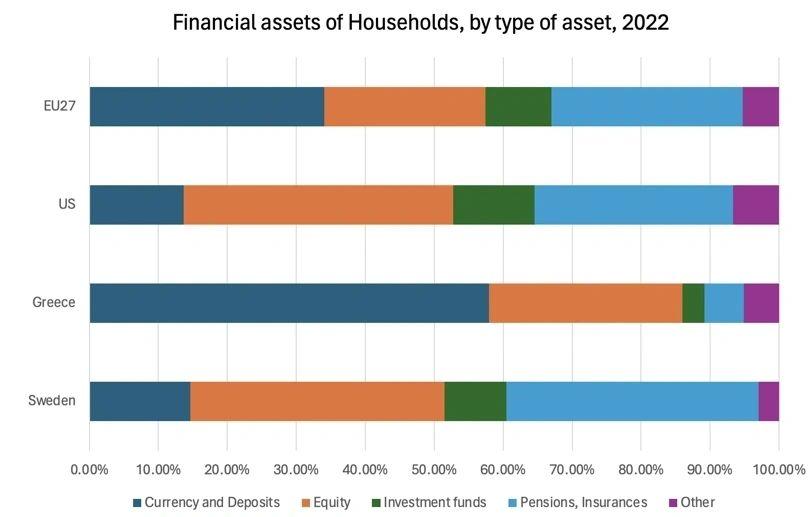
European citizens save at over three times the rate of US citizens: around EUR 10 trillion of retail savings in the EU are currently held in bank deposits that offer negligible returns relative to sovereign bond investments, which carry similar risk and liquidity (ESMA, 2023). EU households allocate their financial assets approximately equally across three categories: 34% in bank deposits, 28% in pension and insurance products, and 38% in stocks, bonds, or investment funds (Figure 1). Such a high allocation into bank deposits relative to the US (13%) can be attributed to the complexity and fragmentation of the retail investment landscape in Europe, along with the relatively high cost of transactions. For instance, retail investors in European mutual funds pay, on average, nearly 60% higher fees than their U.S. counterparts. As a result, many Europeans choose to invest in low-yield guaranteed savings accounts or foreign markets. This trend leads to an estimated EUR 300 billion flowing out of the EU each year towards the American real economy and asset management funds (Lagarde, 2024). Additionally, unlike in the US, Europe’s weaker investment culture encourages caution, and its extensive welfare systems further discourage private investments. Public subsidies in healthcare, education, and pension schemes across many European countries reduce the incentive for individuals to invest their savings in higher-yielding assets to cover future expenses.
Furthermore, EU capital markets are also relatively less efficient in the allocation of long-term assets compared to other major economies, due in part to the underdevelopment of pension funds. In 2022, the level of pension assets in the EU was only 32% of GDP while amounting to 142% in the US and 100% in the UK (Draghi, 2024). The investment gap is further exacerbated by the fact that most European households’ pension wealth takes the form of public pay-as-you-go social security systems, while the same share of citizens’ salaries in the UK and US is invested in private pension funds with plans like 401k and SIPPs. This, among other factors, has led the US to hold twice as much financial assets as the EU, even after adjusting for GDP differences (Deutsche Börse Group, 2025).
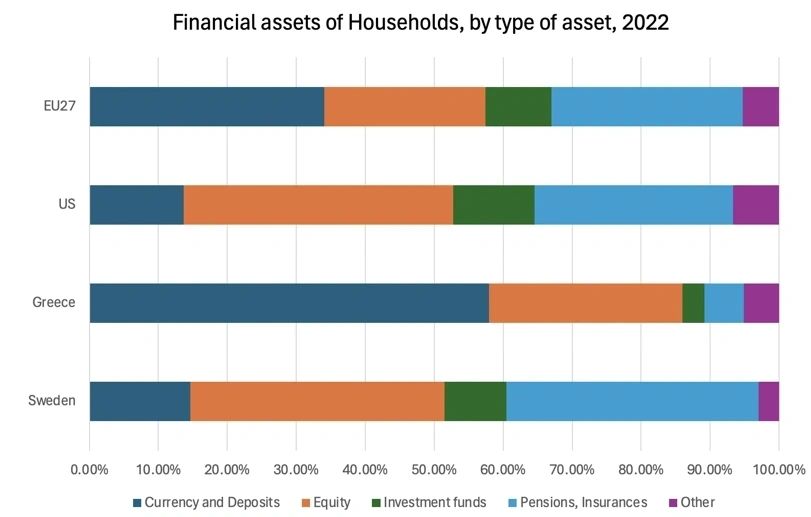
Figure 1: Source: Eurostat and OECD data
The rising need of investments
In this already complicated framework, the EU is facing an “existential challenge” as defined in Mario Draghi's “Report on the Future of European Competitiveness” (2024). To meet the goals laid out in the report, an additional annual investment of EUR 750-800 billion is required, corresponding to 4.4-4.7% of EU GDP in 2023. Historically, 80% of productive investment in Europe has been undertaken by the private sector, and the remaining 20% by governments (Draghi, 2024).
According to the European Commission’s model, a reduction of 250 basis points in cost of capital would be necessary to generate the amount of investment needed from the private sector, potentially generating substantial inflationary pressure. Improving capital markets efficiency, developing innovative solutions such as the “Savings and Investments Union”, and redesigning the Pan-European Pension Product should participate in reducing private financing costs (Draghi, 2024).
Additionally, as of today, the EU relies excessively on bank financing with bank loans still being the major source of external funding for European companies. The underdevelopment of the EU's Venture capital market led more than 30% of “unicorns” founded in Europe to move their HQ abroad, with a vast majority settling in the US (Draghi, 2024). Indeed, banks are not well equipped to finance the most innovative companies and start-ups. A more efficient use of retail savings could help support investment in innovative European companies.
The Pan-European Pension Product (PEPP)
The necessity of building a European market for private pensions was first mentioned in the Capital Market Union Action plan of 2015. In July 2016, the European Insurance & Occupational Pension Authority issued advice to the European Commission, recommending the creation of a PEPP in the form of a complementary regime alongside national ones.
The PEPP’s main features
The Pan-European Personal Pension Product (PEPP) is a voluntary, standardized personal pension scheme introduced by the European Union to provide EU citizens with a portable and flexible retirement savings option. Established under Regulation (EU) 2019/1238, which became applicable in March 2022, the PEPP aims to complement existing state-based and occupational pension systems to address the challenges posed by an aging population and increasing labour mobility within the EU. Its key features include portability (the fund accounts are designed to be portable across EU member states, allowing individuals to continue contributing to the same pension product even if they move to another EU country), standardization (the PEPP offers a standardized product structure, including a default investment option known as the "Basic PEPP," which caps fees to 1% per year and provides capital protection). Moreover, it offers flexibility (savers can choose from up to six investment options and have the right to switch providers or investment options after a minimum of five years) and digital access (designed to be accessible online, facilitating easier account management and broader reach across different demographics).
Adoption of the PEPP across EU Countries
It has, however, encountered several challenges and criticisms since its inception, which have impacted its adoption across EU member states; a significant hurdle is the inconsistent tax treatment among members. While the European Commission recommended that PEPPs receive the same tax relief as national personal pension products, the implementation of this recommendation varies, leading to disparities that can discourage both providers and potential savers (European Commission, 2024). The inconsistency in tax incentives is unfortunate, as it is a primary motivator for individuals to invest in pension products (OECD, 2018). Alongside that, another critical issue is the complexity of the client onboarding process. The PEPP mandates individualized advice and suitability assessments before a contract can be concluded, which, although designed to protect consumers, can be time-consuming and costly. Such complexity can deter both providers from offering PEPPs and consumers from investing in them.
Finally, the PEPP faces stiff competition from well-established national pension products: many European countries already have a wide range of personal pension schemes that are familiar to consumers and often come with established tax benefits and incentives. The existence of this landscape makes it challenging for the project to gain a foothold, especially in countries with mature pension systems like the Netherlands, that operates one of the world’s most robust pension systems, combining a flat-rate public pension with quasi-mandatory occupational pensions, which covers over 90% of workers through collective employer contribution. These are professionally managed, offering strong retirement income security. Similarly, Denmark features a well-integrated system with a basic public pension, a mandatory fully funded occupational scheme (ATP), and widespread voluntary private savings. It is known for its automatic enrolment features and transparent digital pension tracking. Alternatively, Sweden, another EU country with a strong pension fund system, blends a public earnings-related pension with a voluntary defined-contribution “premium pension” system, allowing individuals to allocate part of their contributions to private investment funds, as observed in the case study presented below.
Sweden and Greece perspectives
Taking a closer look in Sweden, as already mentioned as one of the most well established pension plans in Europe, individuals play an unusually active role in managing their pensions. This is thanks to the structure of the country’s public pension system and a strong national culture of financial literacy. A key component enabling this is the Premium Pension (Premiepension), a mandatory, state-managed defined contribution scheme into which 2.5% of a worker’s gross income is directed (Swedish Pensions Agency, 2024). What sets Sweden apart is that each individual is given the freedom to choose how these funds are invested, with access to a wide range of public and private investment funds, including options for ethical investing, equities, and bonds. Those who do not actively choose are enrolled in AP7 Såfa, a state-run default fund that is professionally managed and tailored to the saver’s age, providing solid returns with low fees. This system is supported by the MinPension.se portal, which allows citizens to monitor all aspects of their pension: public, occupational, and private. This tool simulates different retirement scenarios. This transparency, therefore, combined with widespread access to financial tools and education, encourages individuals to engage in their pension planning more consciously. Additionally, most workers are covered by occupational pensions, often with options to choose investment strategies, and it is common for Swedes to make voluntary private contributions as well.
Greece, on the other hand, has a Bismarckian (pay as you go) national pension system that is primarily redistributive, designed to ensure a basic standard of living for all retirees regardless of their lifetime earnings. Following extensive reforms, especially after the 2010 financial crisis, the system now consists of a two-tier structure: a flat-rate National Pension, funded through general taxation, and a Contributory Pension, based on lifetime earnings and insurance contributions (European Commission, 2017). The National Pension, approximately €384 per month, acts as a solidarity mechanism that provides a safety net even to those with minimal work histories, as long as residency requirements are met. Meanwhile, the contributory portion rewards longer and higher contributions, but benefits remain relatively compressed compared to other European systems.
In contrast, Greece’s model emphasizes intergenerational transfers, in which workers fund the pensions of current retirees, reinforcing its redistributive character, but also creating long-term sustainability challenges in the face of an aging population and a shrinking workforce. The country could significantly benefit from the Pan-European Personal Pension Product (PEPP) by complementing its redistributive system with a capital-funded, individual savings pillar. As observed in figure 2, Greece is among the countries with least savings in the EU, a percentage of -1.9% in 2023 according to the European Commission. The country, even with an aggregate negative savings percentage, could take the PEPP as an opportunity for citizens to take greater control of their retirement planning and promote financial engagement. Its portability would also suit Greece’s mobile workforce, especially among younger citizens. The product’s transparency and investment choice could increase trust and participation in voluntary pensions. Ultimately, countries who follow a pay as you go pension system such as Greece, France, Italy etc. could widely benefit from the PEPP.
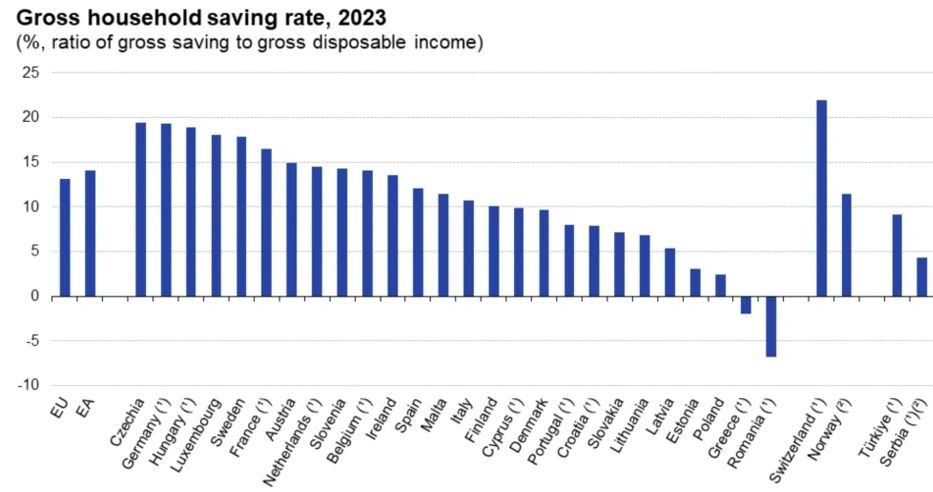
Figure 2: Source: Eurostat
Conclusion
In conclusion, the PEPP has the potential to boost long-term savings and strengthen EU capital markets, but its uptake remains limited due to key challenges. Chief among them is the lack of unified tax treatment across member states, which discourages both providers and savers by creating an uneven playing field with national pension products. In order to unlock the PEPP’s full potential, a harmonised EU-wide tax framework alliance would be necessary. Besides, complex onboarding procedures and mandatory advisory requirements add friction and costs, while established domestic schemes continue to dominate in countries with strong pension systems.. Simplifying the onboarding process, especially through digital tools, would also reduce barriers to entry. The EU must also do more to incentivise financial providers to offer and promote PEPPs, as the limited supply currently hinders consumer access. Finally, increased public awareness and cross-border promotion could help build trust and drive adoption. With these improvements, the PEPP can become a key tool for mobilising retail savings and advancing a more integrated and resilient European financial system.
References List
BlackRock. (2025). Spotlight: Learning from the Pan-European Personal Pension Product (PEPP). Retrieved from https://www.blackrock.com/corporate/literature/whitepaper/spotlight-learning-from-the-pepp-april-2025.pdf
Deutsche Börse Group.Towards an EU Savings and Investments Union, February 2025
ESMA. Costs and Performance of EU Retail Investment Products, December 2023 ESMA Market Report - Costs and Performance of EU Retail Investment Products 2023
Eurostat. (2024). Gross household saving rate, 2023 (%, ratio of gross saving to gross disposable income). Retrieved from https://ec.europa.eu/eurostat/statistics-explained/index.php?title=File:Gross_household_saving_rate,_2023_(%25,_ratio_of_gross_saving_to_gross_disposable_income)_NA2024.png#file
Eurostat. Households - statistics on financial assets and liabilities, October 2024 https://ec.europa.eu/eurostat/statistics-explained/index.php?title=Households_-_statistics_on_financial_assets_and_liabilities#:~:text=Out%20of%20the%20total%20financial,and%20standardised%20guarantees%20(26.9%25)
European Commission. (2017). Commission recommendation on the tax treatment of personal pension products, including the pan-European Personal Pension Product. Retrieved from https://finance.ec.europa.eu/system/files/2017-07/170629-personal-pensions-recommendation_en.pdf
European Commission. (2019). Greek Pension System Fiche. Retrieved from https://economy-finance.ec.europa.eu/system/files/2019-12/country_fiche_el-_2019_peer_review.pdf
European Commission. (2025). Savings and Investments Union: A Strategy to Foster Citizens’ Wealth and Economic Competitiveness in the EU, March 19, 2025 https://eur-lex.europa.eu/legal-content/EN/TXT/PDF/?uri=CELEX:52025DC0124
European Insurance and Occupational Pensions Authority (EIOPA). (n.d.). Consumer-oriented FAQs on the Pan-European Personal Pension Product (PEPP). Retrieved from https://www.eiopa.europa.eu/browse/regulation-and-policy/pan-european-personal-pension-product-pepp/consumer-oriented-faqs-pan-european-personal-pension-product_enregister.eiopa.europa.eu
Financial Times. Can Europe finally fix its capital markets?, May 13, 2025 Can Europe finally fix its capital markets?
Financial Times. EU revives capital markets union plan to unlock trillions in savings, March 19, 2025 EU revives capital markets union plan to unlock trillions in savings
Lagarde, Christine. A Kantian shift for the capital markets union, November 2023 A Kantian shift for the capital markets union
Lagarde, Christine. Follow the money: channelling savings into investment and innovation in Europe, November 2024 Follow the money: channelling savings into investment and innovation in Europe
Organisation for Economic Co-operation and Development (OECD). (2018). Financial Incentives and Retirement Savings. Retrieved from https://www.oecd.org/en/publications/financial-incentives-and-retirement-savings_9789264306929-en.html
Swedish Pensions Agency. (2024). The Swedish pension system. Retrieved from https://www.pensionsmyndigheten.se/other-languages/english-engelska/english-engelska/pension-system-in-sweden
Draghi Report. The future of European competitiveness: Report by Mario Draghi, September 2024 The Draghi report on EU competitiveness