
Intergenerational Fairness: Who Gets to Shape Tomorrow?
The PDF is the official version of this report. The web version below is provided for convenience.
1. Introduction
The decisions Europe makes today will shape the opportunities, security, and quality of life of generations to come. Yet young Europeans often have limited influence over the policies that will define their future.
This report, developed by VOYCE, examines intergenerational fairness across three key dimensions: democratic participation and representation, the future of work in the age of artificial intelligence, and European investment in security and defence. Across these areas, it explores how today’s policy choices distribute opportunities, responsibilities and costs between generations.
Our aim is to bring young Europeans’ perspectives into the heart of European policymaking and put forward concrete, forward-looking proposals. We believe that a fairer Europe requires more than acknowledging the interests of future generations. It requires giving young people a meaningful voice in shaping their future.
2. Having a Say in Tomorrow:
Participation & Representation
Young Europeans may live with the consequences of today’s decisions for longer than anyone else, while often having limited influence over how those decisions are made. Recent student protests across Europe highlight a broader question about how younger generations express political demands, how institutions respond to them, and whether existing channels of participation and representation are sufficient.
The issue is therefore not simply whether young people are represented. It is whether European decision-making gives them meaningful opportunities to participate and influence decisions, particularly on issues whose consequences extend well beyond the present political cycle.
The report will explore participation and representation as an intergenerational fairness issue, looking beyond simple “youth quota” approaches and asking whether European institutions and democratic processes can better incorporate younger generations’ perspectives.
2.1 Intergenerational Tension: What is the Core Issue between Today’s Choices and Future Generations?
Underrepresentation. Today’s institutions and policy makers set long-term policy, but the people making those decisions are older than the population they govern and the young generation in particular is severely underrepresented. The average MEP in the Parliament elected in June 2024 is 50 years old, in contrast to the median age of the EU population at 44.9 on 1 January 2025 (European Parliamentary Research Service, 2024; Eurostat, 2026). The European Youth Forum finds that the new Parliament is just as old as the one elected in 2019, and that MEPs under 35 hold only about 10% of the seats, although around a fifth of Europeans are between 18 and 35 (European Youth Forum, 2024; CIDOB, 2024). Belgium, Ireland, Latvia, Luxembourg, and Romania elected no MEP under 35 at all (European Youth Forum, 2024). At the end of the previous term the picture was even starker. On 6 May 2024 the average MEP was 54, a quarter of MEPs were over 65, and only three of the 705 MEPs were under 30. That is 0.4% of the chamber, while the age group of 18-30 made up 13% of the EU population (Merino, 2024).
How much this matters is open to debate. A Parliament’s spokesperson has argued that its age profile can’t be compared with the general population because of the minimum ages for candidacy (Delaney, 2024). That explains only part of the gap: the previous 2019 to 2024
Parliament had no MEP under 25, even though most countries allow candidates from 18 (Delaney, 2024). So, the age limit alone doesn’t explain the gap, but it signals who the institution is built for, and the European Youth Forum stresses how much it matters for young people to see their own age group represented (Delaney, 2024).
This underrepresentation isn’t static either. According to the Eurobarometer post-election survey,
36% of under-25s voted in 2024, down from 42% in 2019, a drop of six percentage points (European Parliament, 2025). It’s hard to say which is the cause and which is the effect: are fewer young people voting because the institutions they elect into already look nothing like them, or do these institutions end up underrepresenting young people because few of them vote? Among young non-voters in 2024, 15% said they found no relatable candidate or party, 15% cited general distrust or dissatisfaction of politicians, and 16% said they didn’t have enough information to choose (European Commission, 2025).
This imbalance is unlikely to fix itself, because older voters carry a growing weight. The EU’s median age rose from 42.8 in 2015 to 44.9 in 2025, and people aged 65 and over are now 22% of the population (Eurostat, 2026). By 2050, 90% of EU regions are projected to have at least a quarter of their residents aged 65 or over and the median age is projected to rise to 50.1 years (Eurostat, 2026). Without policy change this intergenerational tension is therefore only expected to intensify.
Barriers to Meaningful Youth Participation. Beyond these demographic imbalances, the opportunities available to young people seeking elected office warrant closer examination. Formal candidacy does not necessarily translate into meaningful electoral opportunities. The European Youth Forum's analysis of the 2024 European elections found that candidates under 35 were relegated to positions with less than a 50% chance of securing a seat. Meanwhile, older candidates dominate the top electable spots, securing their seats with ease.
These disparities reflect both individual and institutional factors. Research by Belschner (2024), examining electoral candidates across 21 OECD countries, identifies disadvantages associated with younger candidates' more limited campaign resources, political experience, and less favourable electoral list positions. Such obstacles may persist even among young people already involved in political organisations. A study of Portuguese political parties by Jalali, Silva and Costa (2024) found that, although youth wings provide a substantial pool of politically engaged members, relatively few progress to electoral candidacy and parliamentary representation. The study also highlights the role of informal negotiations with senior party leadership in determining access to candidacy.
Inequalities in political participation also exist within the younger generation itself, as it is not a homogeneous group and does not share the same socioeconomic and educational opportunities. According to the OECD (2024), those from more advantaged backgrounds tend to participate more actively in civic and political life. Young people from low-income families may face barriers related to financial resources and support networks, as well as a perception that their engagement is undervalued in society. Institutional participation mechanisms may reinforce these disparities if they fail to reach young people outside established organisations. OECD research (2020) found that approximately four in ten surveyed ministries responsible for youth affairs had not involved non-organised young people in consultations on national youth strategies. This suggests that formal participation opportunities alone may not ensure inclusive representation, particularly when engagement relies heavily on established youth organisations and networks. Strengthening youth participation therefore requires to not only expand opportunities, but also to ensure that they are accessible to young people from diverse backgrounds.
Educational disparities further reinforce the differences. The European Commission's Education and Training Monitor (2025) identifies a consistent gap in civic knowledge between students from more affluent families and their less advantaged peers, potentially affecting their readiness to engage with democratic institutions. Only around three in ten young people under 18 say they have heard about politics at school or at college. Unequal access to political learning risks widening gaps in who takes part in democracy over time. Providing consistent and accessible democratic education could help reduce participation inequalities and support long-term political engagement.
Unfortunately, even when young people gain access to institutional participation mechanisms, their involvement does not necessarily translate into meaningful influence over policymaking. The European Commission's interim evaluation of the EU Youth Strategy (2024) found that, although the EU Youth Dialogue (EUYD) had expanded youth engagement, there was limited evidence of its direct and systematic influence on EU and national policymaking. The evaluation identified shortcomings in communicating how consultation outcomes shape policy decisions and informing participants of the results. These findings highlight that meaningful youth participation extends beyond consultation itself. Transparent follow-up mechanisms are essential to ensure that young people are informed about whether their recommendations have been influential for policy decisions. Such feedback would strengthen accountability and help bridge the gap between participation and actual political influence.
2.2 Voting and Candidacy Age
Access to formal political channels is not equal across age groups to begin with. The voting age for European elections is 16 in Austria, Belgium, Germany, and Malta, 17 in Greece and 18 everywhere else (European Parliament, 2026). The minimum age to stand as a candidate is higher in 12 of the 27 member states: 21 in nine of them (Bulgaria, Cyprus, Czechia, Estonia, Ireland, Latvia, Lithuania, Poland, and Slovakia), 23 in Romania and 25 in Italy and Greece (European Parliamentary Research Service, 2023). As these thresholds are set nationally, the same European generation has different rights depending on its passport. In Greece, a 17-yearold can vote for the European Parliament but has to wait until 25 to run for it.
Where access opens earlier, young people do use it. Austria lowered its national voting age to 16 in 2007, and turnout among 16-year-old first-time voters reached 88% in 2008, demonstrating that young people can be brought into the electoral process at an early age (European Commission, 2025). Although this figure fell to 63% in 2013, turnout among 16- and 17-yearolds was still higher than among 18- and 19-year-olds in the 2017 national election (European Commission, 2025). Research on two Austrian regional elections also found that first-time voters aged 16 and 17 participated at rates not far below the overall electorate (Zeglovits & Aichholzer, 2014). The figures suggest that, even if younger voters do not always participate at the same rate as the population as a whole, lowering the voting age gives them an earlier opportunity to become part of the democratic process, which is what the EU should be aiming for.
Formal channels are also not where most young people are active. In the European Parliament’s
2024 Youth Survey, 39% of 16- to 30-year-olds indicated they have voted in local, national, or European elections, 26% said they had signed a petition and 16% had taken part in a street protest or demonstrations, compared with 10% who had taken part in a public consultation and 8% who had contacted a politician (European Parliament, 2024). Among those who had never contacted a politician, 30% said they didn’t think it would have an impact and 23% said decision makers don’t listen to people like them (European Parliament, 2024). Many young people seem to doubt that formal channels lead anywhere, which may be one reason some turn to protest instead. In the most recent Student Protests Monitoring of the European Students’ Union, 151 protest actions across 33 countries in all of Europe have been recorded between September 2025 and July 2026 (European Students’ Union, 2026). Out of these actions the leading causes were access & safety in education, university governance, economic & living conditions, and political governance/democracy (European Students’ Union, 2026). These widespread observations must not be neglected, especially from an EU perspective, considering that these numbers don’t even implement the recent wave of protest in France and other member states. Addressing the young generation is not just a matter of hard facts but also about the perception of the EU among young people and the question of being heard.
2.3 Case Study: French Protests
Student protests began in France in late September with the first blockade at Lycée Antoine-deSaint-Exupéry in Créteil (Parisian suburbs). They then quickly spread all across France. The main grievances were concrete and clear. First, teachers who happen to be absent are never substituted, even when their absence would last months, or when the subject was to be taken on the baccalaureate. Second, facilities are in an unsanitary state, classrooms may have leaking ceilings, buildings frequently have dysfunctioning bathrooms, and some have mold. Third, there is a lack of school material, particularly desks and chairs in classrooms, and the classes are composed of 30 or more students, which creates disadvantageous learning conditions. Lastly, during heatwaves, or particularly cold spells, heating and air conditioning devices are rarely functioning, increasing the difficulty these students face. These complaints rest on hard data: according to ministry statistics, in 2024-25, 10% of teaching hours were never delivered, and the 2026 budget cut 1,803 secondary teaching posts.
While the protest began with highschoolers, particularly in the suburbs, university students quickly joined them in blocking access to their university in support of the original protesters, as well as students from more advantageous regions who may not be affected by these issues.
Another issue that has been brought up as the protests were going on is the platform Parcoursup, which is how high school students apply for university studies. This platform is essentially an algorithm, which isn’t always transparent, and has been making it harder for students to reach their targets.
Over the course of October, the numbers of mobilised students kept growing overall. There is, however, a discrepancy between the numbers announced by the government and the organisers. On October 6th, the Interior Ministry counted 256,000 marchers while the unions claimed 450,000. By October 13th the gap had widened to 161,500 against 480,000. The movement reached its climax on October 17th. That day the students were joined by a revived yellow-vests movement, trade unions, climate activists, and farmers, all protesting against the cost of living and fuel prices. The government counted 550,000 people and the organisers 800,000. Turnout dipped on 24 October (410,000 against 800,000), but 5 November went further still: 600,000 according to the Interior Ministry and around 1.6 million according to the CGT, with more than half of secondary school staff on strike. This is striking because the government had already deployed 3,000 substitute teachers and, on 26 October, presented its answers to the movement, including a reform of Parcoursup. Macron had also called for classes to resume calmly after the autumn break. That the mobilisation grew instead of fading suggests these measures were seen as insufficient, as the lycée organisations themselves said.
In fact, when looking at Macron’s response, there is only a small amount of attention given to the students' grievances and very little is taken into account. Macron addressed the nation the evening after October 17th riots. He began his speech by mentioning the violence and destruction of property instead, making this his central preoccupation. He condemned the attacks explicitly, saying that nothing justifies such violence. No specific demands were named, instead he merely announced the establishment of a crisis unit to bring together student representatives and government ministers, with the aim of finding solutions, and an online platform to submit specific complaints. In his address, he also politicised the movement, he accused the far left (LFI) of damaging the Republic and “stealing” the debate, six months before the elections. LFI denies any manipulation of pupils leading to such acts of violence, and also denies instigating the demonstrations. In the eyes of the French, Macron did not provide the people with any valid answer, rather he chose to shift the debate from legitimate grievances into a political conflict in the lead-up to elections, aiming to discredit the movement.
How could effective youth participation have avoided the ‘revolution’? Participation existed in form, not in effect. France already has formal structures for pupils' voices: school-level, regional-level, and national-level conseils de la vie lycéenne. In October the ministry itself announced a "refonte" of these bodies so that pupils' voices would "count and translate into action", but this did not translate into practice. The grievances were local and measurable: a missing maths teacher in a particular class, a broken roof in a particular building. CVLs with real power to trigger a replacement or a repair budget could have defused the conflict school by school before it reached the street. Instead, the first ministerial meeting came about ten days in, and the Élysée meeting after a month.
Moreover, the platform established precisely to solve the issues raised by students gathered over 100,000 contributions, but the answers presented on 26 October were judged insufficient and blockades resumed after the autumn school break. Effective participation requires visible feedback: what was heard, what will change, by when, and why not where the answer is no. Furthermore, the protestors were not treated fairly. In fact, when Macron addressed the citizens, he threatened to effectively forbid demonstrations in ‘high-risk’ zones. Treating minors as partners rather than as a security risk might have limited the police violence that drove the movement's expansion. Credible institutional channels would also have made the movement harder for parties to capture and harder for the government to dismiss as manipulated.
Obviously, the cost-of-living anger behind 17 October existed independently. While better youth participation could not have removed it, but it could have removed the trigger that brought it to a head.
All in all, this shifts back to the debate on voting age. Most of the students who started the movement cannot vote, and the government's insistence on the coming presidential election only underlined that they had no say in it. Yet lowering the voting age would not by itself have answered their grievances. A ballot every five years is a primitive response for a missing maths teacher or a leaking roof. What the highschoolers lacked was not a vote but everyday influence over decisions that shape their schooling. Several policies could provide it:
-
Give school councils real powers: CVLs could have a small budget of their own and the right to trigger a response from the rectorate, within a fixed deadline, on teacher absences and building safety.
-
Make feedback compulsory: every consultation, like the platform that gathered over 100,000 contributions, should end with a published answer.
-
Create a permanent dialogue, not a crisis unit: ministers could meet student representatives regularly, including from suburban and vocational high-schools, rather than only because protests arose.
-
Treat young protesters as citizens: policing minors with de-escalation in mind would stop repression from becoming the movement's main grievance.
2.4 Key Policy Questions
-
Should long-term decisions and policies require some form of future-impact or youthimpact assessment?
-
Is the problem access to the policy process, or relevance once inside?
-
How can European institutions ensure that youth participation translates into meaningful influence over policy decisions, rather than remaining primarily consultative?
2.5 Policy Directions
1. Lower structural barriers to youth candidacy
In order to allow young people to stand as candidates for election, European institutions and the political parties should seek to lower structural barriers to youth candidacy rather than rely on youth quotas. To begin with, Member States should review the minimum age for candidates and lower it to the voting age. Once young people have the right to vote, they should also be able to be elected to office. Parties should be required to publish the criteria they use to select candidates for elections and to report on the age of their candidates. The fact that young people are only placed in non-electable positions on lists of candidates does not allow for any real opportunity for young people to be elected to office. Mentoring, campaign training and financial support for young people to run for election can help to level the playing field between young people with personal wealth and political networks and other young people from different social backgrounds. However, such support should not be given to young people who are members of the party’s youth organisation. The objective is to create a level playing field for young people to compete for viable seats on a fair and equal basis, rather than to establish age quotas.
2. Make youth participation consequential and accountable
In addition to the aforementioned mechanisms of consultation, the EU as well as its Member
States must ensure that youth participation is made more consequential and more accountable. This can be achieved by establishing youth panels for regular consultation on policy issues and by strengthening mechanisms such as the EU Youth Dialogue, making them more directly relevant to decision-makers. In order to reach out to as many young people as possible, including those from less advantaged backgrounds, outreach must also be conducted through vocational schools, community groups, and online spaces. The European Commission and the Member States should also be held accountable for the recommendations put forward by youth participation by responding formally within a set deadline and explaining why certain recommendations were accepted and others rejected. At the local level, school councils could be given a budget and powers to raise certain issues (e.g. state of school buildings, teacher absences) and to receive a formal response from local authorities. This would show young people that their participation is taken seriously and that protesting in public is not the only way to get heard by decision-makers.
3. Apply an intergenerational impact test to long-term decisions
As with other major policy decisions with long-term consequences, institutions should assess the impact on younger and future generations of policies such as on climate, public debt, housing, and digital policy. Assessments should be proportionate and specify who is bearing the costs, whether there are different impacts on different income groups and whether the current decisions are restricting the choices of future generations. It is also important that young people are able to contribute to these assessments early enough to enable them to come up with alternative proposals. These assessments should be reviewed by an independent body or committee and the institutions should be able to account for how youth input has been taken into account in the final policy. This mechanism would complement elected representation but would not assume that all young people have the same interests. Rather, it would help to make the long-term consequences of current decisions more explicit and help to ensure that the interests of those who will live longest with the consequences are taken into account.
3. Jobs and AI: Will Young Europeans Have a Fair Opportunity to Build Their Future?
We, young Europeans, understand intergenerational fairness as a practical question rather than an abstract debate about the future of work. This is why we ask ourselves: can we enter the labour market, gain experience, become economically independent, and share in the benefits of technological progress? AI should not become a system in which employers and experienced workers quickly capture today's productivity gains, while the costs fall on those starting out. Those costs are also about us, as they include fewer entry-level roles, weaker training pathways, and higher skill requirements.
This section sets out how young Europeans experience the labour market in the age of AI, what European data show, the principles that guide us, and three concrete proposals with their budgetary dimension.
3.1 How Young Europeans See the Labour Market in the Age of AI
For many of us, the central worry is the possible disappearance of the first rung of the career ladder. Entry-level tasks such as research, drafting minutes, basic analysis, customer support, routine coding, and administrative work have long been how newcomers step into a profession and build judgement. If AI performs these tasks more efficiently, companies may gain immediate productivity by hiring fewer beginners. However, the job market will still need the experts of tomorrow. Expertise is built through practice, supervision, feedback, mistakes, and accountability, not only in classrooms.
This creates a paradox. Employers increasingly ask newcomers to arrive with experience and specialised skills, yet the roles that would allow them to gain that experience may be the first to be automated.
This worry sits within a wider European picture. Europeans are not hostile to AI at work: in the Commission's February 2025 Eurobarometer, over 60% viewed robots and AI at work positively and over 70% said they improve productivity, while 84% said AI requires careful management to protect privacy and ensure transparency (all age groups). Young people's concerns are more specific. ECB analysis of consumer survey data finds that highly educated young people without a job hold clearly negative views of labour-market prospects, mainly because they see too few suitable openings. A 37-country Pew Research Center survey (September 2026) finds young adults in several countries particularly likely to expect AI to lead to fewer jobs, while also being more likely than older adults to feel both excited and concerned.
3.2 What European Data tell us about AI Effects
European data do not show an AI-driven collapse in youth employment so far. In the EU, Eurofound (September 2026) compared young (15–29) and prime-age (30–49) workers across the EU27 between 2011 and 2025. It finds no youth-specific AI shock: hiring slowed for both age groups after a strong 2022 rebound, and employment is shifting towards AIusing occupations for both. The ECB reaches a similar reading for the euro area, describing recent youth employment trends as broadly in line with a cyclical normalisation after strong job creation in 2022–23. The OECD's Employment Outlook 2026 likewise finds that current evidence does not show AI to be responsible for weaker youth outcomes, and that the trend predates large language models.
US evidence about AI effects
The United States data provide an early warning about what can be the effect of AI on entry level hiring.
The Stanford Digital Economy Lab (August 2026 update, US payroll data) finds no economywide displacement, but employment of workers aged 22–25 in highly AI-exposed occupations was about 19% below the level expected had it kept pace with less-exposed peers by June 2026, up from 15% a year earlier. The adjustment occurs mainly through reduced hiring rather than layoffs.
Youth and employment
Data show that young people are more fragile than other workers. The same sources point to real vulnerabilities:
-
Unemployment: In 2025, EU27 youth unemployment was 11.73%, against 5.09% for prime-age workers, and the gap has widened since the pandemic (Eurofound).
-
Low education: Within the young cohort, the deterioration is concentrated among those with low educational attainment, whose employment rate in 2025 was 4.1% below its 2019 level (Eurofound).
-
Relative position: In the euro area, the ratio of youth to total unemployment rose from 2.1 to 2.4 between early 2023 and early 2026, and youth unemployment reached 15.1% (ECB). The OECD notes that young workers are more exposed to downturns because of fixed-term contracts and limited experience.
-
Exposed sectors: Between early 2023 and early 2026, euro-area employment of young workers fell by 18.6% in ICT, 5.3% in professional services and 3.1% in financial services (ECB). These sources do not establish AI as the cause.
AI and employment
Globally, the International Labour Organization (ILO) estimates that one in four workers is in an occupation with some degree of exposure to generative AI. Because human input remains necessary, it concludes that most jobs will be transformed rather than made redundant.
What it means for Europeans
This evidence needs to be read carefully. It indeed does not justify alarm about mass displacement, and our claim is not that AI has already closed the first rung in Europe. However, it does show that young Europeans remain structurally more vulnerable to labour-market disruptions, particularly those with lower qualifications or limited professional experience. Although the European evidence does not yet establish an AI-specific disadvantage, international findings suggest that reduced recruitment into certain occupations is a risk worth monitoring.
3.3 Our Policy Direction
We do not ask Europe to stop AI. We ask for a labour-market transition designed so that AI expands opportunity instead of narrowing it. Indeed, the direction of AI is not predetermined by the technology itself. Policy choices can either encourage an AI that complements workers, strengthens training, and creates new tasks or an AI that substitutes for labour, hollows entrylevel roles, and concentrates gains among those already advantaged. Hence, we built our proposals on three principles which set the path we think policies should follow:
-
Keeping the first rung open: Entry-level and work-based learning roles do not consist of an optional cost that can be neglected. They are an essential part of Europe's long-term investment in skills.
-
Making skills portable: Education and lifelong learning should prepare people for changing jobs rather than for one fixed occupation.
-
Sharing the gains: Productivity gains from AI should also reach workers, and especially those entering the labour market.
The existing Youth Check, which examines EU policy proposals from a youth perspective, should be extended. It should include the assessment of the effects of major AI-related labourmarket and industrial policies on entry-level hiring, training, and career progression.
Furthermore, monitoring early-career employment in AI-exposed sectors, using timely public data and corrective measures where youth hiring weakens, is crucial. In this way, today’s reliance on US evidence would be replaced with European evidence. We also ask for EU-level support for labour-complementing AI innovation, using the scale of the single market to steer investment towards technologies that create and improve jobs rather than merely replace them.
Monitoring, accountability, and evaluation
All three proposals should be accompanied by a European Youth Employment and AI
Monitoring Framework, developed by the Commission in cooperation with Eurostat, Eurofound, the OECD and national statistical authorities. The framework should track five core dimensions: entry-level recruitment in AI-exposed sectors, the quality and stability of young people's first employment, access to paid apprenticeships and work-based learning, participation in AI literacy and transferable-skills training, and differences in recruitment, training, and career progression between younger and prime-age workers.
Indicators should distinguish between occupational exposure to AI, actual workplace adoption, and measurable employment outcomes, avoiding the assumption that exposure automatically leads to job displacement. Results should be disaggregated by age, gender, educational attainment, region, and sector wherever the data permit, with particular attention to young people with lower qualifications and those facing barriers to employment.
For each proposal, the Commission should establish an initial baseline, define measurable targets, and publish annual progress reports. Targets should be set following the baseline assessment rather than imposed without regard to differences between sectors and Member States. Participating organisations should report on employment, training, and working-condition outcomes, while independent evaluations should assess additional impact and cost-effectiveness. This would allow the EU to identify early signs of declining entry-level opportunities and adjust its policies before technological change translates into lasting inequalities between generations.
3.4 Concrete Proposals
Our proposals are framed against the Commission's July 2025 proposal for the 2028–2034 Multiannual Financial Framework (MFF). In that proposal, the European Social Fund Plus would no longer be a standalone fund but would be implemented through National and Regional Partnership Plans, with a social target of at least 14%, alongside a European Competitiveness Fund and a reinforced Erasmus+. With the package still being negotiated, we only describe instruments by function for now and ask that the final architecture preserves them.
Proposal 1: An AI Transition Apprenticeship Obligation
Employers receiving substantial EU or EU-co-financed support for the adoption, deployment, or scaling-up of AI systems should be required to submit a Youth Employment and Skills Plan proportionate to the scale and nature of the investment. The plan should demonstrate how the project will contribute to skills development, access to entry-level employment, and professional learning opportunities. Depending on the project, this could include creating paid apprenticeships or junior positions, providing structured training for young employees, partnering with universities and vocational institutions, or participating in shared regional training schemes. Larger beneficiaries should face stronger reporting and implementation requirements, while smaller companies should benefit from simplified procedures and flexible compliance arrangements.
Companies that would voluntarily implement this plan independently from their access of EU or
EU-co-financed support for AI systems should be provided with Youth Employment and Skills Funds. These funds have the scope to support them in implementing the plan.
Each funded pathway should include a written learning plan, fair remuneration benchmarked to local wage levels, social-security coverage, a designated mentor, transparent criteria for conversion into stable employment, and clear opportunities for progression. The content should focus on activities where human judgement, responsibility, and technical competence remain indispensable. However, this must not become a substitute for stable employment or a source of cheap labour. Support for training should be tied to real learning objectives where AI automates junior tasks, not merely cheap or precarious placements. Compliance would be monitored through existing audit and reporting arrangements, with recovery of funds in cases of noncompliance.
Along with the Youth Employment and Skills Plan, the EU should launch an influence campaign to show companies the benefits of investing in youth employment.
Additionally, Europe should challenge the assumption that university is the only route to a valuable future. The OECD has indeed highlighted misconceptions about vocational education, including the belief that it is limited to manual work. In order to make vocational routes more attractive, we ask the Commission to develop a European quality label for vocational pathways which would cover pay, working conditions, progression, and guidance.
An equal exposure to career pathways should also be ensured through a Career Exploration
Program. Member States should offer clear guidance and exploration of academic, vocational, and mixed pathways before students choose a specialisation. The program would consist of a series of encounters with workers, workplace visits, individual guidance, and discovery days. A Council recommendation to Member States would encourage universal access to the program while its implementation would be funded by the EU.
The Discovery Days would be a short school-coordinated job-shadowing visit. Workers participating in the encounters would indicate their willingness to host discovery days. Interested students would have the possibility to request a visit through a school coordinator. Then, the school and host would agree on the date, transport, activities, and make sure any requirement of national rules is met. The student would have to complete a brief reflection on their experience afterwards, indicating what they learned from it and if they are interested in exploring further this career path.
MFF dimension
There is no new MFF heading for this proposition. The obligation operates as social conditionality attached to AI-related support under existing instruments, in particular the
European Competitiveness Fund and AI-related investment within National and Regional
Partnership Plans. Beyond administrative costs, this first part of the proposal is budget-neutral.
On the other hand, employers adopting an equivalent plan without receiving AI investment support could seek competitive and co-financed support for additional paid placements and training through eligible employment and skills programs. School-based career exploration, coordination, and transport would require identifiable funding and national or regional delivery arrangements. Erasmus+ can support eligible cooperation, learning mobility, and uptake of the proposed label. These last measures would have costs, whose scale and source of funding should be established before implementation.
Expected benefits
-
For young people: paid, meaningful, and socially protected pathways into work, particularly for those without a university degree, apprentices, NEETs, and those living in regions with weaker labour markets.
-
For employers: a pipeline of workers trained in the technical, digital, and organisational skills needed for responsible AI adoption.
-
For the EU: alignment of the competitiveness agenda with the European social model, so that public investment in AI also supports youth employment, skills formation, and the long-term sustainability of social protection.
Proposal 2: European Framework for Transferable Skills and AI Literacy
Because education is a Member State competence (Article 165 TFEU), the Commission should propose a Council Recommendation which would complement the Commission’s 2026 Education and Skills Package. Along the lines of the Youth Guarantee, it would call on Member States to ensure that all young people in compulsory and upper-secondary education, vocational education, and training, and higher education have access to structured learning in transferable competences such as critical judgement, problem-solving, collaboration, communication, information verification, digital literacy, and the responsible use of AI.
AI literacy does not boil down to learning how to prompt a tool. It also means understanding when AI can support work, when its outputs must be checked, what ethical and legal responsibilities apply, and how to retain the human judgement that AI cannot replace. It is fundamental that young people are taught AI literacy from this larger perspective. Existing EU frameworks and recommendations already emphasise the importance of such competences, but none of them is yet binding. Member States should integrate these competences across curricula rather than confining them to optional digital courses. They should equally update teacher training, learning materials, and assessment methods, and report progress through the European Semester.
Additionally, the recommendation should consider the adaptation to changing skills needs. Needs are indeed dynamic, so we recommend that institutions stay flexible and expand pathways where demand emerges, update those which are changing, and provide routes into new fields for current students. Furthermore, the recommendation would support Member States in using and combining occupational forecasts, graduate outcomes, evidence on actual AI adoption, and regional vacancy data to review education and training provision regularly.
People already established in a career should also have a realistic way to change direction as technology changes their work. The Recommendation should therefore call for portable individual learning accounts and stronger recognition of work-based learning across Member States, so that workers can reskill and move between occupations without losing income or social protection.
Recognition and portable individual learning accounts are already covered by EU recommendations, but their practical implementation could be ensured by strengthened flexibility, accessibility, and participation. First, accessibility should be improved through transparent assessment criteria and clear procedures for recognition of prior education, training, and work-based learning. Second, portability of accounts should be strengthened by developing clear rules regarding the transferability and use of entitlements across Member States and across employment transitions. Finally, participation should be supported through flexible options and income arrangements if needed to complete the training pathway.
MFF dimension
First, the adoption of a Recommendation bears no cost in itself. Considering existing frameworks for supporting implementation, use can be made from Erasmus+ cooperation and mobility activities, from the European Competitiveness Fund projects linked to strategic-sector skills and from the social target of National and Regional Partnership Plans (in cooperation with the OECD and social partners).
Then, Member States would take responsibility for the design and financing of individual learning accounts, while the EU’s support should focus on evaluating and learning from existing accounts, as well as conducting tests on the cross-border use of training entitlements.
Expected Benefits
-
For young people: more equal opportunity to develop the skills needed in an AItransformed labour market, regardless of educational route, social background, or place of residence. Vocational learners and non-graduates would no longer be excluded from high-quality digital and AI-related education.
-
For employers: a workforce able to use AI productively while keeping the critical judgement, accountability, and ethical awareness that automation cannot replace.
-
For public authorities: stronger resilience against misinformation, digital exclusion, and skills shortages, and an education system that prepares people not for a single job but for a working life shaped by technological change.
Proposal 3: A European Productivity and Skills Pilot
If AI enables companies to produce more with fewer resources, productivity gains should also create opportunities for workers and future generations. Rather than immediately establishing a permanent European Productivity Dividend Fund, we propose a time-limited European
Productivity and Skills Pilot to test how AI-related productivity improvements can be translated into better working conditions, stronger training pathways, and new employment opportunities.
The pilot would invite companies, workers' representatives, educational institutions, and regional authorities in selected Member States to develop voluntary productivity-sharing agreements. Participating companies would commit to reinvesting an agreed share of measurable productivity improvements into activities benefiting workers and those entering the labour market. These could include paid apprenticeships, junior recruitment, reskilling, improved wages, reduced working time where appropriate, and career transition support for workers whose tasks are automated.
Particular attention should be given to young people under 30, NEETs, and workers in sectors with high AI exposure. The pilot should also prioritise regions with weaker labour markets, where the benefits of technological progress risk becoming concentrated in major metropolitan areas. Support should therefore extend beyond individual mobility assistance to local job creation, accessible training, digital and transport infrastructure, affordable housing, and public services. The aim is not simply to help young people move towards opportunity, but to bring opportunity closer to them.
The pilot would operate through voluntary participation and agreements negotiated between employers and workers' representatives. The contribution of each company would be proportionate to its circumstances, and productivity gains would be assessed using transparent sector-specific methodologies rather than a uniform mandatory levy. EU support would be conditional on measurable commitments, transparent reporting and the delivery of agreed training and employment outcomes.
The Commission should launch the pilot for an initial three-year period in a limited number of Member States and sectors, followed by an independent evaluation of its employment, skills, productivity, and territorial impacts. The evaluation should determine whether the model can be scaled up, adapted or incorporated into existing European social and competitiveness instruments. The ILO's emphasis on social dialogue provides an important foundation for ensuring that technological change improves both productivity and working conditions.
MFF dimension
The pilot could be financed through existing instruments within the 2028–2034 MFF architecture, particularly relevant activities under National and Regional Partnership Plans and the European Competitiveness Fund, subject to eligibility and programme rules. Participating companies would also provide financial or in-kind contributions. However, we do not propose any permanent new EU fund or mandatory levy. Any additional future permanent instrument would require a separate assessment of its added value, financing model, and compatibility with existing social and adjustment mechanisms.
Expected Benefits
-
For young people: more opportunities to enter the labour market through paid apprenticeships and junior positions, alongside training and income support in regions with weaker employment prospects.
-
For employers and workers: a framework for negotiating how productivity gains from AI can improve skills, working conditions, and career development while supporting competitiveness.
-
For the EU: evidence on how productivity gains can be shared more inclusively, helping ensure that technological progress strengthens rather than undermines intergenerational and territorial cohesion.
3.5 Section Summary
Europe has a distinctive opportunity to show that technological progress and fairness between generations can go together. The evidence does not yet show that young Europeans have been shut out of the labour market by AI, but it reveals existing vulnerabilities and emerging risks that justify preventive action. We therefore ask the Commission to consider three complementary measures: Youth Employment and Skills Conditionality for EU-funded AI projects, a European Framework for Transferable Skills and AI Literacy, and a European Productivity and Skills Pilot.
These proposals are accompanied by a European Youth Employment and AI Monitoring Framework to ensure that progress is measurable, transparent, and responsive to the needs of different generations and regions. Our objective is not to slow down innovation, but to ensure that young Europeans have a fair opportunity to enter the labour market, develop their skills, and share in the benefits of technological progress. We would welcome the opportunity to continue this dialogue with Commissioners and their services and contribute young people's perspectives to the design and monitoring of these measures.
4. Investing in Tomorrow: Is Europe
Funding Its Future or Protecting Its Past?
4.1 The MFF and its innovative tool: Is de-centralised spending the right choice for our future?
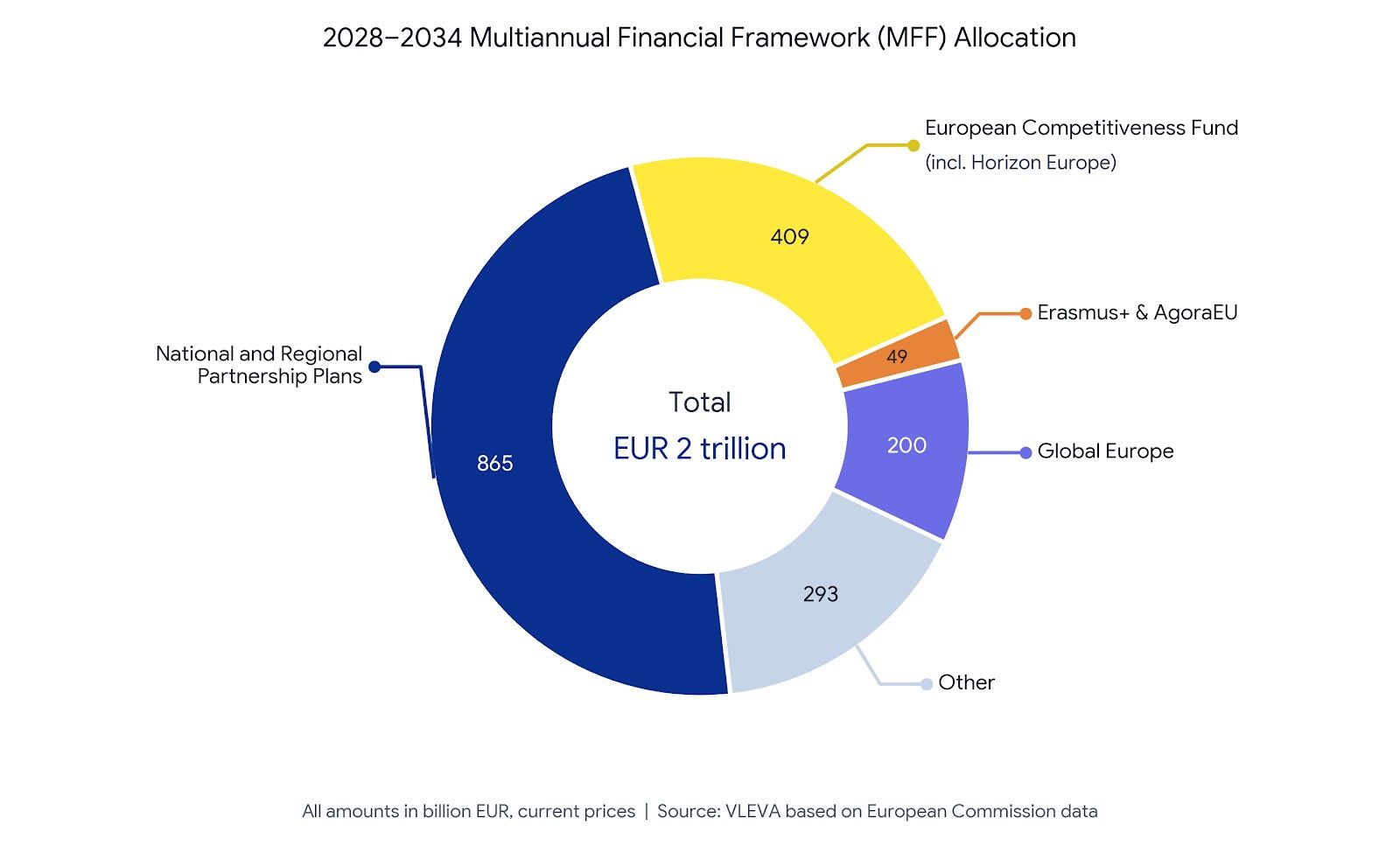
The 2028-2034 MFF comes with an important innovative tool, the National and Regional Partnership Plans (NRPPs).
It leverages the National recovery and resilience plan structure with the aim of integrating and efficiently distributing cohesion, agricultural, migration, and security policies, which until now, were standalone budget components.
This new plan is going to be sustained by a €865bn “mega fund”, the National and Regional Partnership Fund (NRPF).
This reform seeks to simplify and harmonise EU budget rules, extend budget flexibility and strengthen performance assessments. It would in fact reduce the number of MFF headings from 7 to 4 and the number of spending programmes from 52 to 16. (EU commission, 2025)
Figure 1: MFF Fund Allocation
Source: VLEVA based on EU Commission Data
This new performance-based model substantially differs also in how the EU funds the projects to member states.
In fact, under this model EU payments to Member States depend primarily on the achievement of agreed milestones and targets, rather than reimbursement of actual expenditure incurred; implying that verification of actual costs is no longer the principal condition for the Commission's payment (EUR-lex, 2025).
While performance-based disbursement may strengthen incentives to achieve policy objectives and reduce administrative burdens, decoupling EU payments from actual expenditure could weaken financial oversight. In particular, It may complicate assessments of cost efficiency, reduce the traceability of funds to final beneficiaries, and increase reliance on national audit systems.
NRPP Structure
The NRPP funding is divided into 6 broad categories: CAP, fisheries, less developed regions, Migration and security, and remaining flexible allocation. To properly understand the funding allocation of the NRPPs, it is important to distinguish between sector-specific protected funding, geographically protected funding, and resources that Member States can allocate more flexibly.
Figure 2: NRPP funds allocation
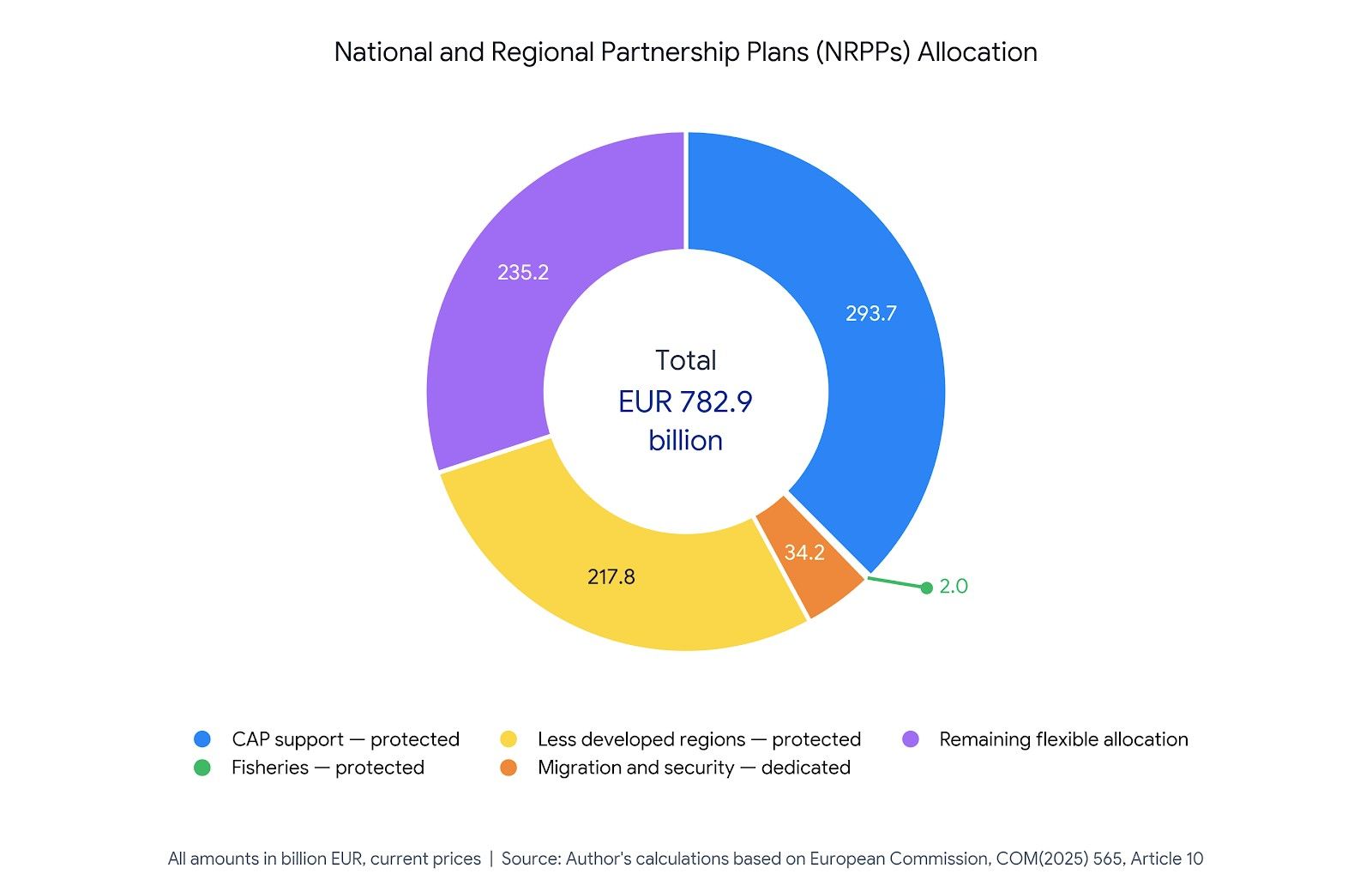
Source: author's calculations based on European Commission, COM(2025) 565, Article 10. Note: The last two segments subdivide the €453bn non-sector-ring-fenced amount. The lessdeveloped-regions earmark is geographic and may overlap with certain eligible policy interventions; this chart is therefore a simplified accounting illustration rather than five legally mutually exclusive funds
CAP
As illustrated in Figure 2, the largest individual protected allocation is directed towards the Common Agricultural Policy (CAP), amounting to €293.7 billion. The proposed framework would replace the CAP's traditional two-pillar financing structure by integrating agricultural interventions into the NRPPs. Compared with the €386.6 billion allocated to the CAP under the current MFF, this represents a headline nominal reduction of approximately 24% in guaranteed funding. However, this comparison does not account for all agricultural expenditure potentially financed under the new framework. After considering additional rural development funding and the agricultural crisis reserve, the European Economic and Social Committee estimates a smaller reduction of approximately 16% in minimum CAP funding (EESC, 2026). The elimination of Pillar II as a separately financed instrument is particularly significant for the future of EU agricultural investment. Unlike Pillar I, which primarily provides income support, Pillar II focuses on rural development, including farm modernisation, infrastructure, environmental measures, and long-term investment. Although these interventions would remain eligible under the proposed NRPP framework, and some would continue to benefit from protected funding, other rural development measures would depend on resources allocated within the broader NRPP envelope. This could reduce the predictability of agricultural investment financing and increase competition between agricultural projects and other national priorities.
Moreover, the absence of a separate agricultural fund, combined with greater national discretion over resource allocation, could lead to increasing disparities in agricultural support across Member States. Such differences risk distorting competition between European farmers, weakening the common character of the CAP and reducing coordination in addressing shared agricultural challenges (ECA, 2026).
Flexible Allocation
The second-largest share of NRPP funding, €235.2 billion, corresponding to approximately 30% of the proposed envelope, constitutes the remaining flexible allocation, one of the most significant innovations of the new MFF. By granting Member States greater discretion in allocating resources across cohesion, agriculture, rural development, housing, social policy, and other eligible priorities, the reform introduces a crucial trade-off for the future of EU funding and policy coordination. While greater flexibility could allow EU resources to better address national economic needs, it could also weaken investment predictability, additionality, and territorial cohesion. Moreover, greater national discretion could lead to increasingly divergent approaches to common European challenges, potentially undermining policy coordination at the EU level. In particular, greater national discretion and the integration of previously separate programmes could weaken regional autonomy and undermine the territorial objectives of cohesion policy (Bruegel, 2026). Furthermore, the proposed 14% social-spending target encompasses a broad range of interventions and may not provide the same level of protection for specific objectives, such as child poverty and social inclusion, as the existing framework (Bocconi IEP, 2026).
On the other hand, the integration of previously separate programmes could improve the coordination of complementary investments within a common development strategy (Bruegel, 2026). By reducing fragmentation between funding instruments, the NRPP architecture could facilitate more coherent investment strategies, potentially increasing the effectiveness of EU expenditure.
Consequently, greater flexibility may improve the allocation of EU resources, but could also intensify competition between policy priorities, reduce investment predictability, and make the distribution of funding more dependent on national political choices.
Is de-centralised spending the right choice for our future?
Simplification could come with significant costs for EU cohesion and policy coordination. First, the introduction of national plans would create a privileged relationship between Member States and the European Commission, the two actors responsible for negotiating and approving them. While increased flexibility in allocating resources could allow governments to channel funds towards more urgent priorities and potentially improve absorption rates, it could also strengthen national interests at the expense of common European objectives. This risks weakening EU integration and its capacity to pursue a coherent, long-term policy agenda, as Member States could increasingly diverge in their approaches to crucial challenges for future generations, such as agriculture, housing affordability, and social inequality. Such fragmentation could undermine the development of common European strategies and reduce the EU's ability to address challenges that require coordinated action. Second, the introduction of a performance-based disbursement system could have significant implications for sound financial management, accountability, and transparency regarding final beneficiaries.
4.2 Security is Inherited too
Intergenerational Tension
Europe is right to rearm. But it treats climate change as an intergenerational question and defence as an emergency, and that is a category error young Europeans will pay for.
Today’s young Europeans grew up in a Europe that took peace for granted. They were children when governments across the continent decided that defence could wait, and young adults when the bill arrived in February 2022. On climate, Europe has since learnt to speak the language of future generations. In Germany, the Constitutional Court has ruled that deferring emission cuts unconstitutionally shifts the burden onto future generations and restricts their freedom (Federal Constitutional Court of Germany, 2021). Defence receives no such treatment in the EU’s fairness strategy. The strategy calls the security and defence of the EU ´among the most pressing concerns of Europeans, especially young people’, and building up defence readiness through the SAFE instrument as an investment 'for a peaceful future’ (European Commission, 2026). Yet none of its 15 actions concerns defence. Instead, Europe’s largest intergenerational investment of this decade is being financed through emergency instruments, designed for speed rather than for the long term. There were good reasons for speed; when the threat is immediate, emergency procedures deliver. The question is what happens when the emergency ends.
History shows why that matters. The EU’s own White Paper concedes that Europe’s 'defence readiness has been weakened by decades of under-investment’ and that member states’ stocks are 'depleted’ (European Commission and High Representative, 2025a). When war returned to Europe, the cost of that saving became visible. The EU pledged in March 2023 to deliver one million artillery shells to Ukraine within 12 months, but reached the target only in November 2024, eight months late (Euronews, 2024; Eunews, 2024). Capacity cut in peacetime cannot be brought back quickly in a crisis. Emergency thinking invites the same cycle again: surge when threatened, cut when the threat seems to pass. In defence, the costliest intergenerational mistake has never been spending too much. It has been stopping too soon.
Rearmament is not without cost. Young Europeans face rising housing costs and the cost of living, and money spent on defence is money not being spent elsewhere. Many young people would rather see that money spent on homes, and that concern is legitimate. But security is the condition on which every other inheritance depends, and the defence investments most exposed in current budget negotiation, such as transport corridors and civil protection, serve civilian life as well.
Youth Perspective
Young Europeans are not reluctant about defence. In 2025, security and defence topped our list of priorities for the EU (European Commission, 2025b). Nor do we want less Europe: we are more likely than Europeans overall to want the EU to have greater means, and more likely than any older group to want a stronger European Parliament (European Parliament, 2026).
We are also the generation being asked to serve again. Denmark extended compulsory service to women in 2025, Croatia reintroduced conscription for young men in 2026, and France is introducing a ten month voluntary service for 18 and 19 year olds from summer 2026 (The Local, 2025; Croatian Ministry of Defence, 2025). The problem is not that young people are asked to serve. It is that they are rarely asked about it. The Commission’s tool for assessing how its policies affect young people has been applied to its consumer and ocean policies, but not to its main defence initiatives.
The aim is not to give young people a veto over defence. It is to treat Europe’s security as the EU already treats its climate: as something owed to those who will inherit it.
Evidence
The fairness tools do not reach defence.
The Commission’s Youth Check, which assesses how major new initiatives affect young people, listed 12 initiatives in 2025, from the Consumer Agenda to the Ocean Pact. The only security item was the Preparedness Union Strategy; none of the major defence initiatives, including the
White Paper on Defence, SAFE, and the Defence Readiness Roadmap, appears among them (European Commission, 2025a).
Defence decisions span generations.
The Commission’s Roadmap states that what Europe does this decade ´will shape the security of the continent for the whole century’ (European Commission and High Representative, 2025b). SAFE lends member states up to €150 billion, repayable over as long as 45 years (European Commission, 2025c; Council of the EU, 2026a). Nineteen member states took part in the first round, and in October 2026 the Commission opened a second call for the remaining €21.3 billion, asking governments to prioritise urgent needs such as air and missile defence, drones, and ammunition (European Commission, 2026b). The rationale remains one of emergency. SAFE was adopted under an emergency procedure without the European Parliament, which has asked the Court of Justice to annul it on procedural grounds while supporting SAFE itself (Eunews, 2025).
The lasting investments are under pressure
In the Presidency’s October 2026 draft of the next EU budget for 2028 to 2034, defence funding still rises sharply on today’s levels. But compared with the Commission’s proposal, military mobility is trimmed by 11 per cent and civil protection by 35 per cent, while the overall budget falls by eight per cent (Council of the EU, 2026b). These are the shared investments the next generation will inherit.
2028 is the moment of decision
The national escape clause for defence spending runs until 2028, the new budget begins that year, and the Commission’s first progress report on intergenerational fairness is due in early 2028 (Council of the EU, 2026c; European Commission, 2026).
4.3 European Industrial Policy
European industry needs a thorough reform. However, changing a system that employs millions of people will inevitably create social tensions. Yet delaying the reform will only worsen the situation and increase the burden of future transformation.
The Struggle of European Industry
Industrial production has long been a pillar of Europe's export-driven economy. Although in decline, industrial production accounted for only 14% of European GDP in 2025 (Country official statistics, National Statistical Offices (NSOs); National Accounts data files, Central Banks; Staff estimates, World Bank (WB), n.d.), it remains important to European welfare states.
Across the continent, manufacturing offers millions of well-paying, stable, and accessible jobs.
Moreover, unlike services, jobs in manufacturing are not reliant on proximity to big cities. Likewise, university education is not a requirement. Thus, the primary beneficiaries of manufacturing done in Europe are lower-class workers from smaller cities, who would otherwise struggle to find other well-paying jobs. Furthermore, a robust defence industry is a huge part of the continent’s overall defensive capability, providing tailored weapons and prioritising the needs of European militaries, which is not the case with other sellers. Thus, the decline of the European industrial base should be viewed in a much wider context than slow growth alone, as it endangers the financial stability and security of many Europeans.
The threat of deindustrialisation is not only a concern for the future, but a real force today.
Hundreds of thousands of jobs have been cut, most notably in the car manufacturing industry, but also in other industries. Thus, it presents a choice to the legislators: support the struggling industries to preserve jobs or invest in the future.
The Issue of Innovation
It is often said that European manufacturing struggles in two key areas: innovation and high operating costs. However, this diagnosis is only partially true, as it omits the technological complexity of manufactured products and its relation to price. Historically, Europe specialised in high-value-added manufacturing, where competition centred on product quality and scarcity, not price. Companies paid high wages to skilled workers who produced quality items, and the customers paid the price knowing that they were buying a highly specialised, well-crafted product. However, a product's technological complexity is always relative. As technology progresses, the production methods become more known, and the product becomes mid- or even low-tech. Thus, producing advanced goods continuously requires constant investment in new technologies.
Most European companies neglected innovation investment, opting instead to improve production methods (Fuest, 2024), which has pushed their products down the technology advancement ladder. The market for less advanced goods differs from the high-tech market. Customers usually have many more alternatives; thus, the price is often the deciding factor. As a result, many companies are now racing to cut costs. European companies are at a direct disadvantage in this environment because of higher inherent costs. European hourly wages are much higher than in Asia (International Labour Organization & International Labour Organization. Inclusive Labour Markets, Labour Relations and Working Conditions Branch, 2024). Moreover, European companies spend more on testing and quality assurance per product compared to Chinese companies, which are often their biggest competition (MarketsandMarkets, 2026). Thus, European companies struggle to compete, not because of high operating costs, but because their operations were never designed to compete on price.
Today, European industry finds itself trapped. Its previous growth engine has run its course, pushing many companies to invest in innovation. However, their ability to invest is limited after profits declined as their products moved down the value-added ladder. Moreover, because continuous innovation was neglected, the initial investment will be much higher (Ideascale, 2013). Yet these investments are necessary to maintain future profitability. Hence, companies restructure by shedding employees and seeking savings.
Workers across Europe already feel the impact of the struggling industry, as millions have been laid off in past years (European Trade Union Confederation, 2024; O’Carroll, 2026). Moreover, new openings are limited and are often tied to high-tech sectors, thus requiring additional skills. Laid-off workers often lack the time or resources to learn new skills in this fast-paced environment. Thus, many of them face difficulties re-entering the job market.
This creates a clear point of conflict between younger and older generations. In the finite reality of the European budget, the two aspects of the current industrial crisis are directly at odds. Supporting current business operations will stabilise the volatile manufacturing job market. Furthermore, this solution benefits the short-term economy, as the invested funds are likely to produce returns quickly. On the contrary, reinvigorating the industry through large-scale investments in cutting-edge technology will take much more time, and in the meantime the decline of traditional manufacturers might worsen the situation for workers. However, it is the only solution promising a sustainable social contract for future generations. Young people realise the pain of transformation; but they also understand the need to reinvigorate European manufacturing.
The Role of Defence Spending
The European defence market developed to serve the needs of European countries, which mainly fought much weaker opponents in the past several decades. Thus, the European militaryindustrial complex produces advanced weapon systems, but only in limited capacity
(International Institute for Strategic Studies [IISS], 2026). As such, it is not well positioned to supply the continent for a prolonged war against a comparable adversary.
The military spending boom is hoped to boost European manufacturing and, more importantly, stagnant GDP growth. However, these are just secondary effects. The main goal of European rearmament is to prepare the continent for a potential war, which should be reflected in the equipment purchases (Koh, 2026). Following the examples of recent conflicts, the war in Ukraine and the war in the Middle East, Europe should increase its production capacity and invest in low-cost weapon systems. Although not as sophisticated, simple drones have been used en masse to exhaust opponents’ reserves of more advanced weapons.
Europe needs simple weapons but in large numbers, which is both a blessing and a disguise. Ramping up the production of simple weapons will not stimulate GDP nearly as much as more advanced high-margin systems. However, countless new positions will be created due to the sheer number of required weapons. Moreover, defence production is a key strategic sector. Thus, the positions created there are more secure, as no country would allow its industrial base to wither away.
The future of European manufacturing
European manufacturing is at a crossroads. Following years of neglecting innovation, many of its most successful products have lost their technological edge. Thus, becoming less competitive. This has led to much lower profits for many of the European companies. At the same time, the defence sector of European manufacturing must adjust to the new reality of warfare. The key question lies in how to respond to this crisis.
5. Conclusion
Intergenerational fairness is not simply about protecting the future; it is about making better decisions today. Whether in democratic representation, technological transformation or European security, young people must be recognised not only as those who will inherit the consequences of today’s choices, but also as stakeholders in shaping them.
The proposals in this report share a common objective: to make European policymaking more inclusive, forward-looking and accountable across generations. Achieving this requires concrete action, from strengthening youth participation and creating fair opportunities in an AI-driven labour market to ensuring that long-term European investments reflect the interests of those who will inherit them.
VOYCE calls on European institutions to turn intergenerational fairness into a practical policy commitment. Young Europeans are ready to contribute. The challenge is to ensure that their voices are heard, their perspectives are considered and their future is meaningfully reflected in the decisions made today.
6. References
Al Jazeera (2026). ‘Protests spread across France as "yellow vests" set to join’, Al Jazeera, 17 October. https://www.aljazeera.com/news/2026/10/17/france-braces-for-nationwide-protests-with-yellow-vestmembers-set-to-join
Banque des Territoires (2026). ‘Rejoint par les étudiants, le mouvement lycéen prend de l'ampleur et le Premier ministre convoque une cellule de crise’, Banque des Territoires. https:// www.banquedesterritoires.fr/rejoint-par-les-etudiants-le-mouvement-lyceen-prend-de-lampleur-et-lepremier-ministre-convoque-une
BBC News (2026). ‘"Everyone hates the police" – what France's school protests reveal about a divided nation’, BBC News, 9 October. https://www.bbc.com/news/articles/crq5nlqnn184o
Belschner, J. (2024). ‘Too young to win? Exploring the sources of age-related electoral disadvantage’,
Electoral Studies, 88, 102748. https://doi.org/10.1016/j.electstud.2024.102748
Bruegel (2026). National Plans, Regional Voices: Cohesion Policy in the Next European Union Budget (Z. Darvas, M.-S. Lappe, B. Sangers & J. Zettelmeyer), Policy Brief 06/2026, March.
Café pédagogique (2026). ‘Grève du 5 novembre : professeurs et lycéens ont manifesté nombreux malgré les annonces du gouvernement’, Le Café pédagogique, 5 November. https://www.cafepedagogique.net/ 2026/11/05/greve-du-5-novembre-professeurs-et-lyceens-ont-manifeste-nombreux-malgre-les-annoncesdu-gouvernement/
CIDOB (2024). Is the European Union Young?, CIDOB. https://www.cidob.org/en/publications/europeanunion-young
Council of the EU (2026a). ‘What is Security Action for Europe (SAFE)?’, Consilium, 15 June. https:// www.consilium.europa.eu/en/policies/safe/
Council of the EU (2026b). Multiannual Financial Framework (MFF) 2028–2034: Negotiating Box,
Document 13922/26, Brussels, 10 October. https://data.consilium.europa.eu/doc/document/ ST-13922-2026-INIT/en/pdf
Council of the EU (2026c). ‘European defence readiness’, Consilium. https://www.consilium.europa.eu/ en/policies/european-defence-readiness/
Croatian Ministry of Defence (2025). ‘Croatia Introduces Mandatory Military Service’. https:// www.morh.hr/en/croatia-introduces-mandatory-military-service/
de Puget, A. & Ilario, M. (2026). ‘Parcoursup, bâti, enseignants, bourses : les réponses du gouvernement à la mobilisation lycéenne’, L'Étudiant, 26 October. https://www.letudiant.fr/lycee/parcoursup-batienseignants-bourses-les-pistes-du-gouvernement-pour-repondre-a-la-mobilisation-lyceenne.html
Delaney, M. (2024). ‘Retire to the European Parliament? Young MEPs are few and far between’, European Data Journalism Network (EDJNet). https://www.europeandatajournalism.eu/cp_data_news/ retire-to-the-european-parliament-young-meps-are-few-and-far-between/
Electoral Commission (2026). Young People’s Views on Politics and Voting 2026. https:// www.electoralcommission.org.uk/research-reports-and-data/young-peoples-views-politics-andvoting-2026
Eunews (2024). ‘EU managed to deliver one million artillery shells to Kyiv’, Eunews, 20 November. https://www.eunews.it/en/2024/11/20/eu-managed-to-deliver-one-million-artillery-shells-to-kyiv/
Eunews (2025). ‘European Parliament takes EU member state governments to court over the SAFE defense fund’, Eunews, 25 August. https://www.eunews.it/en/2025/08/25/european-parliament-takes-eumember-state-governments-to-court-over-the-safe-defense-fund/
Eurofound (2026). AI Is Already in Use in Europe's Workplaces, but Not at the Expense of Young Workers, Article EF26055, 16 September. https://www.eurofound.europa.eu/default/publications/all/ai-isalready-in-use-in-europe-s-workplaces-but-not-at-the-expense-of-young-workers
Euronews (2024). ‘Borrell satisfied despite EU badly failing ammunition target for Ukraine’, Euronews, 1 February. https://www.euronews.com/2024/02/01/borrell-satisfied-despite-eu-badly-failing-ammunitiontarget-for-ukraine
Euronews (2026a). ‘Dozens arrested as protesters clash with security forces in Paris’, Euronews, 17 October. https://www.euronews.com/2026/10/17/france-braces-for-tense-protests-as-security-concernstake-centre-stage
Euronews (2026b). The New Multiannual Financial Framework (MFF): A Future Vision for the EU (M. Töns), Euroviews, 16 October.
European Central Bank (2026). Economic Bulletin, Issue 5/2026 (Focus box on youth employment and AI). https://www.ecb.europa.eu/press/economic-bulletin/focus/2026/html/ ecb.ebbox202605_04~faa9ef5955.en.html
European Commission (2024a). Education and Training Monitor 2024. https://op.europa.eu/webpub/eac/ education-and-training-monitor/en/comparative-report/chapter-2.html
European Commission (2024b). Report on the Interim Evaluation of the EU Youth Strategy 2019–2027,
SWD(2024) 90 final. https://eur-lex.europa.eu/legal-content/EN/TXT/?uri=celex:52024DC0162
European Commission (2025a). Commission Survey Shows Most Europeans Support Use of Artificial Intelligence in the Workplace, Press release (Eurobarometer on AI and the future of work), 13 February. https://digital-strategy.ec.europa.eu/en/news/commission-survey-shows-most-europeans-support-useartificial-intelligence-workplace
European Commission (2025b). Questions and Answers on ReArm Europe Plan / Readiness 2030, Brussels, 19 March. https://ec.europa.eu/commission/presscorner/api/files/document/print/en/ qanda_25_790/QANDA_25_790_EN.pdf
European Commission (2025c). ‘Commission expands youth participation with new Youth Report, Eurobarometer survey and online debate’, Press release presenting Flash Eurobarometer 556: Challenges and Priorities in the EU, Young People’s Views, 25 March. https://cyprus.representation.ec.europa.eu/ news/commission-expands-youth-participation-new-youth-report-eurobarometer-survey-and-onlinedebate-2025-03-25_en
European Commission (2025d). EU Budget 2028–2034 (MFF proposal), 16 July. https:// commission.europa.eu/strategy-and-policy/eu-budget/long-term-eu-budget/eu-budget-2028-2034_en
European Commission (2025e). Proposal for a Regulation Establishing the European Fund for Economic, Social and Territorial Cohesion, Agriculture and Rural, Fisheries and Maritime, Prosperity and Security for the Period 2028–2034, COM(2025) 565 final, Brussels, 16 July.
European Commission (2025f). The 2028–2034 EU Budget for a Stronger Europe, Brussels.
European Commission (2025g). MFF 2028–2034: Support to Rural Areas and Communities, Presentation, Rural Pact Policy Lab, Brussels, 5 November.
European Commission (2025h). Overview of Commission Youth Check in 2025. https://youth.europa.eu/ sites/default/files/inline-files/Overview-of-Commission-Youth-Check-in-2025.pdf
European Commission (2025i). Report on the 2024 Elections to the European Parliament. https://eurlex.europa.eu/legal-content/EN/TXT/HTML/?uri=CELEX%3A52025SC0147
European Commission (2026). Strategy on Intergenerational Fairness, COM(2026) 110 final, 5 March. https://eur-lex.europa.eu/legal-content/EN/TXT/HTML/?uri=COM:2026:110:FIN
European Commission and High Representative of the Union for Foreign Affairs and Security Policy
(2025a). Joint White Paper for European Defence Readiness 2030, JOIN(2025) 120 final, Brussels, 19
March. https://eur-lex.europa.eu/legal-content/EN/TXT/PDF/?uri=CELEX:52025JC0120
European Commission and High Representative of the Union for Foreign Affairs and Security Policy
(2025b). Preserving Peace: Defence Readiness Roadmap 2030, JOIN(2025) 27 final, Brussels, 16 October. https://defence-industry-space.ec.europa.eu/commission-and-high-representative-present-newdefence-roadmap-strengthen-european-defence-2025-10-16_en
European Court of Auditors (ECA) (2026). EU Budget 2028–2034: The ECA's View – Many Changes May Not Make It Better, Luxembourg.
European Economic and Social Committee (EESC) (2026a). The Proposed CAP Reform: Why It Falls Short for Farmers, 21 January.
European Economic and Social Committee (EESC) (2026b). Opinion on the Proposal for a Regulation Establishing the Conditions for the Implementation of Union Support to the Common Agricultural Policy for the Period 2028–2034, Official Journal of the European Union, C/2026/1972, 28 April.
European Parliament (2025a). Stock-taking of the European Elections 2024, Data.europarl.europa.eu. https://data.europarl.europa.eu/en/datasets/texts-adopted-by-the-european-parliament-year2025
European Parliament (2025b). Youth Survey 2024 | FL013EP DGCOMM, Youth Outreach Unit. https:// cdn.edupedu.ro/wp-content/uploads/2025/02/Youth_Survey_2024_FL013EP_report_en.pdf
European Parliament (2026a). ‘EU survey: rising concerns push demand for more European action’, Press release on the European Parliament Autumn 2025 Eurobarometer. https://www.europarl.europa.eu/news/ en/press-room/20260126IPR32643/eu-survey-rising-concerns-push-demand-for-more-european-action
European Parliament (2026b). Fact Sheets on the European Union – 2026. https:// www.europarl.europa.eu/ftu/pdf/en/FTU_1.3.4.pdf
European Parliamentary Research Service (EPRS) (2023). At a Glance: European Elections 2024. https:// www.europarl.europa.eu/RegData/etudes/ATAG/2023/749766/EPRS_ATA(2023)749766_EN.pdf
European Parliamentary Research Service (EPRS) (2024). At a Glance: EPRS | European Parliamentary
Research Service. https://www.europarl.europa.eu/RegData/etudes/ATAG/2024/762356/
European Students’ Union (2026). 5th Student Protests Monitoring: May–July 2026. https://esuonline.org/5th-student-protests-monitoring-may-july-2026/
European Trade Union Confederation (ETUC) (2024). ‘EU loses almost a million manufacturing jobs in just 4 years’, Press release, 18 March. https://www.etuc.org/en/pressrelease/eu-loses-almost-millionmanufacturing-jobs-just-4-years
European Youth Forum (2024). ‘European elections 2024: Young people never had a chance’, European Youth Forum. https://www.youthforum.org/news/european-elections-2024-young-people-never-had-achance
Eurostat (2026a). ‘Median age in the EU increased by 2.1 years since 2015’, Eurostat News Articles. https://ec.europa.eu/eurostat/web/products-eurostat-news/w/ddn-20260213-2
Eurostat (2026b). Population Projections at Regional Level – Statistics Explained. https://ec.europa.eu/ eurostat/statistics-explained/SEPDF/cache/146331.pdf
Eurostat (2026c). Population Structure and Ageing – Statistics Explained. https://ec.europa.eu/eurostat/ statistics-explained/SEPDF/cache/1271.pdf
Federal Constitutional Court of Germany (2021). Order of the First Senate of 24 March 2021, 1 BvR
2656/18 (Neubauer et al. v. Germany). https://www.bundesverfassungsgericht.de/SharedDocs/ Entscheidungen/EN/2021/03/rs20210324_1bvr265618en.html
franceinfo (2026a). ‘Mobilisation lycéenne : depuis le début du mouvement, 165 membres du personnel de l'Education nationale ont été blessés, selon Edouard Geffray’, franceinfo. https://www.franceinfo.fr/ societe/education/blocage-des-lycees/direct-mouvement-lyceen-les-organisations-lyceennes-doivent-etrerecues-pour-la-troisieme-fois-par-le-ministre-de-l-education_8238049.html
franceinfo (2026b). ‘La mobilisation des lycéens a réuni 450 000 manifestants, selon l'intersyndicale, le ministère de l'Intérieur en recense 256 000’, franceinfo, 6 October. https://www.franceinfo.fr/societe/ education/blocage-des-lycees/la-mobilisation-des-lyceens-a-reuni-450-000-manifestants-selon-lintersyndicale-de-la-jeunesse-contre-256-000-d-apres-le-ministere-de-l-interieur_8225587.html
franceinfo (2026c). ‘Mobilisation lycéenne : Emmanuel Macron appelle à une rentrée dans "le calme" lundi’, franceinfo, 28 October. https://www.franceinfo.fr/societe/education/blocage-des-lycees/directmobilisations-des-lyceens-les-deputes-seront-invites-mercredi-a-debattre-a-l-assemblee-nationale-sur-lavenir-de-parcoursup-selon-une-source-ministerielle-a-france-televisions_8256817.html
Fuest, C. (2024). EU Innovation Policy: How to Escape the Middle Technology Trap, ifo Institute / EconPol. https://www.ifo.de/econpol/Zfd
Hart, R. A. (1992). Children's Participation: From Tokenism to Citizenship, Innocenti Essays, No. 4. Florence: UNICEF International Child Development Centre.
Ideascale (2013). ‘Risks of incremental, differential, radical, and breakthrough innovation projects’, InnovationManagement, 29 July. https://innovationmanagement.se/2013/07/29/risks-of-incrementaldifferential-radical-and-breakthrough-innovation-projects/
Institute for European Policymaking (IEP), Bocconi University (2026a). The EU's Next Budget: A Shift Towards a Recovery Fund Model (R. Famà), Commentary No. 358, 23 February.
Institute for European Policymaking (IEP), Bocconi University (2026b). The Social Pillar in the Next Multiannual Financial Framework (R. Famà), Commentary No. 532, 27 October.
International Institute for Strategic Studies (IISS) (2026). The Defence of Europe in a New Era: An Assessment, IISS Strategic Dossier. https://www.iiss.org/publications/strategic-dossiers/the-defence-ofeurope-in-a-new-era-an-assessment/
International Labour Organization (ILO) (2024). Global Wage Report 2024–25: Is Wage Inequality Decreasing Globally?, Inclusive Labour Markets, Labour Relations and Working Conditions Branch.
https://www.ilo.org/sites/default/files/2024-11/GWR-2024_Layout_E_RGB_Web.pdf
International Labour Organization (ILO) (2025). Generative AI and Jobs: A 2025 Update, Research Brief,
May. https://www.ilo.org/publications/generative-ai-and-jobs-2025-update
Koh, P. (2026). ‘European security and defence spending: An economic burden or boon?’, European Investment Bank, 22 September. https://www.eib.org/en/stories/europe-defence-spending-economicimpact
Le Devoir (2026). ‘En France, la colère des lycéens amplifiée par la répression policière’, Le Devoir. https://www.ledevoir.com/monde/europe/1015307/passe-il-lyceens-france
Lonean, I. & Bradt, L. (2024). Review of the 9 Cycles of the EU Youth Dialogue (2010–2022): Executive Summary (L. Pasic, Ed.), EU–Council of Europe Youth Partnership. https://pjp-eu.coe.int/en/web/youthpartnership/-/review-of-the-9-cycles-of-the-eu-youth-dialogue-2010-2022-executive-summary
Lundy, L. (2007). ‘"Voice" is not enough: conceptualising Article 12 of the United Nations Convention on the Rights of the Child’, British Educational Research Journal, 33(6), pp. 927–942.
Macron, E. (2026). Adresse aux Français, 18 October. Paris: Élysée. https://www.elysee.fr/emmanuelmacron/2026/10/18/adresse-aux-francais-7
MarketsandMarkets (2026). Testing, Inspection, and Certification (TIC) Market. https:// www.marketsandmarkets.com/Market-Reports/testing-inspection-certification-market-5352498.html
Merino, À. (2024). ‘Brussels shuts the door on diversity: A European Parliament without young people and minorities’, European Data Journalism Network (EDJNet). https://www.europeandatajournalism.eu/ cp_data_news/brussels-shuts-the-door-on-diversity-a-european-parliament-without-young-people-andminorities/
Ministère de l'Éducation nationale (2026). Construire des solutions avec les lycéens, 9 October. https:// www.education.gouv.fr/construire-des-solutions-avec-les-lyceens-506143
O’Carroll, L. (2026). ‘EU faces 300,000 factory job cuts as China "colonises" supply chains, industry warns’, The Guardian, 6 September. https://www.theguardian.com/business/2026/sep/06/eu-factory-jobcuts-china-colonises-supply-chains-industry-warns
OECD (2020). Governance for Youth, Trust and Intergenerational Justice: Fit for All Generations? (‘Empowering youth to succeed: A call for action’), 22 October. https://www.oecd.org/en/publications/ governance-for-youth-trust-and-intergenerational-justice_c3e5cb8a-en/full-report/component-8.html
OECD (2026a). OECD Employment Outlook 2026. https://www.oecd.org/en/publications/oecdemployment-outlook-2026_7e710f54-en.html
OECD (2026b). Young People, Labour Markets and AI: What OECD Evidence Shows, August. https:// www.oecd.org/en/blogs/2026/08/young-people-labour-markets-and-ai-what-oecd-evidence-shows.html Ouest-France (2026a). ‘« On portera nos revendications » : les lycéens reçus par Emmanuel Macron, entre fortes exigences et faibles attentes’, Ouest-France, 23 October. https://www.ouest-france.fr/education/ ecole/on-portera-nos-revendications-les-lyceens-recus-par-emmanuel-macron-entre-fortes-exigences-etfaibles-attentes-6bc431d4-cebc-11f1-95ba-26d2045f6620
Ouest-France (2026b). ‘Mobilisation lycéenne et étudiante : 48 lycées sont bloqués sur l'ensemble du territoire, annonce le ministère’, Ouest-France, 3 November. https://ouest-france.fr/societe/manifestation/ direct-mobilisation-lyceenne-et-etudiante-48-lycees-sont-bloques-sur-lensemble-du-territoire-annonce-leministere-3f2c0bf6-9120-4048-8002-c7750d7ce2b2
Pew Research Center (2026). What Do Young People Around the World Think About AI?, 17 September. https://www.pewresearch.org/global/2026/09/17/what-do-young-people-around-the-world-think-about-ai/
SNES-FSU (2026). Rentrée 2026 dans les collèges et lycées de l'académie de Limoges : encore pire que prévu !, Press release, 27 January. https://limoges.snes.edu/IMG/pdf/ communique_de_presse_rentree_2026_27_janvier_2026.pdf
Stanford Digital Economy Lab (2026). Canaries in the Coal Mine? August 2026 Update, 12 August. https://digitaleconomy.stanford.edu/news/canariesaug26/
Sud Radio (2026). ‘Crise dans l'éducation : blocages et manifestations en vue en France pour la reprise des cours’, Sud Radio. https://www.sudradio.fr/societe/crise-dans-leducation-blocages-et-manifestationsen-vue-pour-la-reprise-des-cours
The Local (2025). ‘Threat of war: Which countries in Europe have military service?’, The Local, 27 November. https://www.thelocal.dk/20251127/threat-of-war-which-countries-in-europe-have-militaryservice
World Bank (n.d.). Manufacturing, value added (% of GDP) — European Union. https:// data.worldbank.org/indicator/NV.IND.MANF.ZS?locations=EU
Zeglovits, E. & Aichholzer, J. (2014). ‘Are people more inclined to vote at 16 than at 18? Evidence for the first-time voting boost among 16- to 25-year-olds in Austria’, Journal of Elections, Public Opinion and Parties, 24(3), pp. 351–361. https://pmc.ncbi.nlm.nih.gov/articles/PMC4864896