
Quantum-Safe Cryptography: Securing Europe’s Space Communications in the Quantum Era
Aleksandra Grbović Bitić
17 min read · 3,499 words
Date: 20-10-2025
“As we enter the quantum era, post-quantum cryptography is essential to ensure a high level of cybersecurity, fortifying our systems against future threats. The post-quantum cryptography roadmap provides a clear direction to ensure the robust security of our digital infrastructure."
-
Henna Virkkunen, Executive Vice-President for Technological Sovereignty, Security, and Democracy of the EU Commission
Introduction: The Quantum Threat to Europe’s Space Communications
The quantum world operates by rules fundamentally different from those governing our everyday, classical reality. In the classical realm, information is stored and processed in predictable, measurable ways; here, spacecraft soar into orbit and signals travel across the oceans. However, in the quantum world, particles such as photons and electrons can exist in multiple states at once, interact instantaneously across distance, and behave in ways that defy classical logic, and due to these properties, quantum technologies possess extraordinary potential: sensing with unmatched precision, computing at unfathomable speed, and communicating with security beyond today’s limits (IBM, 2025).
Yet, that very strength also represents a formidable challenge. Quantum
computers, machines which utilise quantum mechanics to process information, could break the cryptographic systems that protect modern communication networks. Algorithms such as RSA and elliptic-curve cryptography (ECC), which secure satellite data links and global navigation systems, rely on mathematical problems that are nearly impossible for classical computers to solve (Gilbert, 2024). A sufficiently advanced quantum computer, however, could solve them in moments, rendering current encryption obsolete (Uçar, 2024).
For Europe, whose strategic autonomy depends on secure and uninterrupted satellite communications, this emerging quantum threat strikes at the heart of sovereignty. If encryption fails, so too does the reliability of systems that guide planes, coordinate defense operations, and synchronise financial networks. Due to Europe’s fragile position in the worldwide quantum race, the risk is merely amplified even more. According to the Draghi Report on EU Competitiveness (2024), none of the top ten quantum computing firms by investment are based in Europe, and the continent attracts
only around 5% of global private capital in quantum computing compared to nearly 50% in the United States. The report also identifies six critical dependencies across seventeen enabling technologies, where Europe relies heavily on non-EU suppliers, particularly from the United States and China (Draghi, 2024). Without stronger industrial capacity, Europe’s technological sovereignty, including its ability to secure space communications, remains at risk.
Taking this into account, and considering the advances in quantum technology, Europe faces a decisive test: whether it can adapt faster than the threat evolves (European Commission, 2025d). In this article, we will examine how quantum-safe cryptography can safeguard Europe’s space communications — ensuring resilience, sovereignty, and trust in the quantum era.
The Backbone of the European Space Comms: Why it matters
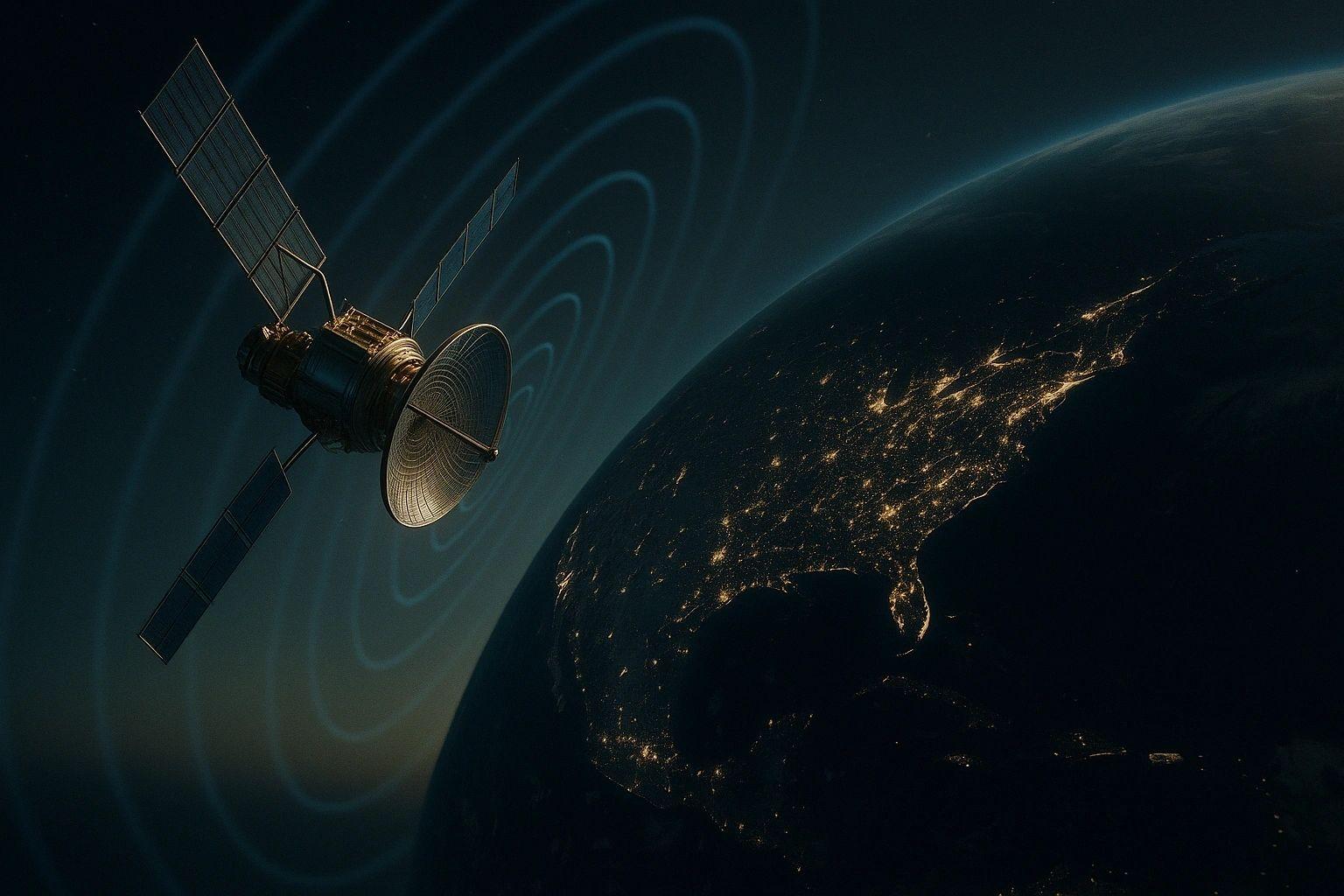
Europe's satellites are more than merely spacecraft; they are the invisible nervous system of the continent. Numerous systems, such as Galileo for navigation, Copernicus for environmental monitoring, Eutelsat for commercial communications, and secure government satellites, collectively work together to facilitate a vast array of services, spanning from daily digital activities to critical defense operations (ESA, 2025a; ESPAS, 2025).
‘Space communication’ refers to more than merely transmitting signals into orbit. It includes uplink channels that send instructions from ground stations to satellites, downlink channels that deliver data back to Earth, inter-satellite links that relay information across orbits, and ground-to-space command systems that manage and steer satellites (Emon, 2022). It is critical to maintain the consistent operation of all of them. Even small disturbances in their operation have the potential to have far-reaching effects on digital infrastructure, air traffic, navigation, and emergency response.
This substantial reliance makes the necessity of quantum-safe cryptography evident. In fact, if the encryption securing the communications fails, sensitive data could be intercepted or manipulated. Therefore, securing these channels is not merely a technical concern but is essential for the continent’s strategic autonomy and operational resilience (JRC, 2022).
The Quantum Computing Threat: From Theory to Urgency
Unlike classical computers, which process information sequentially, quantum exploit qubits that can exist in multiple states simultaneously, which, therefore, enables them to perform complex calculations exponentially faster (NIST, 2024a). Europe’s space communication still depends on cryptographic systems such as RSA and elliptic-curve cryptography (ECC), systems that were built on the premise that their underlying mathematical problems were too complex for classical computers to solve. However, recent research shows that this premise is becoming increasingly fragile (ESA, 2025a). Therefore, it is clear that their capability pose a direct threat to the security of Europe’s communications (Gartner, 2024).
A recent study suggests that breaking RSA-2048 encryption might become feasible in under a week using fewer than one million noisy qubits, dramatically lowering the bar from previous predictions (Gidney & Ekerå, 2025). Further, according to another analysis warns that asymmetric cryptography could become unsafe as early as 2029, and broadly breakable by 2034 (Gartner, 2024). For Europe, this means that some of the signals keeping governments, satellites and critical infrastructure connected may soon be exposed.
Hence, the threat is not purely theoretical. Adversaries may already be recording encrypted communications - satellite telemetry, government orders, strategic air-traffic data. The intent behind it is to decrypt them later when quantum technology matures. This tactic, called the ‘harvest now, decrypt later,’ turns what seems like benign data today into tomorrow’s vulnerability (HashiCorp, 2025). Confirming this, the U.S. National Institute of Standards and Technology (NIST)’s cybersecurity division warns that intercepted data today could be retroactively exposed once quantum computing matures enough (NIST, 2024a). In practice, it means that transmissions sent under today’s “secure” shield could be readable years down the line.
In response, the U.S. National Institute for Standards and Technology finalised the first three Post-Quantum Cryptography (PQC) standards in 2024. And with it, it set the stage for quantum-resistant encryption (NIST, 2024d; NIST, 2024b). Meanwhile, Europe is following suit, albeit at a slower institutional rate. The European Commission, acknowledging the urgency, published a Coordinated Implementation Roadmap for PQC transition. Nevertheless, a consistent timeline across member states is still lacking (European Commission, 2024a; European Commission, 2025c).
In the last five years, the European Union has already spent about €2 billion on quantum technologies. And it plans to spend another €9 billion until 2030. However, private investment in European quantum start-ups declined by almost 40% in 2024, while it tripled in the U.S (QuIC, 2025).
For Europe, the stakes extend far beyond science. The integrity of its satellite networks is essential for its strategic autonomy, defense readiness, and economic stability. Thus, understanding this threat is crucial because securing Europe’s space infrastructure is no longer just a matter of technology, but of sovereignty and survival (Geremew & Mohammad, 2024).
Quantum-Safe Cryptography: Europe’s Defensive Strategy
At the heart of Europe’s defense is quantum-safe cryptography, which blends two complementary approaches to preserve confidentiality: first, Post-Quantum Cryptography (PQC), which relies on new mathematical algorithms designed to resist quantum attacks, standardised by the U.S. National Institute of Standards and Technology in 2024 (FIPS 203/204/205: Kyber for key establishment; Dilithium and SPHINCS+ for digital signatures) (NIST, 2024d; NIST, 2024b), second, Quantum Key Distribution (QKD), which takes a physics-based approach, using the laws of quantum mechanics to transmit encryption keys as individual photons — where any attempt at interception alters the signal and exposes eavesdropping (Bedington et al., 2017) (Liao, 2017).
Due to the fact that PQC can be integrated through software and firmware upgrades, it provides the fastest way to harden existing systems, from satellite ground control to encrypted inter-agency communications. In 2024, the European Commission issued the Coordinated Implementation Roadmap for the Transition to Post-Quantum Cryptography (PQC). In it, it urges all member states to begin adopting quantum-resilient algorithms in critical sectors by 2030 (European Commission, 2024a, 2025c). The roadmap broadly aligns with NIST’s own standardisation of Kyber for key establishment, and Dilithium and SPHINCS+ for signatures, paving a transatlantic path to interoperable security (NIST, 2024b; NIST, 2024d).
Yet PQC alone cannot guarantee absolute protection. Europe’s second line of defence, Quantum Key Distribution (QKD), adds a physical layer of assurance. QKD does not depend on computational difficulty but on the behaviour of photons: if an intruder intercepts a key, the act itself disturbs the signal, instantly exposing the breach (Bedington et al., 2017). Building on China’s pioneering Micius experiment (Liao, et al., 2017), Europe is developing its own sovereign QKD infrastructure through missions such as EAGLE-1 and SAGA, coordinated by the European Space Agency (ESA) and integrated into the European Quantum Communication Infrastructure (EuroQCI) (ESA, 2025b; European Commission, 2025b). These systems are designed to deliver
quantum-secure key exchange between satellites, ground stations, and government networks. Therefore, ensuring that Europe’s most sensitive data can move safely across space and terrestrial domains.
Crucially, this strategy does not treat PQC and QKD as competitors but as complements. PQC offers scalability and rapid deployment across Europe’s digital ecosystem. While QKD protects the highest-priority communication routes, defense coordination, crisis response, and government command links. Together they form a hybrid security architecture that reflects Europe’s pragmatic approach (European Commission, 2025b).
However, coordination and investment will certainly be crucial for the road ahead. The effort involved in transitioning to PQC might extend for years and affect vital infrastructure (NIST, 2024c). For QKD, studies suggest a hybrid terrestrial and space quantum backbone, with testbeds and optical ground segments managed by EuroQCI to control costs and complexity (JRC, 2022). As the IETF TLS group notes, “post-quantum public keys and ciphertexts can run from hundreds of bytes to over one hundred kilobytes,” which makes handshakes heavier on thin links (IETF, 2025). This is likely only one of several frictions to expect. While NIST describes PQC migration as a multi-year effort across protocols, PKI, and interfaces (NIST, 2024c; NIST, 2023).
In each one of these challenges a point of innovation may be represented. The European Union efforts span superconducting prototypes and photonic roadmaps (Quandela’s 2024–2030 plan). While EU–ESA coordination continues under EuroQCI arrangements (IQM, 2025; Quandela, 2024; European Commission, 2025b). On deployment, pilots such as EAGLE-1 and ESA’s SAGA are described as stepping-stones toward operational key delivery with partners including SES and Thales Alenia Space (ESA, 2025b; SES, 2024).
Thus, Europe’s window appears open. If timelines, interoperable profiles, and day-to-day practice converge, quantum-safe cryptography may both mitigate risk and reinforce sovereignty where it matters most—the links that move Europe’s data.
Policy and Strategic Implications for Europe
The turn toward quantum-safe cryptography is no longer just a technical upgrade. It represents a test of Europe’s ability to govern its own digital fate (European Parliament, 2024). Europe is not yet autonomous in space and advanced tech. Despite its efforts to establish a sovereign boundary around critical communications, Europe remains
reliant on non-European components, funding, and platforms (European Parliament, 2024). IRIS², the EU’s secure connectivity constellation, is a step in the right direction. An estimated €10.6 billion programme, with €6.5 billion public and €4+ billion industry financing, aiming for service this decade (ESA, 2024a/2024b; The Verge, 2024). In the face of tightening supply chains and changing encryption standards, those figures represent the price of being strategically dependent (ESA, 2024a; The Verge, 2024).
Global quantum investment more than doubled to around 1.25 billion US dollars in Q1 2025, proving that the private sector is moving overall. Yet, Europe captures only a sliver of that surge (The Quantum Insider, 2025) (Reuters, 2025). The structural gap is visible in the outputs as well. The EU hosts around 32% of the world’s quantum companies but only around 6% of global quantum patents. This mismatch signals fragile industrial depth (JRC, 2025; EISMEA, 2025).
Considering policy is moving, execution is still lacking. The Cyber Resilience Act and NIS2 enhance the minimum level of security for vital infrastructure, such as communications supply chains. However, rules alone do not protect satellites (European Parliament, 2023; European Commission, 2025a). What’s still missing is an operational layer. A single European mechanism that can prioritise upgrades, coordinate PQC/QKD rollouts across IRIS², governmental links and commercial operators, and act quickly when standards evolve (European Commission, 2024a; HaDEA, 2024). Without that, even generous budgets can dissolve into slow procurement and fragmented interfaces.
Internationally, quantum-safe communications are rapidly becoming a diplomatic tool. NATO and European defence projects are already trialling QKD-capable architectures as part of secure optical networks. This represents a sign that allies expect quantum-resilient channels to be table stakes in the next planning cycle (JRC, 2022). And if Europe fields a sovereign space-plus-terrestrial stack (EuroQCI + IRIS²), it can negotiate standards (European Commission, 2025b; ESA, 2024a). This matters because whoever embeds their cryptographic choices into global interfaces will quietly shape how allied and partner networks trust or exclude each other for years.
For Europe’s youth, this is not merely regarding jobs in “quantum”. It is about running an infrastructure that integrates physics-grade security, post-quantum algorithms, and space operations. And doing it under European control. That is a political project masquerading as a technical roadmap, and it should be owned as such.
The Road Ahead: Innovation, Youth, and Resilience
The European Union will not safeguard its space "nervous system" solely through will. Instead, it will accomplish so by shipping, migrating cryptography on real satellites, standing up quantum-secure links, measuring with hard checkpoints, and training the people who will run them. Deadlines, deployments, and talent should be used to judge the next phase, not merely roadmaps.
Firstly, establishing enforceable deadlines. The United States aligns standards to clocks, agencies must inventory vulnerable cryptography and plan for PQC migration, with PQC-ready TLS on the horizon, so the work remains consistent (OMB, 2022; NIST, 2024c; NIST, 2023). Europe should mirror that urgency and require operators of essential services and IRIS² contractors to publish crypto-inventories and cut-over schedules, audited annually, because large estates take years to re-key and re-certify (NIST, 2024c; NIST, 2023).
Second, building and solely controlling the full stack: satellites, ground segment, and skills. The People’s Republic of China is explicit about a space-ground integrated quantum network; Europe should make EuroQCI + IRIS² the same kind of full stack—optical ground stations, inter-satellite optical links, and PQC gateways at the ground segment—locked to interoperable profiles so allies can talk securely without bespoke adapters (European Commission, 2025b; ESA, 2024a).
Third, fixing financing where it hurts. Later-stage scale-up. Despite the strong state of public funds, the lack of private quantum capital in Europe slows industrial depth. A recent study suggests that the solution is not merely more grants, but rather growth capital, anchor procurements, and export credit that let European vendors ship at volume (Reuters, 2025).
Fourth, treating talent as strategy. The EU’s Digital Decade target, 20 million ICT specialists by 2030, only matters if quantum-and-space skills are inside that number. For instance, apprenticeships on EuroQCI and IRIS² testbeds could be funded through existing EU instruments (DIGITAL Europe, 2024; EIC Accelerator, 2024)
As EuroQCI deployments advance under the 2024-27 CEF programme and EAGLE-1 enters space trials, the late 2020s should make progress visible-PQC-enabled command links in service, a cross-border QKD pilot with audited key management, and transparent crypto-inventory reporting, across EU institutions and IRIS² segments (European Commission, 2025b; ESA, 2024a).
In conclusion, space communications are Europe’s nervous system; quantum computing endangers the cryptography that protects it; and quantum-safe cryptography, PQC for scale, QKD for crown-jewel links, is the credible defensive path. It is a challenging task at hand: political as much as technical. With timelines, a coherent stack, and trained teams, Europe could move toward a more quantum-ready footing (European Commission, 2025d; NIST, 2024c).
Bibliography
Bedington, R., Arrazola, J.M., Ling, A. (2017) ‘Progress in satellite quantum key distribution’, npj Quantum Information. Available at: https://www.nature.com/articles/s41534-017-0031-5 (open preprint: https://arxiv.org/abs/1707.03613).
Emon, Bipu Alam. (2022). “Introduction to Satellite Communication: Orbits, Signal Transmission and Technological Relevance.” Available at: DOI:10.13140/RG.2.2.31913.10080
Eren Danyel Uçar. (2024). “Post-Quantum Cryptography: Designing Secure Cryptographic Systems to Withstand the Threat of Quantum Computing Attacks.” Available at: https://doi.org/10.62802/53c7az87
European Commission. (2024a). “Recommendation on a Coordinated Implementation Roadmap for the transition to Post-Quantum Cryptography”. Available at: https://digital-strategy.ec.europa.eu/en/library/recommendation-coordinated-implementation-roa dmap-transition-post-quantum-cryptography?
European Commission. (2025a). Cyber Resilience Act. Available at:
https://digital-strategy.ec.europa.eu/en/policies/cyber-resilience-act
European Commission. (2025b). European Quantum Communication Infrastructure (EuroQCI). Available at:
https://digital-strategy.ec.europa.eu/en/policies/european-quantum-communication-infrastructure -euroqci
European Commission. (2025c). “A Coordinated Implementation Roadmap for the Transition to Post-Quantum Cryptography”. Available at:
https://digital-strategy.ec.europa.eu/en/library/coordinated-implementation-roadmap-transition-p ost-quantum-cryptography
European Commission. (2025d). “Quantum Europe Strategy” Available at: https://digital-strategy.ec.europa.eu/en/library/quantum-europe-strategy
European Health and Digital Executive Agency (HaDEA). (2025). EuroQCI — CEF funding. Available at:
https://hadea.ec.europa.eu/programmes/connecting-europe-facility/about/quantum-communicatio n-infrastructure-euroqci_en
European Innovation Council and SMEs Executive Agency (EISMEA). (2025) New JRC policy report — Future Directions for Quantum Technology in Europe. Available at: https://op.europa.eu/en/publication-detail/-/publication/e520442e-a7ed-11f0-a7c5-01aa75ed71a1 /language-en
European Investment Fund (EIF). (2025). “EIF invests €30 million in Quantum technologies and Deep physics with Quantonation II”. Available at:
https://www.eif.org/InvestEU/news/2025/eif-invests-eur30-million-in-quantum-technologies-and -deep-physics-with-quantonation-ii.htm
European Parliament. (2023). NIS2 overview (Think Tank Brief). Available at: https://docs.google.com/document/d/1cwPe-Hvvq8dXamJdC-9fCAcv3xvKSOHaKww9rGTllN Y/edit?tab=t.0
European Parliament. (2024). “Quantum — What is it and where does the EU stand?” Available at:
https://www.europarl.europa.eu/RegData/etudes/ATAG/2024/760413/EPRS_ATA(2024)760413_ EN.pdf
European Space Agency (ESA). (2025a). “Advancing Europe’s quantum secure communications from space.” Available at:
https://www.esa.int/Applications/Connectivity_and_Secure_Communications/Advancing_Europe _s_quantum_secure_communications_from_space
European Space Agency (ESA). (2025b). “Eagle - 1”. Available at:
https://www.esa.int/Applications/Connectivity_and_Secure_Communications/Eagle-1
European Space Agency (ESA). (2024a) “ESA to support the development of EU’s secure communication satellites system (IRIS²)”. Available at:
https://www.esa.int/About_Us/Corporate_news/ESA_to_support_the_development_of_EU_s_se cure_communication_satellites_system
European Space Agency (ESA). Connectivity & Secure Communication (CSC). (2024b). “ESA confirms kick-start of IRIS² with European Commission and SpaceRISE.” Available at: https://connectivity.esa.int/news/esa-confirms-kickstart-iris%C2%B2-european-commission-and spacerise
European Strategy and Policy Analysis System (ESPAS). (2025). “EU capabilities in space: Scenarios for space security by 2050”. Available at:
https://www.espas.eu/files/EU%20capabilities%20in%20space%20-%20Zsolt%20Pataki.pdf
Geremew, A. & Mohammad, A. (2024). Preparing Critical Infrastructure for Post-Quantum Cryptography: Strategies for Transitioning Ahead of Cryptanalytically Relevant Quantum Computing. International Journal on Engineering Science and Technology, 6(4), 338-365. Available at: https://doi.org/10.46328/ijonest.240
Gidney, C. & Ekerå, M. (2025) How to factor 2048-bit RSA integers with less than a million noisy qubits. arXiv. Available at: https://arxiv.org/abs/2505.15917
Gilbert, Chris & Gilbert, Mercy. (2024). “Investigating the Challenges and Solutions in Cybersecurity using Quantum Computing and Cryptography”. 8. 291-315. Available at: https://www.researchgate.net/publication/386565942_Investigating_the_Challenges_and_Solutio ns_in_Cybersecurity_using_Quantum_Computing_and_Cryptography
HashiCorp. (2025). Harvest Now, Decrypt Later: Why Today’s Encrypted Data Isn’t Safe Forever. Available at:
https://www.hashicorp.com/en/blog/harvest-now-decrypt-later-why-today-s-encrypted-data-isn-t safe-forever
IETF. (2025) Hybrid key exchange in TLS 1.3 (Internet-Draft draft-ietf-tls-hybrid-design-16). Fremont, CA: IETF Datatracker. Available at:
https://datatracker.ietf.org/doc/draft-ietf-tls-hybrid-design/16/.
InnovationAus (2025) EU Turns to Private Funding to Boost Quantum Technology Ambition. Available at:
https://www.innovationaus.com/eu-turns-to-private-funding-to-boost-quantum-technology-ambit ion/
International Business Machines Corporation (IBM). (2025). “What is Safe-Quantum Cryptography?” Available at: https://www.ibm.com/think/topics/quantum-computing
IQM Quantum Computers (2025) Press releases (superconducting quantum processor milestones, incl. IQM/VTT 50-qubit update). Espoo: IQM. Available at:
https://meetiqm.com/company/press-releases/.
Joint Research Centre. (JRC). Lewis, A. M. & Travagnin, M. (2022). Secure Quantum Communications Infrastructure for Europe: Technical background for a policy vision. Available at: https://publications.jrc.ec.europa.eu/repository/handle/JRC129425
Joint Research Centre (JRC). (2025). “Quantum technology: 32% of companies, 6% of patents from EU.” Available at:
https://joint-research-centre.ec.europa.eu/jrc-news-and-updates/quantum-technology-32-compani es-only-6-patents-are-eu-2025-10-13_en
Kundu, Twinkle Gupta, Akash Sardar, Anjan Bandyopadhyay, Sujata Swain, Saurav Mallik. (2025). “A survey on quantum computing: Transforming cryptography, AI/ML, blockchain, and network communication”, Franklin Open, Volume 12. Available at: https://doi.org/10.1016/j.fraope.2025.100371
Liao, S.-K. et al. (2017) ‘Satellite-to-ground quantum key distribution’, Nature 549, 43–47. Available at: https://www.nature.com/articles/nature23655 (open PDF:
https://arxiv.org/pdf/1707.00542).
Mario Draghi. European Commission. (2024). “The Future of European Competitiveness: Part A; A competitive strategy for Europe.” Available at:
https://commission.europa.eu/document/download/97e481fd-2dc3-412d-be4c-f152a8232961_en ?filename=The%20future%20of%20European%20competitiveness%20_%20A%20competitiven ess%20strategy%20for%20Europe.pdf
Mark Horvath, Gartner. (2024). Begin Transitioning to Post-Quantum Cryptography Now. Available at: https://www.gartner.com/en/articles/post-quantum-cryptography
MERICS Report. (2024).“China’s long view on quantum tech has the US and EU playing catch-up.” Available at:
https://merics.org/sites/default/files/2024-12/MERICS%20China%20Tech%20Observatory%20 Quantum%20Report%202024.pdf
National Institute of Standards and Technology (NIST). (2023). SP 1800-38C (Preliminary Draft): Migration to Post-Quantum Cryptography. Gaithersburg, MD: National Institute of
Standards and Technology, NCCoE. Available at:
https://www.nccoe.nist.gov/sites/default/files/2023-12/pqc-migration-nist-sp-1800-38c-prelimina ry-draft.pdf.
National Institute of Standards and Technology (NIST). (2024a) “What Is Post-Quantum Cryptography?” Available at:
https://www.nist.gov/cybersecurity/what-post-quantum-cryptography
National Institute of Standards and Technology (NIST). (2024b). “Post-Quantum Cryptography Standards. Available at: https://csrc.nist.gov/projects/post-quantum-cryptography
National Institute of Standards and Technology (NIST). (2024c). “Internal Report 8547 (Initial Public Draft): Transition to Post-Quantum Cryptography Standards”. Available at: https://nvlpubs.nist.gov/nistpubs/ir/2024/NIST.IR.8547.ipd.pdf
National Institute of Standards and Technology (NIST). (2024d) NIST Releases First Three Finalized Post-Quantum Encryption Standards. Available at:
https://www.nist.gov/news-events/news/2024/08/nist-releases-first-3-finalized-post-quantum-enc ryption-standards
Office of Management and Budget (OMB). Executive Office of the President of the U.S.A. “M-23-02: Memorandum for the Heads of Executive Departments and Agencies”. Available at: https://www.whitehouse.gov/wp-content/uploads/2022/11/M-23-02-M-Memo-on-Migrating-to-P ost-Quantum-Cryptography.pdf
Quandela. (2024). Quandela unveils its 2024–2030 roadmap (photonic quantum processors to logical qubits). Massy, France: Quandela. Available at:
https://www.quandela.com/about-us/newsroom/quandela-unveils-its-2024-2030-roadmap/.
QuIC Report (2025) Quantum Industry Consortium: European Investment Update 2025. Available at: https://quic.eu/wp-content/uploads/2025/06/QuIC-Investment-Update-2025.pdf
Reuters. (2025). “EU turns to private funding to boost quantum technology ambition”. Available at:
https://www.reuters.com/business/eu-turns-private-funding-boost-quantum-technology-ambition 2025-07-02/
ScienceBusiness (2025) EU Unveils Plan to Boost Quantum Research and Innovation. Available at:
https://sciencebusiness.net/news/quantum-computing/eu-unveils-plan-boost-quantum-research-a nd-innovation
SES. (2024). EAGLE-1: Advancing Europe’s Leadership in Quantum Communications (industry partners incl. SES and Thales Alenia Space). Betzdorf: SES. Available at: https://www.ses.com/newsroom/eagle-1-advancing-europes-leadership-quantum-communication s.
The European Telecommunications Standards Institute (ETSI). (2023). “Technical Report: Cyber; Quantum-Safe Signatures”. Available at:
https://www.etsi.org/deliver/etsi_tr/103600_103699/103616/01.01.01_60/tr_103616v010101p.pd f
The Quantum Insider. (2025). “Q1 2025 Quantum Technology Investment: What’s Driving The Surge In Quantum Investment?” Available at:
https://thequantuminsider.com/2025/05/27/q1-2025-quantum-technology-investment-whats-drivi ng-the-surge-in-quantum-investment/
The Verge. (2024). “Europe’s Starlink competitor is go.” Available at:
https://www.theverge.com/2024/12/16/24322358/iris2-starlink-rival-europe-date-cost