
The meaning of art for humans: an overview in history
12 min read · 2,326 words
In this paper, we give a panoramic glance at some moments in history to understand the communication between artists and society, and how they have been responding to one of the biggest questions: what is a Human Being, and what actually matters?
This might be one of the questions that paved the way for the importance of Art for human beings, where European societies are no exception. The answer to that question shaped the mind of the people and above all, artists.
Answering it is not easy, but if we look back at the history of art in Europe, we can see how it is basically the story of how European artists learned to see themselves, and translate it into art (Gombrich E.H. 1951).
Artists have long been projecting their reality onto their artwork, and that means art has long been a reflection of human experience, a mirror of existence portraying both the self and its context (its society) (Maes, 2022)
As a consequence, art itself changed during the centuries. In fact in every era it changed its purpose, bending to the needs of the people that created it. In Prehistoric Europe survivalism and rituals shaped everything. Murals were created to «influence» the hunting season, the task of which was to control reality: paint the animal, influence the hunt, survive the winter. It was not done for exhibition, for beauty, it was more so a survival technology (Lawson, 2016). Here, the subjects were often the animals, the prey, and the desire to catch it.
It is only later on in Ancient Greece that humans become the central piece of attention, and the concept of art begins to be intertwined with that of the human experience. Beauty Canons and perfect proportions were mandatory. Since the universe is rational, beauty should follow a mathematical order (Pollitt 1990). Precisely then, the human being starts to be seen as a son of nature and all the mathematical theses that rule it, and, therefore, something not only to take inspiration from, but to be perfectly represented (M. Guia 2022).
Only later, in Rome, are people represented “accurately” and not “perfectly”, as realist depictions, not an ideal representation. That is why Roman busts were more natural and lifelike than Greek ones, as they believed a person's character could best be shown through facial features and expressions (Ragans, 2000). There, art was linked with power. In fact, almost only senators, emperors, and rich families were depicted (ibid.).
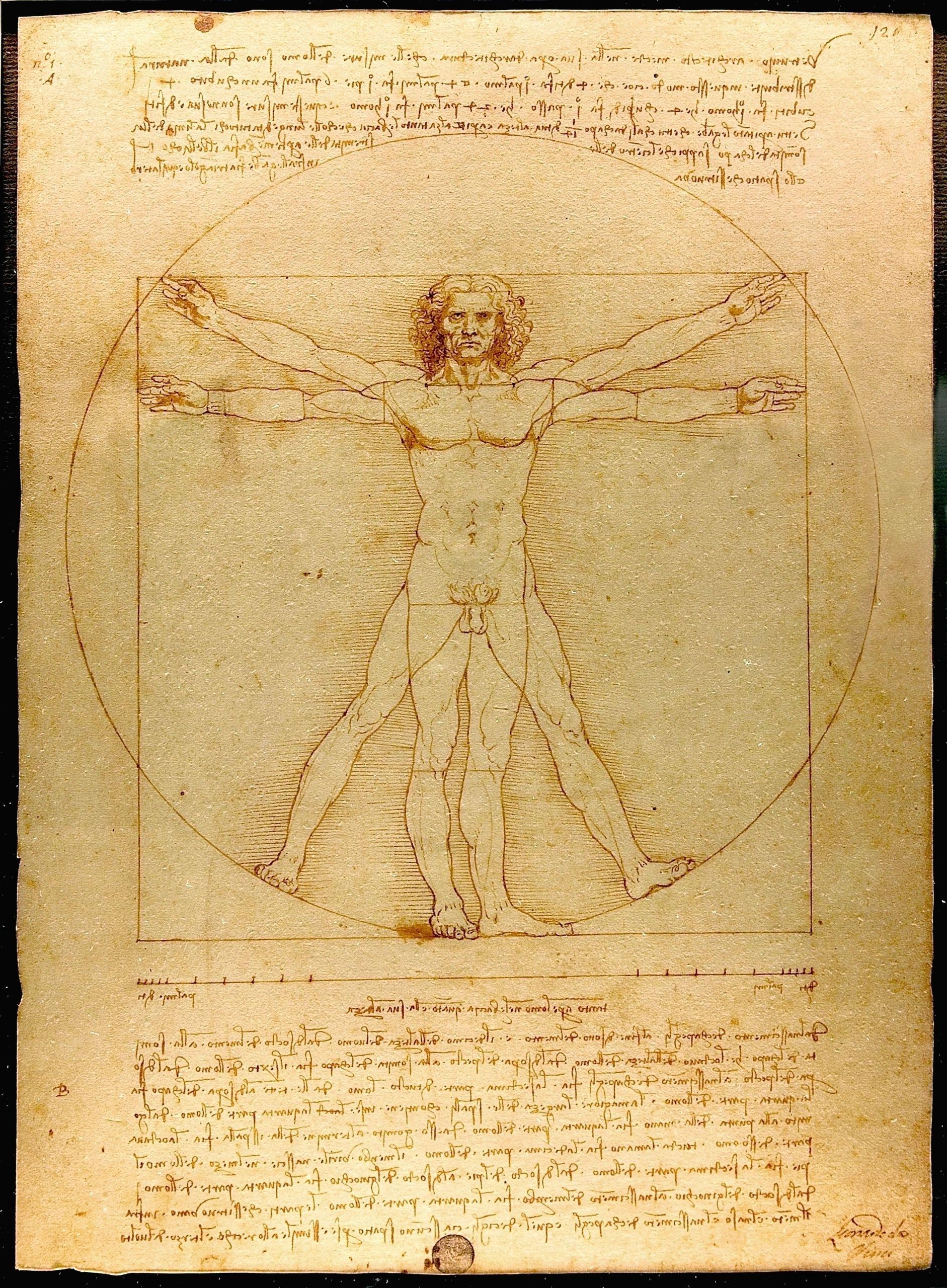
It was with the Renaissance that Greek art became again a big point of inspiration. Reason, the human body and perfect proportions became again central themes in the art world (Burckhardt, 1990). Anatomy slowly became more popular and artists, in order to paint perfection, started to dissect bodies to study them.
People like Leonardo DaVinci were not only artists but also scientists, integrating mathematical and scientific knowledge into art. Here, humanity understood itself as capable of creation. Again the human body became fundamental, a symbol of perfection (Burckhardt 1990). In a sense, it was a logical step to consider ourselves as a point of reference to reflect upon the world.
After this period arose the question of whether art was a representation of an objective reality, everyday life, or of a more subjective reality, an inner one. According to Venturi, in The Aesthetic Idea of Impressionism, even though the theory of art has been linked to Romanticists, Winckelman, German art historian of the 18th Century “defined beauty as indifference towards passion. This is an abstraction from life, which is the very beginning of the theory of art for art's sake” (Venturi, 1941).
Venturing far from Romanticists, and even figures like Delacroix, whose work, imagination and coloring were highly valued for impressionists, they did not choose either christian or other types of mythologies, whether political or religious. They defined a new paradigm of interests. As put by Venturi (1941), “Impressionists painted simple trees instead of monumental trees; peasant cottages instead of palaces; plain girls instead of great ladies; working-men instead of noblemen (...). . This meant the discovery of a new beauty where, before, it had not been believed that beauty existed”. Coincidentally, in that decade (1870-1880), the Second Empire fell, and “Impressionism was the artistic symbol of the rise of a new class to human consciousness” (ibid.).
Others like Baudelaire, a 19th and 20th century writer, came to profoundly affect European Art and its relationship with reality. Rimbaud looked for heightened senses of reality, expressed through the subconscious, abandoning traditional structure. Symbolist poetry, for example, with ideas such as the verse “I is an other” (Je est un autre), a somewhat banal idea now that at the time was unthought of, completely disrupted the patterns and archetypes of art as a linear movement following the order of nature and reality. Evidently here, people are becoming more aware of consciousness, and at this point art stops defining what humans should be, an idealized, god-searching matter. Instead, it explores what humans want to be (Herbert, 1988) from where they stand, from their experience of the world and its effects on each individual’s world.
This era came to heavily influence the following modernist surrealist ones.Later on, Pasolini, for example, has a unique view, which potentially reveals a time where religion began to lose the dominance over Europeans and European art. In an interview, he displays this shift in focus perfectly: “ I experience things in a very interior manner. Evidently, my view of the things of the world, objects, is not a natural or secular one. I always see things as being a bit miraculous. For me, every object is a miracle (...) in a formless way, non confessional, but in a way, a religious [view] of the world” (Pasolini, 1971).
This statement, induces a certain sense of life as miraculous in and of itself, without attached meanings of significance attributed through an outsourced paradigm (that of religion, for example). And he proceeded, after being asked if the Gospel consoles him: “(...) I completely exclude the word “consolation”. For me, the Gospel is a great intellectual work, a great work of thought that does not console. It fills, integrates, regenerates, I do not know how to put it, that sets one’s own thoughts in motion. But consolation? What use is consolation?”. As a cinematographer, this statement reveals a sense of art beyond itself not as a search, but as a response, in a way: he is not searching for perfection, for miracles, for divine signals, ideals, but he responds to what he sees is already there. The consciousness and the reflectiveness of the self upon its reality is key and that is still seen today.
Somewhat linked to Pasolini’s defiant approach, in Artaud’s work the self is also at the center. “What is prefigured in Baudelaire’s prose poetry of spleen and Rimbaud’s record of a season in hell becomes Artaud’s statement of his unremitting, agonizing awareness of the inadequacy of his own consciousness to itself—the torments of a sensibility that judges itself to be irreparably estranged from thought. Thinking and using language become a perpetual calvary” (Sotang, 1973). Artaud (2020), was another great pillar of modernity, although never reaching success while living, shaping a whole generation of theater. He completely rejected mass media and the search for the general public opinion. He saw theater as a double of society, a portal to human experience having the self as the center for reflecting the unconscious, wrote as if art was a portrayal not only of beauty, but of reality as is: violent, confrontational, visceral, disruptive, a mirror of his own experience. As put by Susan Sotang (1973), “the artist is a consciousness trying to be. “I am he who, in order to be, must whip his innateness,” writes Artaud, modern literature’s most didactic and most uncompromising hero of self-exacerbation”, his mind is the object.That view bled into the views of art and its role in today’s world. Nowadays the European art scene is formulating its answer to human experience through installations, street art, live performances, social themes, electronic sound, that mirror what the society is feeling and living at the time. The human being is no longer a “measure of the cosmos”, but a critical conscience within a complex system (Bauman, 2011). And art reflects that, no more canons or aesthetic purposes, no more representation to bend reality, nothing to do with power, but something to live for, to experience it, to feel it. In a sense, we are becoming part of the art itself. In Europe, we have shown the capacity to redefine standards, to transform history and legacy in languages and crisis into art. (Bauman, Z 2011).
Modern artistic representation is strictly linked to social themes; music, painting, poetry, cinema, all of them are portraying human feelings that are being shaped by what's happening around them. And if modern artistic expression reflects human emotions shaped by social reality, then some artists are each transforming social conditions into deeply yet personal political and visual languages (Clark 1973).
For example Jean-Michel Basquiat wanted to represent a society fractured by inequality and commodification, divided by racism, celebrity culture, and capitalism. His style was unique, frenetic brushworks, vivid colors and many levels of representation to better explain the society. He said that «When I work I don't think about art, I think about life» (M. Longman 2024) and surely this was a mantra in his work, his paintings were restless and raw, because what he had around Him was restless and raw. If Basquiat represented power in the ´80s with race, capitalism, and power structures, how is the same theme represented today? What even is power today?
Well, Hito Steyrel is eager to show us. She is a photographer from Germany, and the parallelism with Basquiat is on point. If Steyrel is giving us the definition of 21st century techno-capitalism power, Jean-Michel, as said before, is depicting the ´80s capitalism; algorithmic classification vs social labeling and again digital power vs cultural power.
In Hito´s work, Photos are often blurry, focus is not set in an efficient way, she aims at the ``Black Word`` of intelligence, surveillance and covert operations, because nowadays real power is unseen, is behind a curtain (Fondazione Prada, 2025). Humans are data points, pixel clusters and biometric patterns, predictable subjects in a digital system. (Fondazione Prada, 2025)
Other pop artists like Daft Punk target the contrast between Humans and Machines. The French duo is using self-imposed anonymity to explore identity and technology (D. Burrocacao 2013) while Paglen is using system-imposed anonymity to show how the digital world flattens identity. While Daft Punk explore the concept of tech personas, the American artist is more focused on data and surveillance. But both of them are asking us the same question, what does it mean to be human in a technological world?
Human beings are still fundamental to the creative process. They cannot be substituted, as we are the only ones that are capable of real creation and feelings. Many artists, as well, respond to crisis: from raising ecological awareness, such as Bordallo II, Bahia Shehab, to the humanitarian refugee crisis, like Ai Weiwei, or war, like Hazem Harb, or Saleh al-Jumaie, or Banksy, among many others, became central themes of art, where the responsibility of human behaviour and its effects on earth. Although apparently more linear and objective (problem awareness > artistic response), these movements reflect the deeply rooted questions on human experience and its active role in its own reality.
Across history, European art has been used as a lens, a mirror, for humans. From prehistoric hunters to Renaissance anatomists, impressionist and contemporary creators have scouted how cultural differences, society and technology have shaped our existence. And over time people have evolved from a survival tool to a symbol of perfection and finally to a subject of emotions and feelings and a conscious agent exploring complex social and technological systems. (Gombrich 1951)
Artists like Picasso, Hilma af Klint, Basquiat, and Steyrel enhanced this trajectory confronting the structures of society, showing how human experience remains central, and Art a catalyst for reflection and change. Art today is not just about representing humans, it incorporates them in a more complex structure, where we are challenged to consider how society, technology and culture shape our feelings and identities. In the end what matters is who we are and what we might become.
Gombrich E. H. (1951). The Story of Art. Phaidon.
Andrew J. Lawson (2016), Painted Caves: Palaeolithic Rock Art in Western Europe (Oxford University Press)
Pollitt, J. J. (1990) Galen, De Placitis Hippocratis et Platonis
Miguel Guia (2022), The Canon of Proportions in Ancient Greek Sculpture
Ragans, R. (c. 2000) et al. Art Talk, Chapter 9: Roman Art. Glencoe/McGraw-Hil
.
Burckhardt, J (1990). The Civilization of the Renaissance in Italy. Penguin Classic
https://archive.org/details/civilizationofth005644mbp
Potts, Alex. Flesh and the Ideal: Winckelmann and the Origins of Art History. Yale University Press, 1994.
https://www.jstor.org/stable/3046180
Nochlin, Linda. Realism. London: Penguin Books, 1971.
https://archive.org/details/rialism0000unse
Herbert, Robert L. Impressionism: Art, Leisure, and Parisian Society. New Haven: Yale University Press, 1988.
https://www.gettydocents.org/wp-content/uploads/Herbert_Impressionism_Art_Leisure_Parisian_Society.pdf
https://rondoveneziano.com/en/our-history/
D. Burrocacao Memorie random sui Daft Punk 2013
Mitchell Tony Global Noise: Rap and Hip-Hop Outside the USA. Wesleyan University Press, 2001.
Bauman, Z. Modernità liquida. Laterza, 2011
Clark, Image of the People. London: Thames & Hudson, 1973.
https://archive.org/details/imageofpeoplegus0000clar_q5r5
https://www.basquiat.com/about
M. Longman, Disability Aesthetics in the Art of Jean-Michel Basquiat 2024
https://www.racar-racar.com/uploads/5/7/7/4/57749791/racar_49_2_08_longman.pdf
The Island - Hito Steyerl, Fondazione Prada (2025)
https://www.fondazioneprada.org/project/the-island-hito-steyerl/
Maes, H. (2022). Existential Aesthetics. Journal of Aesthetics and Art Criticism. https://doi.org/10.1007/S42048-019-00029-4
Artaud, A. (2020). Heliogabalus: Or, The Crowned Anarchist. SCB Distributors.
Venturi, L. (1941). The Aesthetic Idea of Impressionism. The Journal of Aesthetics and Art Criticism, 1(1), 34–45. https://doi.org/10.2307/426742
Sontag, S. (2004). Approaching Artaud. Under the Sign of Saturn, 13-72.
Rimbaud, A. (1871). Letters of the Visionary" (Lettres du voyant)