
The Political Rise of ‘Remigration’
By Sinem Øzbal
Introduction
International migration has become one of the most politically salient issues across Europe in recent years. As Timothy J.Hatton (2021) establishes, public attitudes towards immigration are driven not simply by underlying policy preferences, meaning citizens’ desired level of immigrants, but also by issue salience, which measures how much political importance they attach to the issue. While preferences tend to change relatively slowly, salience is considerably more volatile (Hatton, 2021). This distinction matters politically because an increased focus on immigration may particularly benefit far-right parties that have made this issue a central tenet of their party platforms, as reflected in the growing electoral influence of Germany’s AfD, Swedish Sweden Democrats, and Austria’s FPÖ. It is within this increasingly politicised environment that 'remigration' has gained new prominence. Although the term has no universally agreed definition (OECD, 2024), it has historically been used descriptively in migration research, including to describe return migration and migration undertaken again after return. More recently, however, radical and New Right actors have repurposed 'remigration' as a political concept centred on the outward movement of migrant populations. This article aims to examine this changing meaning, its growing political significance, and what political actors mean when they call for 'remigration' using different European cases.
The Convoluted Language of Return
First and foremost, understanding what 'remigration' means requires placing it within the broader language of return. While the terminology surrounding return in migration scholarship is far from uniform, return migration provides a useful starting point for understanding the wider family of related concepts. Broadly, return migration refers to the movement of people back to their country or place of origin after having previously migrated elsewhere (King & Christou, 2011).
Yet what falls within this seemingly straightforward category becomes more complex when considering how and under what circumstances return occurs. Hagan and Wassink (2020) identify a historical divide between an economic sociology of return, which has generally approached return as voluntary, and a political sociology of return, concerned particularly with deportees, rejected asylum seekers, and others forced to return. Importantly, they argue that keeping these literatures entirely separate can overshadow important dimensions of return that would otherwise allow for a more comprehensive understanding of the phenomenon. While the former risks overlooking how state power and legal constraints shape return decisions, the latter can understate the agency and resourcefulness of forced returnees. This distinction matters for contemporary political debates about 'remigration'. If return can describe movements taking place under very different degrees of choice and coercion, understanding a political call for remigration requires looking beyond the term itself, as its meaning can depend on who is using it and for what purpose (Şahin-Mencütek, 2024).
The same conceptual ambiguity applies to remigration. In its traditional, descriptive use, remigration has often been used interchangeably with return migration to describe migrants returning to their countries of origin (Bilecen, 2022; Kunuroglu, van de Vijver and Yagmur, 2016; Oltmer, 2024). However, other definitions also exist. The OECD (2024), for example, defines remigration as a new departure after a migrant has already returned to their country of origin, whereas other research includes onward migration to a third country from the host country (Monti, 2019). Yet, in contemporary European politics, the word has increasingly undergone a distinct political repurposing.
A Repurposing, Not a sudden Invented Word
In their study, 'Remigration: The Rise of a Fringe Idea into the Political Mainstream', Leidig and Khan (2026) demonstrate how remigration has shifted from a neutral concept describing return, to a politically weaponized, ethnonationalist buzzword used by figures like Donald Trump and European parties, particularly within parts of radical-right and New Right discourse.
According to their online dataset, political uses of the term emerged in the early 2010s and gained greater traction following the 2015-16 European refugee crisis and ISIS-related terrorism. Its visibility accelerated sharply from 2023, reaching what the authors describe as 'mainstream visibility' by 2025, when the term reached 952,000 online mentions from 303,000 unique authors (Leidig and Khan, 2026, pp. 4, 19). Yet what is meant by remigration, and who exactly is expected to remigrate, varies considerably between its advocates and is underpinned by different narratives.
Main narratives underpinning political remigration
Firstly, there are ideological formulations of remigration that draw on population-replacement narratives that portray migration as threatening to the demographic or cultural continuity of European nations. Bromley (2019) connects this to the Great Replacement conspiracy theory, a white-nationalist and nativist narrative portraying migration from the Global South, particularly Muslim migration, as gradually replacing Europe’s predominantly white population. Within this logic, restricting future immigration is considered insufficient because the perceived demographic transformation has already occurred. Instead, remigration offers a means of reversing it through the departure and return of parts of the existing migrant population. Moreover, this logic is further illustrated in Langer, Hartleb and Schiebel’s (2026) analysis of Martin Sellner, whose conception of remigration is rooted in an ethnonational understanding of belonging.
These demographic narratives are closely intertwined with concerns about culture, integration, and national identity. In particular, far-right discourse across Europe has increasingly connected Muslim migration to the perceived threat of 'Islamization'. Within this framing, far-right actors can present Islamic culture as fundamentally incompatible with Western values, while Muslims are portrayed as interconnected cultural, demographic, and security threats (Heidenreich et al., 2020; Santos and Roque, 2021; Leidig and Khan, 2026). This framing is also reflected online, where male migrants from North Africa, the Middle East, and South Asia have often been associated with Islamist extremism, violence, and organized crime (Leidig and Khan, 2026).
Prominent examples
The political use of remigration has taken different forms, with Germany, Austria and, more arguably, Sweden illustrating different ways in which the concept and its underlying ideas have entered political debate and policy.
Germany
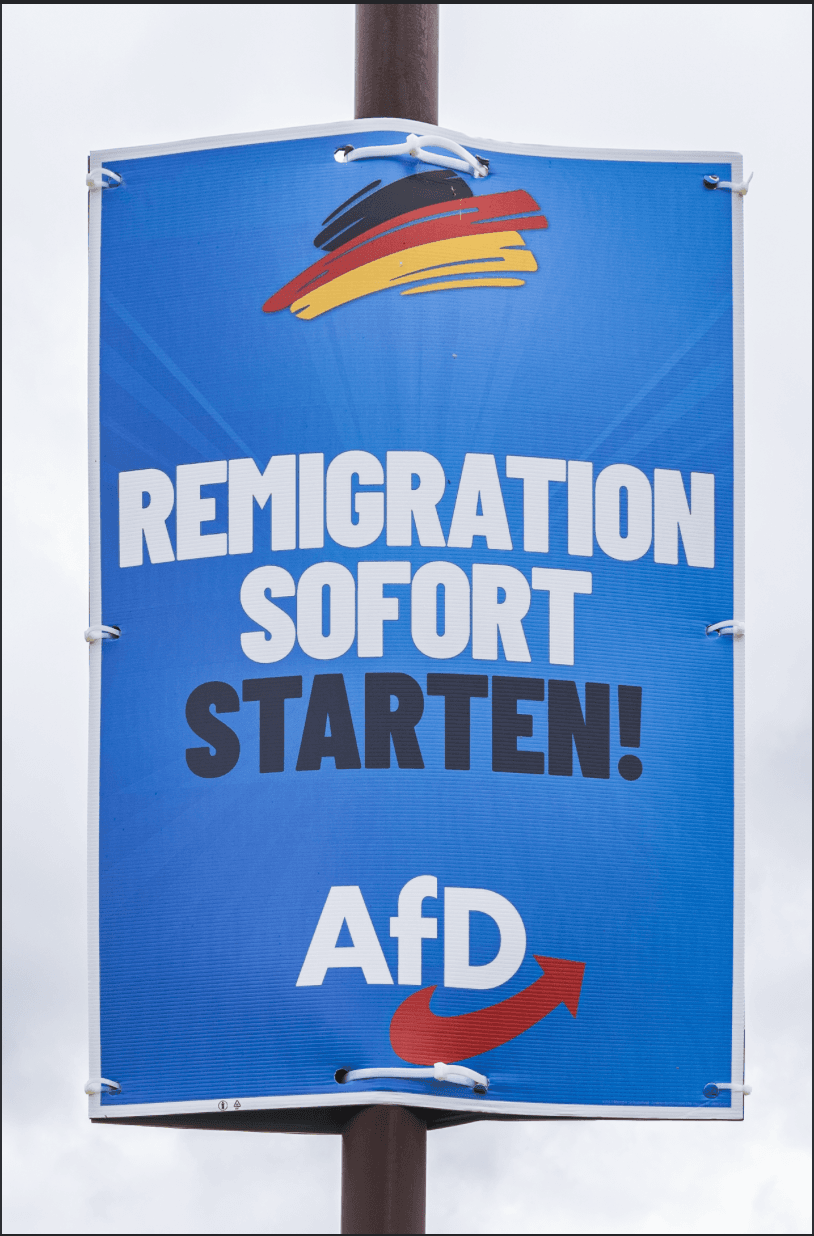
For example, Germany shows how remigration can move from far-right activism into formal party politics while remaining contested in scope. The term attracted widespread national attention following revelations in January 2024 about a meeting in Potsdam attended by AfD-linked participants and Austrian far-right activist Martin Sellner, where plans for remigration were discussed (Langer, Hartleb and Schiebel, 2026). Sellner’s proposal extended beyond conventional return policy to include lawful non-citizen residents considered an economic, criminal, or cultural 'burden' and naturalized German citizens considered insufficiently assimilated, who would face pressure either to assimilate according to his conception of German identity or leave the country (Hernandez Aguilar, 2026, p.15). This controversy contributed to 'remigration' being named Germany’s 'Unword of the Year' for 2023 (Oltmer, (2024). Nevertheless, the AfD nearly doubled its national vote share from 10.4% in 2021 to 20.8% in 2025, becoming the second-largest party in the Bundestag with far-right politics (The Federal Returning Officer, 2025).
Austria
Similarly, Austria shows how remigration has entered the electoral programme of a major radical-right party. During the 2024 parliamentary campaign, the Freedom Party of Austria (FPÖ) explicitly adopted the term, calling for the establishment of an 'EU Commissioner for Remigration' and proposing migration centres outside Europe for people facing removal. Importantly, these proposals do not emerge in a political vacuum, but are situated within the broader narratives underpinning remigration discussed earlier. For example, the FPÖ programme presented migration as a threat to Austrian cultural identity and social stability, while describing Muslim communities as 'Islamic parallel societies' (Langer, Hartleb and Schiebel, 2026). Subsequently, FPÖ emerged as Austria’s strongest party in the September 2024 election, within a political environment in which 47% of Austrians agreed that immigrants were gradually replacing the native population, while 23% believed this replacement was being deliberately promoted by political elites (Kranebitter and Willmann, 2024). The election victory also corresponded with the largest increase in online discussion of remigration recorded that year (Leidig and Khan, 2026).
Sweden
Sweden provides a more nuanced picture of the remigration debate. Although remigration has not been framed as explicitly as among parts of the far right in Germany and Austria, the politics surrounding repatriation and deportability have become increasingly prominent. These two terms belong to the broader language of return, but they are not interchangeable (Şahin-Mencütek, 2024). This becomes particularly relevant when considering the rise of the Sweden Democrats (SD). The party’s growth has been linked to the increasing political salience of immigration, rather than to Swedish society as a whole becoming more anti-immigration (Rydgren and van der Meiden, 2018). Crucially, SD was not simply taking advantage of this growing salience, as its own political activity helped make immigration a more important issue to voters (Loxbo, 2025).
This growing influence is visible in Sweden’s return policies. On the one hand, SD has increasingly emphasized voluntary, state-supported repatriation, and government commitments to increase the grants paid to migrants who voluntarily return to their countries of origin (Carlsson, 2024, pp.473-475). On the other hand, the 2022 Tidö Agreement, negotiated between the governing Moderate Party, Christian Democrats, and Liberals with support from SD, marked a shift from voluntary return towards expanding 'deportability' to groups whose status had previously been considered more secure, such as permanent residents and some dual citizens (Carlsson, 2024, pp. 463-466). Importantly, legal insecurity and the possibility of removal can create a hostile environment that pressures marginalized populations to leave 'voluntarily' (Carlsson, 2024).
These developments also reflect ideological narratives similar to those identified in Germany and Austria. SD’s conception of the nation emphasizes cultural homogeneity, opposition to multiculturalism, and restrictions on non-European immigration (Elgenius, 2019). Moreover, this emphasis on national belonging is also reflected in proposals for broader grounds for legal removal based on conduct and lifestyle, including behaviour considered to threaten 'Swedish values' (Carlsson, 2024). Sweden is therefore relevant to the remigration debate because similar objectives of encouraging outward migration can emerge through different terminology and policy mechanisms without being explicitly framed as 'remigration'.
Conclusion
In conclusion, remigration belongs to the broader language of return in migration scholarship. While there is no universally accepted definition, the term has traditionally been used descriptively, often interchangeably with return migration, to describe the movement of migrants back to their country of origin. In contemporary European politics, however, remigration has been increasingly repurposed from a largely descriptive term into a politically contested concept associated particularly with the radical right. By first clarifying the complex terminology surrounding return, this article has provided a foundation for understanding how the meaning and purpose of remigration can change when translated into political discourse and policy. The cases of Germany, Austria, and Sweden ultimately demonstrate that these ideas can take different forms, from explicit calls for 'remigration' to policies centred on repatriation and expanded deportability, making attention to both terminology and political purpose essential.
References
Bilecen, T. (2022) ‘To stay or to return? A review on return migration literature’, Migration Letters, 19(4), pp. 367–385. doi: 10.33182/ml.v19i4.2092
Bromley, R. (2019) ‘Immigrants are stripping Europe of its culture: the far right narrative of Europe and two migrant responses’, Textual Turnings: Department of English Journal of English and Comparative Studies, 1, pp. 17–31.
Carlsson, N. (2024) ‘Dreams of mass repatriation: government and far-right expansions of deportability in Sweden’, Citizenship Studies, 28(4–5), pp. 462–481. doi: 10.1080/13621025.2024.2418604.
Elgenius, G. and Rydgren, J. (2019) ‘Frames of nostalgia and belonging: the resurgence of ethno-nationalism in Sweden’, European Societies, 21(4), pp. 583–602. doi: 10.1080/14616696.2018.1494297.
Federal Returning Officer (2025) ‘Final result of the 2025 Bundestag election’. The Federal Returning Officer. Available at: The Federal Returning Officer (Accessed: 24 March 2026).
Hagan, J.M. and Wassink, J. (2020) ‘Return migration around the world: an integrated agenda for future research’, Annual Review of Sociology, 46, pp. 533–552. doi: 10.1146/annurev-soc-120319-015855.
Hatton, T.J. (2021) ‘Public opinion on immigration in Europe: preference and salience’, European Journal of Political Economy, 66, 101969. doi: 10.1016/j.ejpoleco.2020.101969.
Heidenreich, T., Eberl, J.M., Lind, F. and Boomgaarden, H.G. (2020) ‘Political migration discourses on social media: a comparative perspective on visibility and sentiment across political Facebook accounts in Europe’, Journal of Ethnic and Migration Studies, 46(7), pp. 1261–1278. doi: 10.1080/1369183X.2019.1665990.
Hernández Aguilar, L.M. (2026) ‘Conspiring a conspiracy theory: from Umvolkung to remigration and the Alternative for Germany’s political mobilization of population replacement conspiracy theories’, The Journal of Race, Ethnicity, and Politics, 11(1), pp. 1–23. doi: 10.1017/rep.2026.10094.
King, R. and Christou, A. (2011) ‘Of counter-diaspora and reverse transnationalism: 'Return' mobilities to and from the ancestral homeland’, Mobilities, 6(4), pp. 451–466. doi: 10.1080/17450101.2011.603941.
Kranebitter, A. and Willmann, J. (2024) Rechtsextremismus Barometer 2024. Vienna: Stiftung Dokumentationsarchiv des österreichischen Widerstandes. Available at: Rechtsextremismus Barometer 2024 (Accessed: 24 March 2026).
Kunuroglu, F., van de Vijver, F.J.R. and Yagmur, K. (2016) ‘Return migration’, Online Readings in Psychology and Culture, 8(2), Article 1. doi: 10.9707/2307-0919.1143.
Langer, A., Hartleb, F. and Schiebel, C. (2026) ‘Dog-whistle politics in far-right discourse: analyzing ethnonationalism in Martin Sellner’s book 'Remigration'’, European Journal of Political Research, pp. 1–18. doi: 10.1017/S1475676526101467.
Leidig, E. and Khan, R. (2026) Remigration: The Rise of a Fringe Idea into the Political Mainstream. Washington, D.C.: Center for the Study of Organized Hate.
Loxbo, K. (2025) ‘How the radical right reshapes public opinion: the Sweden Democrats’ local mobilisation, 2002–2020’, West European Politics, 48(7), pp. 1653–1680. doi: 10.1080/01402382.2024.2396775.
Monti, A. (2020) ‘Re-emigration of foreign-born residents from Sweden: 1990–2015’, Population, Space and Place, 26(2), e2285. doi: 10.1002/psp.2285.
OECD (2024) Return, Reintegration and Re-migration: Understanding Return Dynamics and the Role of Family and Community. Paris: OECD Publishing. doi: 10.1787/625fb5e6-en.
Oltmer, J. (2025) ‘Rückwanderung’, Bundeszentrale für politische Bildung. Available at: Rückwanderung (Accessed: 24 March 2026).
Rydgren, J. and van der Meiden, S. (2018) ‘The radical right and the end of Swedish exceptionalism’, European Political Science, 18(3), pp. 453–471. doi: 10.1057/s41304-018-0160-y.
Şahin-Mencütek, Z. (2024) ‘Conceptual complexity about return migration of refugees/asylum seekers’, Journal of Asian and African Studies, 59(7), pp. 2125–2138. doi: 10.1177/00219096241283651.
Santos, R. and Roque, S. (2021) ‘The populist far-right and the intersection of anti-immigration and antifeminist agendas: the Portuguese case’, DiGeSt: Journal of Diversity and Gender Studies, 8(1), pp. 53–59. doi: 10.21825/digest.v8i1.16543.