
Institutionalized Precarity: Living Conditions in Greek Refugee Camps
by Antonino Enrico Repaci
7 min read · 1,389 words
Following the 2015 European immigration and “refugee crisis” (further discussed in ), a substantial influx of undocumented migrants reached the European borders, leading to a large-scale humanitarian and reception challenge that mainly affected Southern European countries, including Spain, Italy (already analyzed here), and especially Greece (Plakas et al., 2023). This crisis was further exacerbated in March 2016 after the closure of the Western Balkans migration route and the subsequent “EU-Turkey statement”, which forced Greece to transform from a transit country into a host country (Tsitselikis, 2018). Consequently, thousands of asylum seekers and refugees were confined within its borders for an indefinite stay, institutionalizing a legal grey area. For these reasons, Greece, already constrained by its national economic crisis and by EU institutions, was compelled to establish a reception and accommodation system largely focused on Reception and Identification Centers (RICs or “Hotspots”), similar to those in Italy, as well as mainland Reception Sites (RSs or camps) (Papadimos et al., 2020).
The extensive existing literature suggests that the living conditions of people residing in Greek reception centers are in consistent violation of basic human rights and international and European humanitarian legal frameworks (Plakas et al., 2023; Stathopoulou, 2018). In this regard, the physical condition of the centers is often identified as the primary factor contributing to inadequate living standards, especially in facilities located on the Aegean islands and along the Evros land border, where conditions are notably worse than on the mainland (Kondilis et al., 2021). More specifically, these facilities tend to operate beyond their intended capacity (as set by national and European procedural standards), with the number of refugees often exceeding capacity by half or more, rendering overcrowding endemic to the centers themselves (Papadimos et al., 2020). As a result, high population density and limited resources (as RICs are systematically underfunded) strain available services and exacerbate tensions among residents and staff (Kourachanis, 2018).
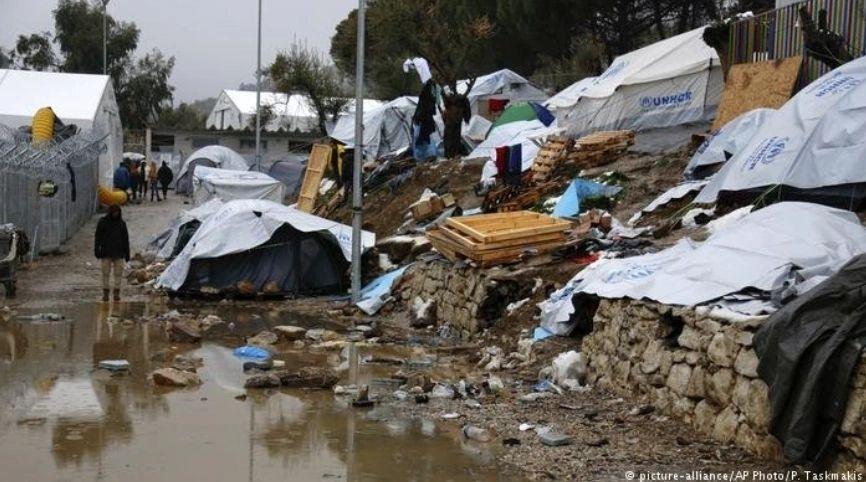
In addition, the housing provided is often makeshift, consisting of tents or poorly constructed containers, which pose a structural problem as they are neither stable nor durable enough for long-term habitation and fail to meet European safety guidelines (Papatzani et al., 2022). Furthermore, in cases of extreme weather, the lack of proper infrastructure often results in energy poverty, extreme cold, or excessive heat, depending on the season. These conditions are further aggravated by the lack of stable and centralized hygiene and sanitation systems, which are severely compromised in multiple camps (Beza, 2022). Reported issues include sewage leaks beneath containers, general rubbish accumulation due to insufficient cleaning staff, and a systemic shortage of basic cleaning products and personal hygiene essentials (Plakas et al., 2023). In extreme cases, especially during peak crisis periods, improvised tent camps adjacent to official hotspots lacked even basic provisions such as toilets and heating during the winter months.
These inadequate living conditions, worsened by traumatic pre-migration experiences, have reportedly resulted in a prolonged health and mental health crisis within the camps. Empirical evidence demonstrates that Health-Related Quality of Life levels have reached historic lows (Plakas et al., 2023), while studies among refugees and asylum seekers in Northern Greece show consistently low average scores for both the Physical Component Scale and the Mental Component Scale (Beza et al., 2022). Regarding the latter, factors such as poor living conditions, limited access to care, and persistent uncertainty about the future exert a stronger negative influence on psychological distress than even pre-migration trauma. High levels of anxiety, where over 92% of screened Syrian refugees reported anxiety, and severe psychological disorders, such as Major Depressive Disorder, reaching 44% in some groups, are particularly common (Papadimos et al., 2022). In more extreme cases, children in Greek camps, some as young as ten, have been reported to have attempted suicide (Papadimos et al., 2022).
In terms of physical well-being, refugees face an increased risk of infectious diseases, including respiratory and gastrointestinal infections (Plakas et al., 2023), while during the COVID-19 pandemic (2020), refugees and asylum seekers in Greek reception facilities experienced infection rates approximately 2.5 to 3 times higher than the general Greek population, with the highest risk occurring in overcrowded RICs (Kondilis et al., 2021). Moreover, empirical studies prove that the basic right to healthcare is often denied due to bureaucratic barriers and legal obstacles, as many refugees remain undocumented and thus unregistered in the Greek healthcare system (Mavridis & Mouratidou, 2019). Even within RICs and RSs, healthcare provision is inadequate due to a severe shortage of specialized staff.
The inadequacy of living conditions, however, extends beyond physical infrastructure to the systemic mechanisms of management. In this context, scholars often use the term “precarity of place” to describe the absence of the right to remain or to decide on one’s own habitation and mobility, characteristic features of Greek reception centers (Papatzani et al., 2022). Statistically, the total number of asylum applications in Greece increased dramatically from 13,188 in 2015 to 51,054 in 2016, and again to 58,643 in 2017, as a consequence of the closure of the Western Balkan route (Mavridis & Mouratidou, 2019). Nonetheless, at the beginning of 2018, the first appointment for an asylum interview for some applicants was scheduled for the summer of 2020. During the same period, 4,000 asylum seekers who had filed their requests before June 2013 were still awaiting examination of their applications by a committee (Tsitselikis, 2018). Simultaneously, the central government imposed a geographical restriction on asylum seekers residing in the Aegean Islands, prohibiting them from moving to the rest of the country, which contributed to overpopulation in the hotspots (Vergou, 2019). Regarding the most vulnerable populations, the accommodation system displayed significant deficiencies: while unaccompanied minors constitute a highly vulnerable group, only 1,250 minors were housed in designated facilities, despite thousands of applications (Tsitselikis, 2018).
Furthermore, this extended and uncertain duration of stay in Greece is significantly correlated with reduced mental health and life satisfaction scores. A study by Plakas et al. (2023) reports that the median life satisfaction of refugees in the Vagiochori Accommodation Center was 12.00, well below the neutral point of 20, while 75% of participants scored below the neutral point on the Satisfaction With Life Scale, reflecting generally low life satisfaction.
In conclusion, empirical evidence overwhelmingly suggests that Greek reception centers are structurally inadequate and systematically fail to meet the standards set by human rights law. Additionally, the restrictive policies and legal uncertainty created by weak administrative procedures actively reinforce marginalization, isolation, and psychological distress, placing migrants in a state of both mental and physical distress.
Bibliography
Beza, S., Mavrodi, A. G., Kyratso, G., & Aletras, V. H. (2022). Health-related quality of life among refugees and asylum seekers in Northern Greece. Journal of Immigrant and Minority Health, 24(2), 437–444. Springer Nature.
Kondilis, E., Papamichail, D., McCann, S., Carruthers, E., Veizis, A., Orcutt, M., & Hargreaves, S. (2021). The impact of the COVID-19 pandemic on refugees and asylum seekers in Greece: A retrospective analysis of national surveillance data from 2020. eClinicalMedicine, 37, 100958. 8
Kourachanis, N. (2018). Asylum seekers, hotspot approach and anti-social policy responses in Greece (2015–2017). International Migration & Integration, 19(4), 1153–1167. Springer Nature.
Mavridis, S., & Mouratidou, S. (2019). Living in refugee camps in northern Greece. Multilingual Academic Journal of Education and Social Sciences, 7(1), 27–46). Knowledge Words Publications.
Papadimos, T., Pappada, S., Lyaker, M., Papadimos, J., & Casabianca, A. (2020). Health security and the refugee crisis in Greece: The refugee perspective. In Contemporary Developments and Perspectives in International Health Security (Vol. 1, pp. 1–20). IntechOpen.
Papatzani, E., Psallidaki, T., Kandylis, G., & Micha, I. (2022). Multiple geographies of precarity: Accommodation policies for asylum seekers in metropolitan Athens, Greece. European Urban and Regional Studies, 29(2), 189–203. SAGE Publications.
Plakas, T. D., Aletras, V. H., Voutsa, E. I., & Niakas, D. (2023). Health-related quality of life and life satisfaction in a Greek refugee accommodation center. Cureus, 15(7), e42005.
Stathopoulou, T. (2018). Safety, health and trauma among newly arrived refugees in Greece. National Centre for Social Research (EKKE)
Tsitselikis, K. (2018). Refugees in Greece: Facing a multifaceted labyrinth. International Migration, 57(2), 156–172.
Vergou, P. (2019). Living with difference: Refugee education and school segregation processes in Greece. Urban Studies, 56(15), 3162–3177.