
The EU - Tunisia Deal: Three Years Later
15 min read · 3,075 words
The European Union’s migration policy has, throughout the years, increasingly relied on partnerships with third countries in order to reduce irregular migration flows. In July 2023, the EU and Tunisia signed a non-binding Memorandum of Understanding (MoU) on a “strategic and global partnership”, built on five pillars: macroeconomic stability, trade and investment, green energy transition, people-to-people contacts, migration, and mobility (European Commission, 2023a; Stanicek, 2023). The MoU’s stated aims included reducing irregular departures from Tunisian shores, strengthening Tunisia’s border and coastguard capacity, facilitating returns of its nationals irregularly residing in the EU, and disrupting migrant smuggling networks. The agreement also provided for a financial package intended to help Tunisia’s concurrent severe economic crisis (Stanicek, 2023). From the outset, the agreement drew criticism over matters such as its legal form and the absence of human rights safeguards, concerns which have recurred over the years (Andrade & Frasca, 2024).
Three years after its signature, the MoU’s effects remain contested. Although some objectives have been (partially) met on the EU’s own terms, others remain unfulfilled or disputed, and the mentioned concerns, especially those relating to human rights breaches, led to explicit calls for renegotiation and revisions of the agreement.
The Memorandum of Understanding
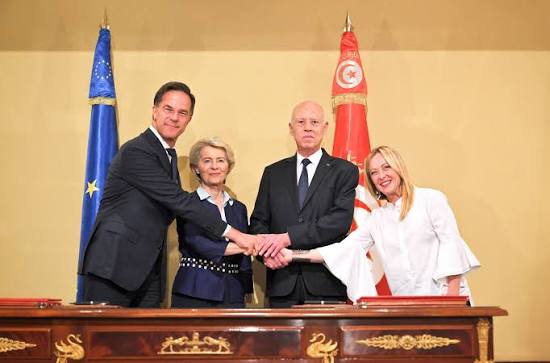
The MoU, announced on 16 July 2023, was the result of a severe domestic economic crisis that left the country in need of external financing, together with a high rise in irregular crossings from Tunisia to EU countries, particularly Italy. Indeed, by mid-2023, Tunisia had become the leading point of departure for irregular crossings on the Central Mediterranean route, overtaking Libya for the first time in over a decade (Andrade & Frasca, 2024; Miner, 2026; European Union, 2023). The MoU was signed by European Commissioner for Neighbourhood and Enlargement Olivér Várhelyi, and Tunisian Secretary of State, Mounir Ben Rjiba, in the presence of European Commission President Ursula von der Leyen, as well as the Prime Minister of Italy, Giorgia Meloni, then-Dutch Prime Minister Mark Rutte, and the President of Tunisia, Kaïs Saied (Strik & Robbesom, 2024).
The MoU was based on five pillars: macro‑financial assistance, economic cooperation, trade and investment, renewable energy cooperation, and migration. On the latter specifically, the EU allocated 105 million Euros in immediate aid for border and coastguard management, alongside €150 million in budget support under the macroeconomic pillar, and a further €900 million in macro‑financial assistance (whose disbursement was made conditional on Tunisia concluding a loan programme with the International Monetary Fund (IMF)) (Stanicek, 2023; Aivatidis, 2024; Blaakman, 2026). Legal migration was also briefly addressed, with the agreement outlining the formation of a ‘Talent Partnership’ intended to promote skilled labour mobility and other initiatives (Aivatidis, 2024). Overall, the general objective of the MoU was to reduce irregular migration and loss of life at sea, while supporting Tunisia’s economic stabilization.
From the beginning, however, the MoU attracted criticism regarding legal, institutional, and human rights concerns. As it was concluded as a non-binding political instrument rather than a formal international agreement, it fell outside the scope of Article 218 of the Treaty on the Functioning of the European Union (TFEU), which requires the European Parliament’s consent for a legally-binding agreement between the Union and third countries. Instead, the MoU was published as a press release and treated as a soft-law instrument (Strik & Robbesom, 2024; Andrade & Frasca, 2024). This choice was criticized by many, describing it for instance as part of a broader ‘informal’ EU external migration policy pattern, whereby non-binding instruments are used instead of formal treaties and binding agreements precisely because they escape procedural safeguards, including Parliamentary consultation, that would otherwise apply (Strik & Robbesom, 2024; Frasca & Roman, 2023). Indeed, the Parliament was neither consulted during the negotiation of the agreement nor granted a formal oversight role in monitoring its implementation. These procedural concerns were paired by substantive ones, including the absence of binding human rights clause in the MoU and the lack of an independent mechanism to oversee the treatment of migrants and the use of EU funds (a gap that remained unresolved even in subsequent implementation) (Miner, 2026; Andrade & Frasca, 2024).
The MoU’s legal basis, human rights safeguards, and effectiveness were questioned by many, ranging from NGOs to the European Parliament itself. For instance, Amnesty International publicly warned, already in 2023, that the agreement risked making the EU complicit in documented abuses against migrants in Tunisia, effectively assigning the country the role of external border guard in exchange for financial support (Amnesty International, 2023; Solidar, 2024). The European Ombudsman also criticized the Commission's failure to carry out a human rights impact assessment and made recommendations to ensure human rights were respected (European Ombudsman, 2024; Blaakman, 2026). The European Court of Auditors also reached similar conclusions in a parallel review of the EU trust fund architecture financing migration cooperation in Africa, questioning whether the Commission's human rights due diligence met the standards required by the EU itself (European Court of Auditors, 2024). Moreover, the European Parliament, in its resolutions adopted in September 2023 and again in 2024, condemned the lack of transparency around the MoU and the absence of a binding human rights mechanism, as well as the disbursement of the agreed sums, which were dispatched all together rather than gradually, against verifiable progress (Blaakman, 2026). Three years on, the Commission’s procedural informality and substantive silence on human rights have remained very contested areas of the agreement.
Assessing the MoU Three Years On
The MoU’s results over the first three years have been uneven. Of the funds tied to the macroeconomic pillar, a €150 million tranche of associated budget support was disbursed by the Commission in March 2024 on the stated basis of satisfactory progress on Tunisian reforms (European Commission, 2024). The European Parliament subsequently questioned, in its 2024 resolution, the criteria behind that assessment, given the human rights concerns already documented at the time. The macro-financial assistance sum, set at up to €900 million, remains largely undisbursed as it continues to be tied to the conclusion of an IMF programme that Tunisia is yet to resume since 2022, after President Saïed rejected the reform conditions attached to it, leaving a substantial share unrealized (Strik & Robbesom, 2024).
On migration control, the results were vague and argued by critics. Indeed, in the first half of 2023, before the MoU’s signature, Italy experienced significantly high numbers in arrivals from Tunisia, as they rose to 34,321, making it the main country of departure along the Central Mediterranean route (Strik & Robbesom, 2024; UNHCR, 2023). In the months immediately following the signature arrivals did not drastically drop, and indeed nearly 60,000 people still reached Italy from Tunisia (roughly two-third of 2023’s total) (Meiners & Niederfranke, 2025). Only in the final quarter of 2023 did numbers of arrivals in Italy from Tunisia decline sharply, which made EU officials, including President von der Leyen, declare the success of the partnership (Meiners & Niederfranke, 2025). However, critics argued that any data compared to that of the 2023 summer would seem like a drastic decrease, as that was an unusual spike in departures from Tunisia, overstating the MoU’s impact. This therefore functioned as a statistical baseline from which any subsequent decline would appear large regardless of policy intervention. According to the UNHCR, the reason behind the spike was tied to the economic crisis that the country was going through, together with increasingly frequent cases of violence and discrimination against migrants, and that more broadly, the fluctuations in the number of asylum seekers are influenced by a range of external factors, including wars and disasters (Meiners & Niederfranke, 2025; Strik & Robbesom, 2024; Blaakman, 2026).
Nevertheless, by 2024, Libya returned to being consistently the main departure point for migrants and refugees reaching Italy by sea, accounting for circa 62% of departures compared with Tunisia’s 27% (ASGI, 2025). Furthermore, as stated by the Commission in the European Asylum and Migration Management Strategy, between 1 July 2024 and 30 June 2025, arrivals along the Central Mediterranean route had decreased by 40% compared to the previous reporting period (July 2023-June 2024) (European Commission, 2026; Blaakman, 2026). Therefore, despite the criticism, Commission President von der Leyen is convinced that the drop in irregular arrivals, such as the 80% fall in arrivals in Italy from Tunisia in 2025, is a direct result of the deal, marking it as a success and an example for future similar agreements (Meiners & Niederfranke, 2025).
The €105 million agreed for border support was, unlike the €900 million macro-financial package, largely disbursed and used for existing projects. Tunisia’s coastguard and its patrol boats, radars and intelligence significantly expanded its interception operations thanks to the EU funds (at least €65 million by February 2024 specifically to train the Tunisian coastguard), and cooperated in anti-smuggling programs. From a purely operational perspective, therefore, the EU’s investment and agreed objective was fulfilled, as fewer boats reached the European coast (ECCHR, 2026).
The Italian government, who heavily supported the MoU, has continued its active role, providing a number of seasonal visas as well as coast guard assets, also through its own bilateral cooperation with Tunisia (Meiners & Niederfranke, 2025). The Dutch government, then led by Rutte, also played a role in the agreement, partly in response to the domestic pressure over migration. Broader EU asylum and migration reforms (such as the EU Pact on Migration and Asylum, applicable as of June 2026, and the Safe Country of Origin lists) have made access to asylum in the EU more restrictive, potentially increasing the incentive for single Member States, as well as the Commission, to pursue externalization arrangements similar to that of the MoU with Tunisia. These patterns of cooperation by the Union, however, have been described by many as forms of ‘asymmetrical regionalism’, in which the EU sets terms of engagement while the partner countries (such as Tunisia, but also Morocco and Libya) absorb a disproportionate share of the operational and reputational costs of externalized border enforcement, calling for Europe’s unequal power relations with weaker countries (Koutsikou, 2026).
Controversiers and Human Rights Concerns
Despite policy efforts, the EU-Tunisia deal has generated significant controversy. Among the most persistent concerns is the treatment of migrants and refugees in Tunisia and the EU’s role in enabling it. Numerous reports have documented violent interceptions at sea, widespread arbitrary detention, violence in camps and holding facilities, and forced collective expulsions of individuals towards the border with Libya and Algeria (practices usually categorized by international rights bodies as amounting to refoulement), alongside reports of torture and sexual violence (ECCHR, 2026; SOS Humanity, 2026).
Because these systematic interceptions and returns, without individualized screening and together with other violations experienced, are carried out by Tunisian security forces who are trained, equipped, and partly funded by the EU and because the MoU includes no binding human rights conditionality, critics argue that the Union risks complicity, by virtue of support, in the violations of international refugee and human rights law carried out by Tunisia (Beccacece et al., 2026). These violations have also been racially targeted, with sub-Saharan individuals in Tunisia facing systemic discrimination and violence, fueled by Tunisian President Saïed’s own public rhetoric describing sub-Saharan “hordes” of migrants as part of a “criminal plan” threatening the country’s identity (HRW, 2023; UN News, 2023).
Furthermore, Tunisia still lacks an exhaustive national asylum law, and UNHCR-administered registration procedures for asylum seekers have been suspended in the country since June 2024 (at the government’s request), which further leaves individuals seeking protection with limited recourse (ECCHR, 2026). Civil society organizations providing legal and humanitarian assistance to migrants have themselves faced growing restrictions in the country, with prison sentences and suspensions issued (ECCHR, 2026). Despite this, the EU has proceeded in late 2025 to include Tunisia on its first EU-wide ‘safe countries of origin’ list (endorsed in February 2026), thus deeming it ‘inherently safe’ for the purposes of asylum procedures, a decision which has been argued difficult to reconcile with the absence of a functioning national asylum system (Blaakman, 2026; Beccacece et al., 2026).
Institutionally, the lack of transparency surrounding the MoU’s conclusion and implementation was criticized from the beginning, together with the structural weaknesses regarding the management of the migration cooperation. As previously mentioned, in 2024 the European Ombudsman carried out an own-initiative inquiry for the Commission’s failure to disclose its human rights assessment (or the absence of one altogether), which should have been carried out and disclosed before the MoU was signed (Beccacece et al., 2026; ECCHR, 2026). The Ombudsman highlighted that the Commission’s secrecy was incompatible with the principle of transparency enshrined in EU Treaties, recommending that a pre-signature human rights risk assessment be published, as well as disclosing the outcomes of ongoing monitoring, establishing clear criteria for suspending funding in the event of violations, and providing accessible complaint mechanisms for individuals affected by EU-funded programs (European Ombudsman, 2024; Blaakman, 2026). The European Court of Auditors had also reached a similar conclusion in its own review of the broader EU trust fund architecture, finding that the Commission had not demonstrated that its human rights monitoring met EU standards (European Court of Auditors, 2024).
Despite these criticisms, both the Commission and, to a degree, Tunisia have highlighted outcomes they present as achievements. On legal migration, initiatives announced in the MoU have gradually developed, building on pre-existing EU-funded schemes. Most notably, the ‘Talent Partnership’, building on the THAMM program and the Mobility Partnership Facility, has been developing with the stated aim of facilitating regulated employment opportunities in the EU for Tunisian nationals (European Commission, 2025). Roundtables for the Partnership have taken place in 2023, 2024, and 2025, where the partnership’s roadmap was endorsed identifying priority sectors for cooperation (European Commission, 2025).
From the Commission’s own perspective, the MoU’s central achievement is based on statistical data: irregular arrivals to EU shores (particularly Italy) have significantly fallen since the 2023 peak, even if the causes of that decline remain contested. Von der Leyen has repeatedly cited the agreement as a ‘blueprint’ for further partnerships with other third countries (for example, a similar deal was agreed on with Egypt in 2024) (Meiners & Niederfranke, 2025; European Commission, 2023b). However, the Commission is yet to act on the human rights violation concerns raised.
Concluding Remarks
Three years on, the EU-Tunisia MoU exemplifies the persistent tensions between the EU’s efforts to manage irregular migration and its human rights commitments. Judged solely by the numbers of arrivals along the Central Mediterranean route, the Commission’s objective for the agreement appears to have been achieved. However, when assessed against the EU’s own human rights commitments and oversight mechanisms, the MoU, concluded as a non–binding agreement, lacks parliamentary consultation and enforceable human rights safeguards. These shortcomings have largely remained unresolved, with the structural gaps identified by the Ombudsman, the Court of Auditors, and the Parliament yet to be meaningfully addressed. Looking ahead, renegotiations appear increasingly likely, particularly following calls from the Tunisian government in March 2026 and reduced data-sharing with the EU since mid-2025, suggesting growing dissatisfaction with the current form of the arrangement. Whether the EU will use this opportunity to introduce a binding human rights clause and monitoring mechanisms, as repeatedly suggested by civil society organizations and EU bodies, remains an open question.
Bibliography
(2023a). Memorandum of Understanding on a strategic and global partnership between the European Union and Tunisia. European Commission. https://ec.europa.eu/commission/presscorner/detail/en/ip_23_3887
(2023b). Speech by President von der Leyen at the International Conference on Development and Migration. European Commission. https://ec.europa.eu/commission/presscorner/detail/en/speech_23_3981
(2023). EU Migration Support in Tunisia. European Union. https://enlargement.ec.europa.eu/system/files/2023-07/EUTF-Tunisia_v9.pdf
(2023). EU/Tunisia: Agreement on migration ‘makes EU complicit’ in abuses against asylum seekers, refugees and migrants. Amnesty International. https://www.amnesty.org/en/latest/news/2023/07/eu-tunisia-agreement-on-migration-makes-eu-complicit-in-abuses-against-asylum-seekers-refugees-and-migrants/
(2023). ITALY Sea Arrivals Dashboard. UNHCR.
(2023). Racist rhetoric in Tunisia must stop, independent UN experts warn. UN News. https://news.un.org/en/story/2023/04/1135347
(2023). Tunisia: No Safe Haven for Black African Migrants, Refugees. Human Rights Watch (HRW). https://www.hrw.org/news/2023/07/19/tunisia-no-safe-haven-black-african-migrants-refugees#:%7E:text=Though%20international%20human%20rights%20standards,assisting%20illegal%20entry%20or%20exit
(2024). Auditors step up criticism of EU migration fund for Africa. European Court of Auditors. https://www.eca.europa.eu/en/news/NEWS-SR-2024-17
(2024). Decision on how the European Commission intends to guarantee respect for human rights in the context of the EU-Tunisia Memorandum of Understanding. European Ombudsman. https://www.ombudsman.europa.eu/en/decision/en/193851
(2024). The European Union continues to implement the Memorandum of Understanding with Tunisia with the disbursement of EUR 150 million in financial support. European Commission. https://ec.europa.eu/commission/presscorner/detail/en/ip_24_1301
(2024). Partnering with Tunisia, the EU persists in its ill-guided politics to keep people out of its territory - and have a highly repressive country do the dirty job. Solidar. https://www.solidar.org/wp-content/uploads/2024/01/eu_tunisia_deal_statement_en.pdf
(2025). Talent Partnerships. European Commission. https://home-affairs.ec.europa.eu/policies/migration-and-asylum/legal-migration-and-resettlement/talent-partnerships_en#documents
(2026). A Blueprint For Complicity: Three Years On, the EU-Tunisia Deal Continues to Fuel Human Rights Violation. European Center for Constitutional and Human Rights (ECCHR). https://www.ecchr.eu/pressemitteilung/a-blueprint-for-complicity-three-years-on-the-eu-tunisia-deal-continues-to-fuel-human-rights-violations/
(2026). European Asylum and Migration Management Strategy. European Commission. https://home-affairs.ec.europa.eu/document/download/ce0d294e-5dd9-4e2a-bf68-53d9d16fc95a_en?filename=European%20Asylum%20and%20Migration%20Strategy.pdf
(2026). EU: Tunisia Migration Deal Worsening Human Rights Violations. SOS Humanity. https://sos-humanity.org/en/press/eu-tunisia-migration-deal/
Aivatidis, I. (2024). A change in the EU external migration policy? The EU-Tunisia Memorandum of Understanding. Bruges Political Research Papers. https://www.coleurope.eu/sites/default/files/research-paper/wp96_AIVATIDIS_02_0.pdf
Andrade, P. G. and Frasca, E. (2024). The Memorandum of Understanding between the EU and Tunisia: Issues of procedure and substance on the informalisation of migration cooperation. EU Migration Law Blog. https://eumigrationlawblog.eu/the-memorandum-of-understanding-between-the-eu-and-tunisia-issues-of-procedure-and-substance-on-the-informalisation-of-migration-cooperation/
ASGI. (2025). Access to the territory and push backs - Italy. Asylum Infomration Database (AIDA). https://asylumineurope.org/reports/country/italy/asylum-procedure/access-procedure-and-registration/access-territory-and-push-backs/
Blaakman, S. (2026). Beyond borders: Managing irregular migration with EU external partnerships. European Parliamentary Research Service (EPRS). https://www.europarl.europa.eu/RegData/etudes/BRIE/2026/785690/EPRS_BRI(2026)785690_EN.pdf
Beccacece, G., Bompard Caubel, R., Fabiano, M., Hargas, A., Jungman G., Bouafia, E., Boughanmi, M., Chemli, H., Dassi, Y., Ltifi, K., and Masmoudi, A. (2026). Reforming EU-Tunisia Migration Cooperation: How to Prevent Discrimination and Fundamental Rights Violations Committed in the Name of Security? Avocats Sans Frontières (ASF). https://asf.be/wp-content/uploads/2026/06/Policy-Brief-Reforming-EU-Tunisia-Migration-Cooperation.pdf
Frasca, E. and Roman, E. (2023). The Informalisation of EU Readmission Policy: Eclipsing Human Rights Protection Under the Shadow of Informality and Conditionality. European Papers. https://www.europeanpapers.eu/system/files/pdf_version/EP_eJ_2023_2_SS2_3_Eleonora_Frasca_Emanuela_Roman_00695.pdf
Meiners, S. and Niederfranke, S. (2025). Two Years In, the Impact of the EU-Tunisia Deal On Migration Is Overstated. German Council on Foreign Relations. https://www.ssoar.info/ssoar/bitstream/handle/document/110655/ssoar-2025-meiners_et_al-Two_Years_In_the_Impact.pdf?sequence=1
Miner, E. (2026). Soft law and hard consequences: The EU-Tunisia Memorandum of Understanding. Eurac Research. https://www.eurac.edu/en/blogs/mobile-people-and-diverse-societies/soft-law-and-hard-consequences-the-eu-tunisia-memorandum-of-understanding-
Stanicek, B. (2023). EU-Tunisia Memorandum of Understanding. European Parliamentary Research Service (EPRS). https://www.europarl.europa.eu/RegData/etudes/ATAG/2023/751467/EPRS_ATA(2023)751467_EN.pdf
Strik, T. and Robbesom, R. (2024). Compliance or Complicity? An Analysis of the EU‑Tunisia Deal in the Context of the Externalisation of Migration Control. Netherlands International Law Review.
Koutsikou, S. (2026). European Union Cooperation with Third Countries on Migration: The Case of the Maghreb Region. Panoply Journal. https://www.ciris.info/panoply/index.php/journal/article/view/129/59